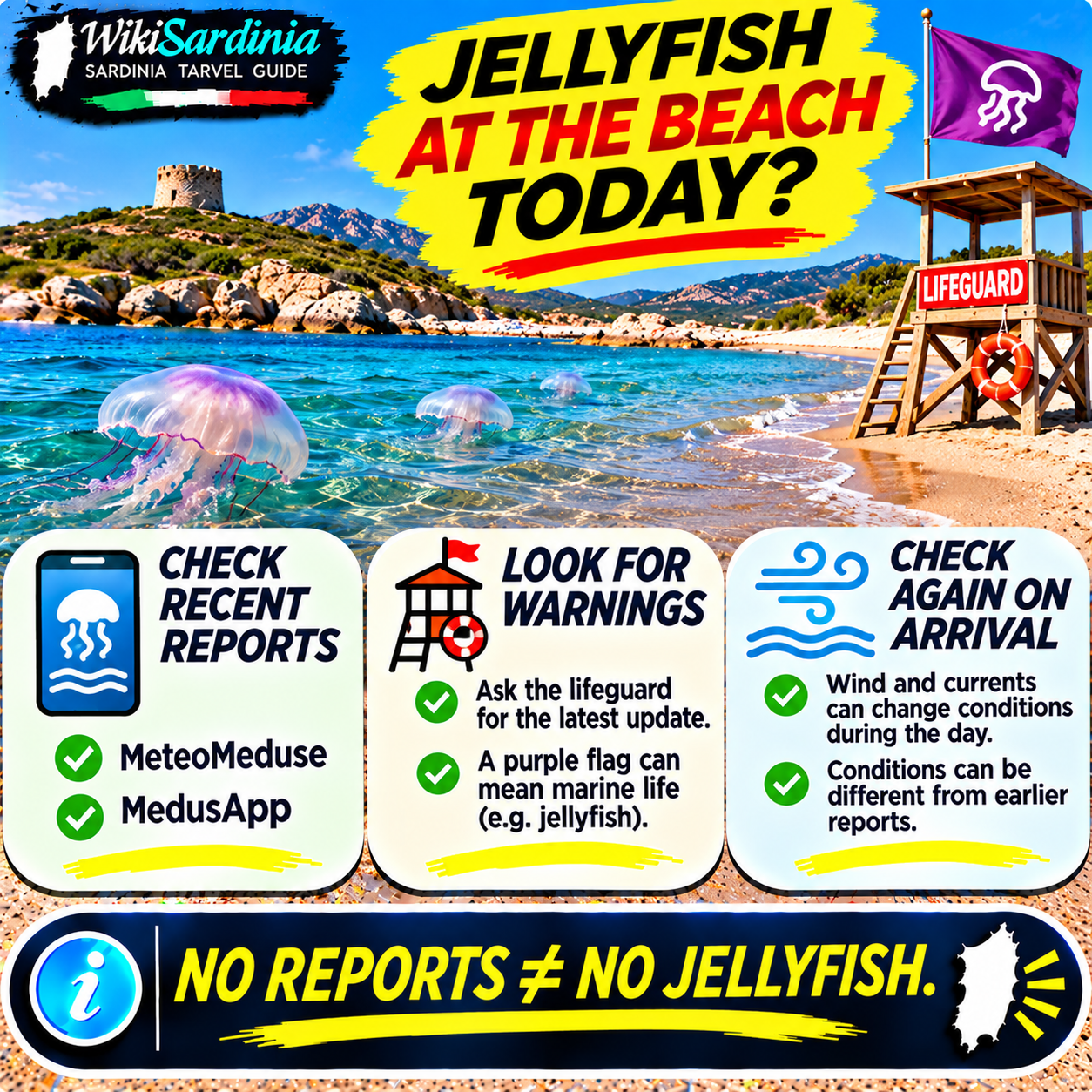
Before heading into the sea in Sardinia, you can check whether jellyfish have recently been reported at your beach. MeteoMeduse and MedusApp collect sightings, while local lifeguards may know about conditions that have changed within the last few hours. A purple warning flag can signal potentially hazardous marine life under international beach-safety standards. But there is no guaranteed real-time jellyfish census for every Sardinian beach, and the absence of a warning is not proof that the water is clear.
Step 1: Check MeteoMeduse before leaving
Open MeteoMeduse.it and look for reports around the specific beach you plan to visit. Check the date and location of each sighting rather than relying on a general marker for a large coastal area. A report from yesterday is useful context; one from several weeks ago says little about today's swimming conditions. The service also includes reports of beaches where users did not observe jellyfish, but a negative report is not a guarantee for the following day.
Step 2: Compare reports in MedusApp
MedusApp is a citizen-science application developed with scientific input from researchers associated with the University of Alicante. Users can submit geolocated sightings and view reports, including observations of jellyfish-free areas. Check the timestamp, any photograph and the exact location. A blank map may simply mean nobody submitted a report. The app also offers identification and first-aid information. You can find it on the Apple App Store or Google Play.
Step 3: Look for flags and ask the lifeguard
Under the International Life Saving Federation's beach-flag guidance, a purple flag warns of potentially hazardous marine life, including jellyfish. However, do not assume that every Sardinian beach uses this flag or follows an identical flag system. Look for the beach's posted legend and ask the lifeguard what its warnings mean. A red or yellow warning may relate to waves, currents or other hazards, not necessarily jellyfish. On unstaffed beaches, there may be no flags at all.
Step 4: Check the water again when you arrive
Before entering, watch the shallow water and shoreline for jellyfish, especially if other swimmers are leaving the sea or alerting one another. Ask beach staff or nearby swimmers whether they have seen any that morning. Wind and currents can move jellyfish between coves and along the coast, so conditions may differ from a report made earlier in the day. Do not enter the water if a visible concentration of stinging jellyfish is present.
Can wind tell you where jellyfish will be?
Wind and surface currents can influence the movement of drifting jellyfish, but there is no simple reliable rule that guarantees a jellyfish-free beach on one side of Sardinia. Bays, local currents, species and weather conditions all matter. Use forecasts to understand the sea, not as a substitute for actual sightings and local advice.
What if the beach has no lifeguard?
At an unstaffed beach, recent reports and careful observation become even more important. If you cannot assess the conditions safely, choose a staffed beach or postpone swimming. Never assume that an empty flagpole means the water is safe.
What should you do if you see jellyfish?
Keep your distance and warn others nearby. Do not pick up jellyfish, including stranded ones: tentacles can still sting. If you see many jellyfish, notify the lifeguard or local authorities. Do not attempt to clear the water by handling animals yourself.
What if someone is stung?
Leave the water calmly and seek help from the lifeguard or a medical professional. Do not rub the affected area, apply freshwater, use urine or scrape tentacles off with bare hands. First aid can vary by species; follow locally appropriate medical guidance rather than assuming one remedy works for all jellyfish. Call 112 for breathing difficulty, faintness, a severe allergic reaction or other serious symptoms.
Frequently asked questions
Is MeteoMeduse a live jellyfish detector?
No. It shows submitted sightings and observations. Check timestamps; it does not continuously monitor every beach.
Does a purple flag always mean jellyfish in Sardinia?
No. International guidance uses purple for potentially hazardous marine life, which may include jellyfish, and local flag systems can differ. Ask the lifeguard or consult the posted flag legend.
Does no report mean there are no jellyfish?
No. It may mean nobody has checked or reported the beach recently.
Can jellyfish arrive during the same day?
Yes. Currents and wind can change local conditions, so check again before swimming.
Can I report a jellyfish sighting?
Yes. Use a reporting platform such as MedusApp and provide the correct location, time and a photo taken without touching the animal.
The bottom line
To find out whether a Sardinian beach may be full of jellyfish today, combine three checks: recent reports on MeteoMeduse or MedusApp, beach flags or lifeguard advice, and a fresh look at the water when you arrive. The purple flag is a useful international warning symbol, but its absence does not guarantee safety. For a broader comparison of beaches, see our guide to finding a Sardinian beach with no reported jellyfish.
Sources: MeteoMeduse reports; MedusApp; International Life Saving Federation flag guidance; ARPAS jellyfish monitoring; WWF Italia.