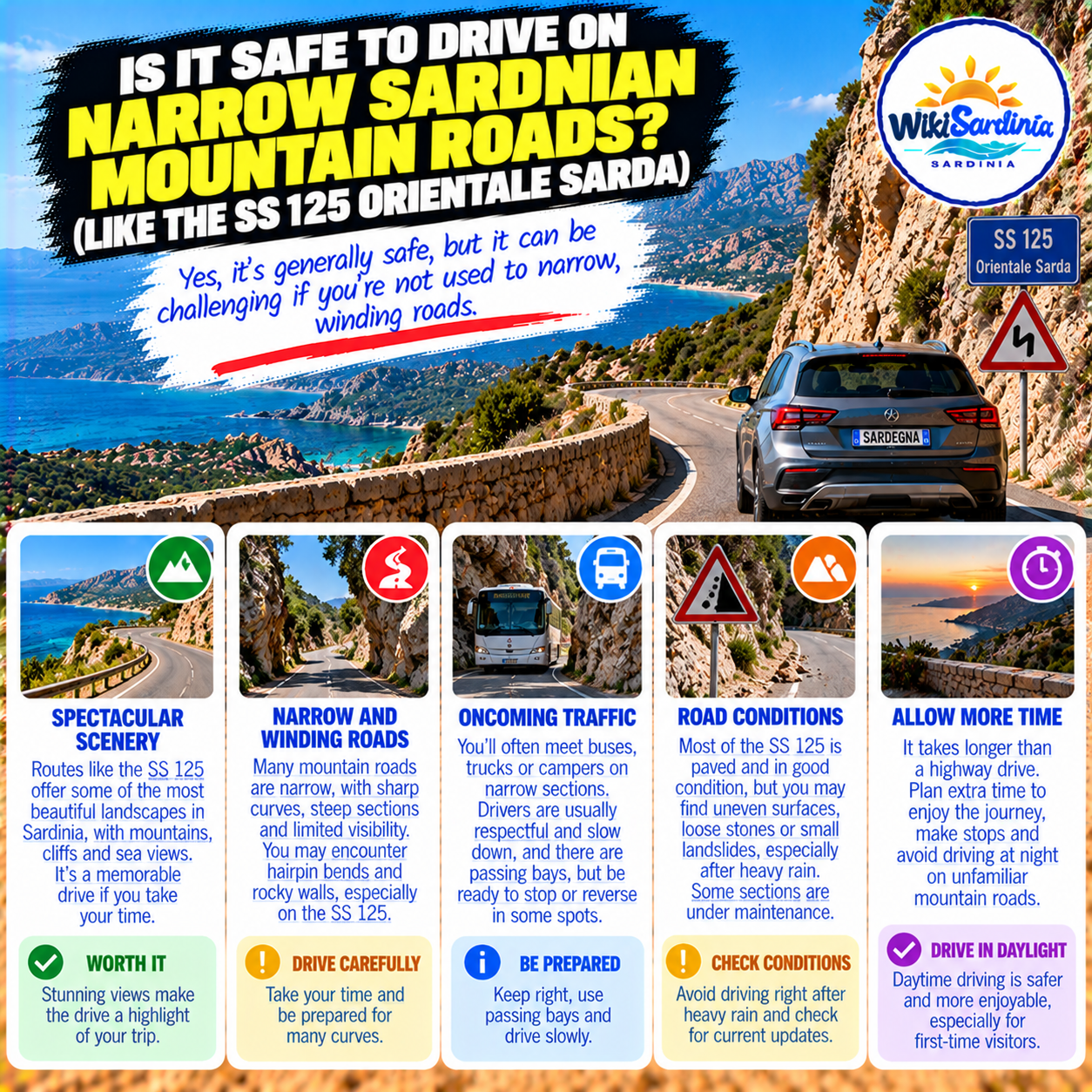
Sardinia's SS 125 Orientale Sarda is famous for its mountain scenery, limestone cliffs and dramatic bends. For visitors used to wide, straight highways, the idea of driving a rental car along a narrow mountain road can sound intimidating. Is it safe? Generally, these roads can be driven safely with an appropriate vehicle, good conditions and cautious driving—but the level of difficulty varies greatly from one section to another.
What exactly is the SS 125 Orientale Sarda?
The SS 125 is a historic road corridor along eastern Sardinia, associated with some of the island's most memorable landscapes. The name covers a long route, not one uniformly narrow cliffside lane. Over time, modern road sections, bypasses and improvements have changed parts of the journey, while older stretches remain winding and scenic. When a traveller says “the SS 125,” it is therefore important to know which section they mean.
Some stretches are straightforward paved roads. Others, especially in mountainous areas, feature repeated bends, steep gradients, limited sightlines and places where larger vehicles need more room.
Is the SS 125 dangerous?
No road can be described as risk-free, and there is no basis for promising that every section of the SS 125 is safe in all conditions. The key hazards are familiar mountain-road challenges: bends with restricted visibility, oncoming traffic, changing weather, occasional debris and drivers who misjudge their speed. These risks can be managed by slowing down, keeping to your lane and adjusting your plans when conditions are poor.
Most visitors do not need specialist off-road driving skills to use normal paved public roads. What they do need is patience and the willingness to travel at a speed that allows them to stop within the distance they can see.
Why are some stretches so narrow and winding?
Eastern Sardinia's rugged terrain makes direct road construction difficult. The Supramonte mountains and other limestone formations create valleys, slopes and rocky barriers. Older roads were built to follow the landscape, which explains their curves and changing elevation. A route that looks short on a map can take considerably longer when it climbs and winds through mountain terrain.
Modernised sections may offer easier driving, so check the precise route your navigation app proposes rather than assuming every road labelled SS 125 has the same characteristics.
What should you do when a bus or camper approaches?
On narrow roads, larger vehicles may need extra space around a bend. Reduce speed early, stay on your side and never cut across the centre line to take a corner faster. If a safe, legal passing place is available, use it appropriately; do not stop abruptly in a blind bend or reverse unless doing so is genuinely necessary and safe.
Never assume an approaching driver can see you around a rock wall or tight curve. If you cannot see far enough ahead, drive slowly enough to react to what may be around the bend.
Are there guardrails on the SS 125?
Roadside protection varies by location and road design. Some exposed sections have barriers or stone walls, while others may not offer the kind of protection a nervous driver expects. Do not rely on a guardrail to make a risky manoeuvre safe. The most effective precaution is to maintain control of the vehicle, stay within your lane and avoid unnecessary distractions.
What happens after heavy rain?
Heavy rainfall can reduce visibility and traction, while steep slopes may be vulnerable to debris, rockfalls or temporary closures. These are potential hazards on mountain roads generally; they should not be treated as proof that a particular section is currently blocked. Before setting out after severe weather, check official road updates and any local notices.
If a road is closed or appears unsafe, follow the signed diversion. Never drive around barriers to continue a scenic route.
Is it better to drive in daylight?
For a first-time visitor unfamiliar with the bends and gradients, daylight is usually the more comfortable option. It improves your ability to read the road and enjoy the scenery. At night, limited visibility makes tight curves and unexpected obstacles more demanding. If you are nervous about mountain driving, plan your journey to finish before dark and avoid rushing to meet a reservation.
Do you need a 4x4 or SUV?
Not simply because you are driving the SS 125. Ordinary paved roads can generally be used by a standard roadworthy car when open and in suitable condition. A compact vehicle may actually feel easier to position on narrow lanes than a large SUV. Choose a rental car that fits your luggage and driving experience, and avoid unpaved tracks unless your vehicle, rental agreement and the law explicitly allow them.
What if you are afraid of heights?
Some mountain stretches offer dramatic views across valleys and coastal landscapes, which can be uncomfortable for drivers or passengers with a strong fear of heights. It is perfectly reasonable to choose a less exposed alternative when one is available, or to let a more confident driver take the wheel. A scenic route is optional, not a test of courage.
Use navigation to compare routes, but remember that the fastest option is not always the least stressful. If you are unsure about a particular section, seek recent local road information before departure.
How fast should you drive?
Follow posted speed limits and always adapt your speed to visibility, traffic, surface conditions and the shape of the road. On tight bends, a safe speed may be substantially lower than the maximum permitted. Avoid trying to keep up with locals who know the route better than you. Allow faster traffic to pass only where doing so is legal and safe.
Do not pull over for photographs on a bend, narrow shoulder or other unsafe location. Wait for a designated viewpoint or suitable parking area.
Are there cyclists and motorcyclists?
Yes, scenic Sardinian roads attract motorcyclists and cyclists as well as cars and buses. Expect road users with different speeds and needs, especially around bends. Give vulnerable road users appropriate clearance, do not overtake where visibility is restricted and stay alert for vehicles approaching from behind.
What should you check before driving?
Check the weather forecast, road status, fuel level and expected travel time. Download an offline map if mobile coverage may be unreliable, but follow current road signs and closures over an outdated digital route. Tell someone your general plan if travelling through remote areas, and carry water and a charged phone.
For official information on state roads and disruptions, consult ANAS and the applicable regional or local authorities. Emergency assistance in Italy can be requested through 112.
Is the SS 125 worth driving?
For many travellers, yes. Its combination of rugged mountains, Mediterranean vegetation and extraordinary viewpoints can be one of the highlights of a Sardinian road trip. But the experience is most enjoyable when you leave plenty of time and do not treat the drive as a race. The road deserves attention first and admiration from safe stopping places second.
The verdict
Driving on Sardinia's narrow mountain roads, including older stretches of the SS 125 Orientale Sarda, is generally manageable for a careful and confident driver in suitable conditions. They are not all the same: some sections are modern and easy, while others demand more concentration. Travel in daylight if you are unfamiliar with the route, slow down for blind bends, check weather and road updates, and choose an alternative if you feel uncomfortable. The safest trip is the one planned around your abilities and the actual conditions—not around a dramatic photograph.