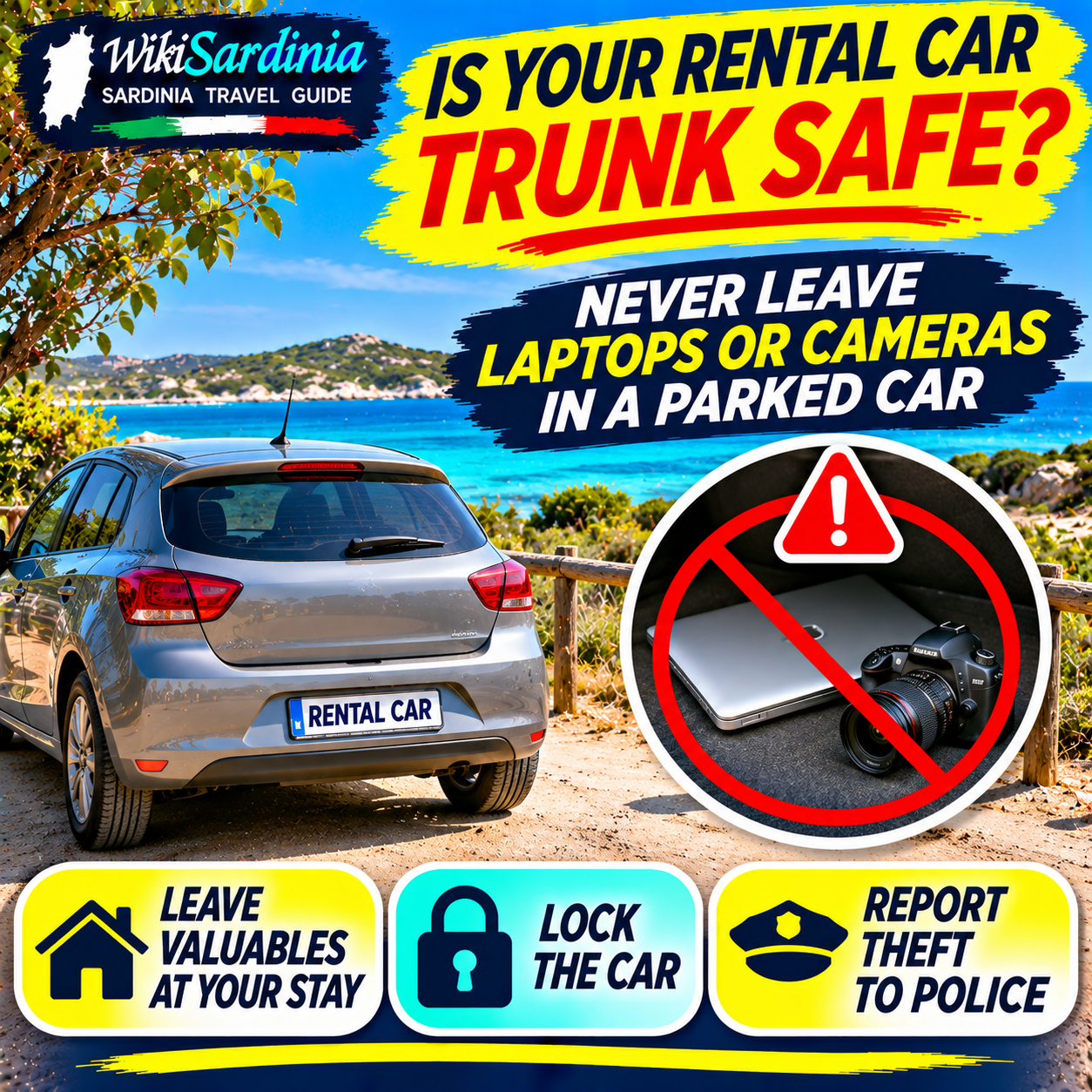
No. A locked rental-car trunk is not a safe place to store a laptop, camera, passport or expensive equipment while you spend the day on a Sardinian beach. A closed trunk keeps belongings out of sight but cannot prevent a break-in. Official travel advice from the United States, United Kingdom and Canada explicitly warns visitors against leaving valuables in unattended cars, even in the trunk. The best plan is to leave electronics at your accommodation, take only what you need for the day and never assume a busy or paid beach parking lot guarantees security.
Why is a locked trunk not enough?
Thieves can force a vehicle or gain access to its luggage compartment. A car parked near a beach may remain unattended for hours while its occupants are out of sight. Even if a bag is hidden, the vehicle can still be targeted. The US State Department's Italy travel advisory warns that break-ins of rented vehicles occur and specifically says not to leave baggage in a car, including a closed trunk. The UK government's Italy travel advice gives the same warning.
Are beach parking lots in Sardinia particularly risky?
There is no reliable basis for ranking individual Sardinian beaches by theft risk without current local crime data. Nevertheless, beach parking areas can create opportunities for theft because visitors leave vehicles for extended periods. Australia's official Italy advice identifies parking areas near beaches and coastal attractions among places where theft from vehicles can occur. This is a precaution, not a claim that every Sardinian beach parking lot is dangerous. Choose legitimate parking areas, lock the car and take valuables with you or leave them in secure accommodation.
Is a paid or guarded parking lot safe?
Paid parking does not necessarily mean supervised parking, and a parking ticket does not automatically insure your belongings. Look for signs explaining whether the facility is attended, whether security cameras are present and what the operator actually undertakes to safeguard. Even at a staffed facility, ask before leaving valuable property in the vehicle. A guarded lot can reduce certain risks, but it is not a guarantee against theft or heat damage.
What about remote beaches such as Cala Luna, Cala Goloritzé or La Pelosa?
The same general rule applies wherever you park to reach a beach, whether in a busy resort or a remote coastal area. At beaches accessed by a hike or boat, returning to the vehicle may be especially difficult if you discover a problem. Do not assume that a rural location is automatically safer or that a crowded tourist destination is automatically worse. Plan storage before setting off, especially when your route involves long walks, limited transport or several hours away from the car.
Can summer heat damage a laptop or camera?
Yes. Heat is a second reason not to leave electronics inside a parked car. A closed vehicle can become much hotter than the outdoor air, including in the trunk. Apple's Mac laptop guidance advises against leaving a Mac laptop in a car because temperatures can exceed its recommended range. Cameras, batteries, screens and other electronics have their own operating and storage limits; check the manufacturer's instructions. Shade or a reflective windshield cover does not turn a parked car into temperature-controlled storage.
What should you do with a laptop if you're driving between hotels?
This is a common problem on check-out or arrival day. The best option is to ask your current or next accommodation whether it can hold your luggage securely before check-in or after check-out. A staffed luggage-storage service may also be an option in a town, subject to its terms and opening hours. If you cannot arrange storage, consider postponing the beach stop until you have deposited your valuables. Do not plan a full beach day around leaving your entire luggage collection in a parked rental car.
Is it safer to put valuables in the trunk before arriving?
It is generally better not to advertise valuable items by moving them into the trunk in a busy parking area. However, hiding a laptop before arrival does not make leaving it there safe. If you must transport belongings between accommodations, keep them discreet during the journey and arrange secure storage as soon as possible. Avoid leaving any valuable equipment in an unattended vehicle, regardless of when you loaded it.
What should photographers do?
Bring only the equipment you genuinely need, use a comfortable bag that stays with you and consider whether a smaller camera or phone is sufficient for a beach day. Never leave a camera bag on an unattended towel while swimming. If you plan to snorkel or swim, arrange for a trusted companion to remain with your belongings or use a secure locker where available. Waterproof pouches can protect suitable small items from splashes, but they are not a substitute for careful supervision or proper waterproof camera housing.
Should you leave your passport or rental documents in the car?
A passport, wallet and other essential documents should not be left in an unattended car. Keep identity documents and payment cards secure according to local legal requirements and your travel circumstances. Save secure digital copies of important documents for reference, but remember that a photo is not necessarily a legally accepted substitute for the original. Check your rental agreement for which vehicle documents must remain with the car and which personal documents you should carry.
Does rental-car insurance cover stolen laptops or cameras?
Do not assume it does. Collision damage waiver and theft protection typically address specified risks involving the rental vehicle, subject to the contract, rather than automatically covering personal electronics left inside. Travel insurance, baggage insurance, home insurance or specialist equipment insurance may provide separate protection, but exclusions and unattended-vehicle conditions are common possibilities. Read the policy before traveling and ask the insurer whether items in a locked trunk are covered, whether a forced-entry requirement applies and what documentation is needed for a claim.
What if someone breaks into your rental car?
First, make sure everyone is safe and do not confront a suspected thief. If the incident is ongoing or there is immediate danger, call 112, Italy's emergency number. Otherwise, report the theft to the local Carabinieri or Polizia di Stato and request documentation of your report (denuncia). Contact the rental company promptly using the number on your agreement, especially if a window or lock is damaged. Take photographs of the damage when safe, make a list of stolen items and retain receipts, serial numbers and the police report for any insurance claim. Canada's official Italy travel advice identifies local police as the place to report crime.
What if your laptop contains sensitive information?
From another trusted device, follow your manufacturer's official account-security instructions. Consider remotely locating or locking the device if you had previously enabled those functions, change relevant passwords, revoke active sessions and inform your employer if the device contains work data. A location signal does not justify confronting anyone or trying to recover the device yourself; give information to the police. Use encrypted storage and current backups before travel so a theft does not also become an irreversible loss of photographs or documents.
Does an AirTag or GPS tracker make a bag safe?
A tracker may help identify a last-known location, but it does not prevent theft, guarantee recovery or replace insurance. Tracking can be delayed or unavailable, and location information may be imprecise. If a stolen device or bag appears on a map, share the information with police rather than approaching the location yourself.
How can you reduce the risk before a beach day?
- Leave expensive equipment at your accommodation in an appropriately secure location, using a safe or luggage-storage service if available.
- Carry only essential belongings to the beach and keep them supervised.
- Choose legal, reasonably visible parking, lock doors and close windows, but do not treat parking choice as a guarantee.
- Do not leave bags or electronics in the car, even concealed in the trunk.
- Back up important data and record device serial numbers before traveling.
- Read insurance exclusions for unattended vehicles and personal property.
- Plan check-out-day storage so you do not have to leave luggage in the car while swimming.
What if you have no other option for a short stop?
There is no risk-free duration for leaving valuables in a parked car. A five-minute stop is not a guarantee of safety, and keeping the vehicle within sight is not the same as securing the contents. If you absolutely must make a stop while transporting valuable equipment, minimize the time, keep the car locked, choose a lawful visible location and avoid displaying possessions—but understand that these are risk-reduction steps, not an endorsement of leaving electronics unattended. Whenever possible, have a trusted adult remain with the belongings or arrange professional storage.
Useful Italian phrases
“C'è un deposito bagagli custodito?” — Is there a staffed luggage-storage service? “Posso lasciare la valigia in hotel dopo il check-out?” — Can I leave my suitcase at the hotel after check-out? “Mi hanno rubato il computer dall'auto.” — My laptop was stolen from the car. “Devo sporgere denuncia.” — I need to file a police report. “Hanno rotto il finestrino dell'auto a noleggio.” — Someone broke the rental car window. “Dov'è la stazione dei Carabinieri più vicina?” — Where is the nearest Carabinieri station?
Official sources
US Department of State — Italy Travel Advisory; UK Foreign, Commonwealth & Development Office — Italy safety and security; Government of Canada — Italy travel advice; Australian Government — Italy travel advice; Apple Support — laptop temperature guidance. These sources support general precautions for Italy; they do not establish theft rates for individual Sardinian parking lots.
The WikiSardinia takeaway
Never count on a locked trunk to protect a laptop, camera or other valuables at a Sardinian beach. Leave them at your accommodation or arrange secure storage before heading to the sea. A paid parking space, tinted windows or a hidden bag does not eliminate theft risk, and a hot parked car can damage electronics even if nobody touches it. A little planning is far less stressful than dealing with a broken window and a stolen computer during your holiday.