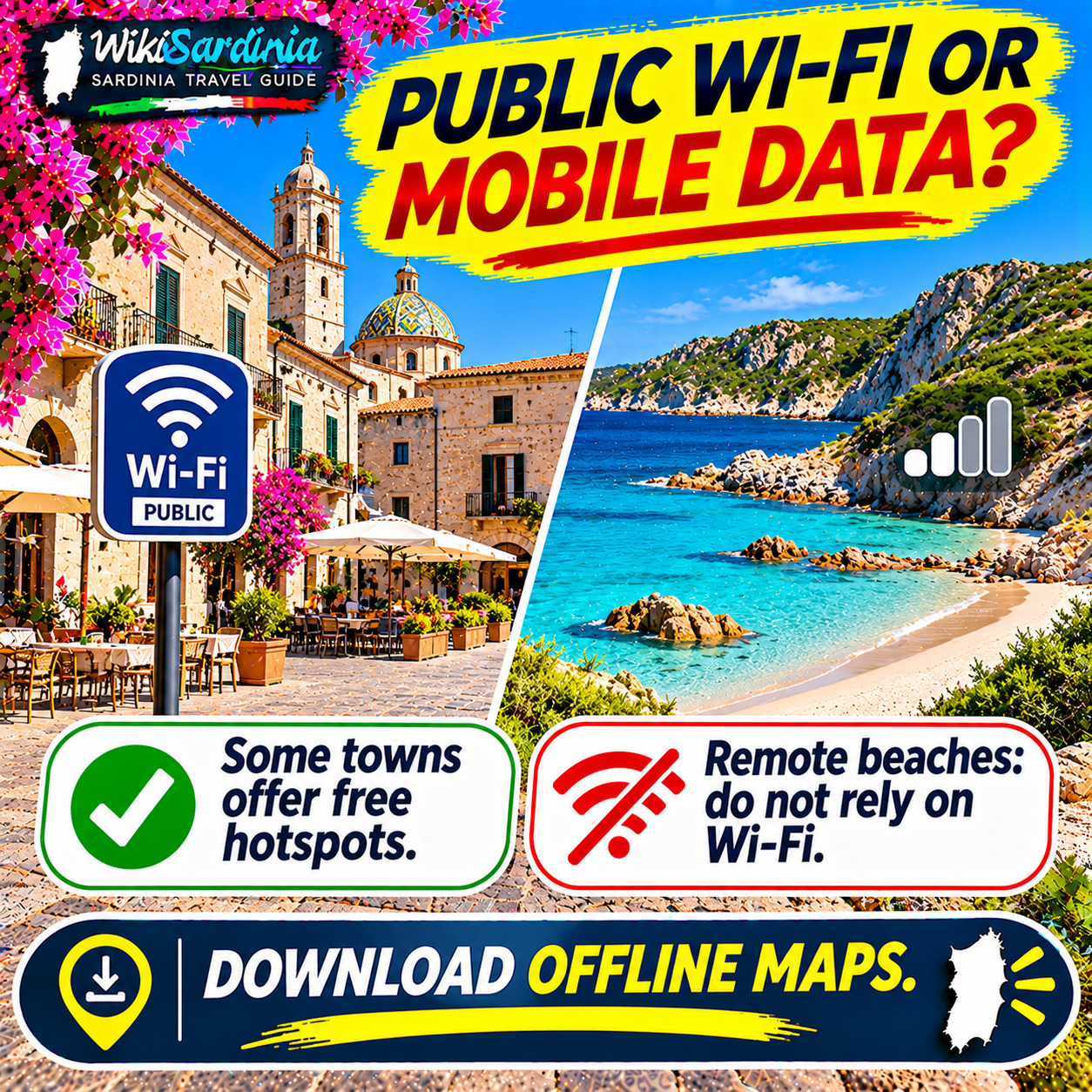
Some Sardinian town squares, public buildings, hotels, cafés and beach businesses offer Wi-Fi, but you should not expect free public internet everywhere. In particular, an isolated beach or small inland village may have no usable public hotspot. A mobile data plan is the most practical everyday option for most visitors, combined with offline maps and important information downloaded in advance. Mobile coverage is not guaranteed everywhere either.
Is there free Wi-Fi in Sardinian piazzas?
Some municipalities participate in public hotspot initiatives or operate their own networks. Italy's government-supported Piazza WiFi Italia initiative was created to provide free access in public areas, with implementation coordinated through Infratel Italia. But the existence of a national program does not establish that the particular piazza you are visiting has an active hotspot. Check the municipality's current website or official hotspot information for the exact location.
Is public Wi-Fi available on Sardinian beaches?
Do not assume it is. Some equipped beaches, lidos, restaurants and seaside accommodation businesses may provide guest Wi-Fi, often only near their premises. Other beaches have no public network at all. Sardinia has funded initiatives aimed at connectivity on selected coastal areas, but a regional investment plan is not proof that a specific beach currently has a working hotspot. If you are heading to a remote cove, plan as though there will be no Wi-Fi.
Do beach bars and restaurants let tourists use Wi-Fi?
Some do, but access is a business decision and may require a password, purchase or guest login. Signal strength may drop sharply once you leave the premises. Ask staff whether the network is for customers and whether it reaches the seating area. Do not assume that seeing a network name means it is free, safe or officially provided by the venue.
How do I find a genuine public hotspot?
Check official municipal tourism pages, public notices and information about the WiFi Italia project. Where the service uses an app or login process, follow the provider's published instructions. Confirm the network name with a trusted official source or staff member before connecting; a similar-looking network name can be created by someone else. Avoid entering sensitive credentials on an unfamiliar captive portal.
Is cellular data necessary for a Sardinia road trip?
Not legally necessary, but strongly recommended for practical reasons: navigation, contacting accommodation, checking transport updates, arranging taxis and confirming bookings. Rural roads, cliffs, valleys and remote beaches can have weaker reception, and the signal varies by operator and device. A data plan is not a guarantee of coverage in every location. Download offline resources as a backup.
Should American visitors get an Italian SIM or eSIM?
Check your US carrier's Italy roaming price first. If international data is expensive, an Italian prepaid SIM or compatible travel eSIM may be a useful alternative. Compare total data allowance, validity dates, network access, hotspot/tethering conditions, voice/SMS inclusion and activation requirements. A data-only eSIM may not provide a local telephone number or ordinary calls and texts. Confirm that your phone is unlocked and eSIM-compatible before purchasing; do not assume every plan works with every handset.
What about EU visitors and roaming?
Eligible customers with mobile plans from EU and participating EEA countries generally benefit from the EU's Roam Like at Home rules when visiting Italy, subject to fair-use conditions and plan-specific limits. This does not automatically apply to visitors using a US or UK mobile plan. Check the current European Commission roaming guidance and your provider's terms. A domestic 'unlimited data' plan may have a roaming fair-use allowance.
Can I navigate without mobile reception?
Yes, if you prepare. Google Maps allows users to download selected areas for offline use. Offline driving navigation can work within downloaded map coverage, but live traffic, alternative routes and some modes such as transit and walking directions may be unavailable offline. Apple Maps also offers offline maps on compatible iPhones in supported areas. Download the areas you need while connected and verify that the maps open before leaving your accommodation.
What else should I download before going to a remote beach?
Save your accommodation address, parking location, return route, ferry or excursion ticket, emergency contact numbers and any access or reservation instructions. If the beach requires a booking or digital pass, check whether a screenshot is accepted; some systems require live verification or the original booking. Tell someone your planned destination when exploring isolated areas, and do not rely on a phone connection as your only safety measure.
Is public Wi-Fi safe for banking and payments?
Public networks can expose users to fake hotspots, insecure login pages or other risks. Prefer your mobile connection for sensitive tasks when possible. Keep your device updated, use encrypted websites and official apps, disable automatic connection to unknown networks, and avoid installing certificates or configuration profiles from suspicious login pages. A VPN can add protection in some situations but does not make a fraudulent network trustworthy.
Will WhatsApp and Wi-Fi calling work?
Messaging and internet calling generally work over a usable Wi-Fi or mobile data connection, subject to app and network restrictions. Ordinary Wi-Fi calling through your phone number depends on carrier and device support. A data-only travel eSIM can support internet-based messaging but may not supply ordinary voice calling or SMS. Keep an appropriate method to contact emergency services and your accommodation.
What about ferries and boat trips?
Do not assume that mobile coverage remains reliable offshore or that a ferry's Wi-Fi is free. On ships, phones can connect to maritime satellite-based mobile networks that are not covered by ordinary EU terrestrial roaming price protections and may be expensive. Check the network and tariff, and consider airplane mode when appropriate. The European Commission's roaming FAQ explains this distinction.
How much does Wi-Fi or an eSIM cost?
Public hotspots may be free, while hotel, campsite or venue networks can have their own access conditions. SIM and eSIM prices change frequently with provider, data allowance and duration. There is no trustworthy single island-wide price. Compare the exact package before paying, including taxes, fair-use limits and renewal terms. Never assume an advertised 'unlimited' plan has unrestricted high-speed usage.
Useful Italian phrases
“C'è il Wi-Fi gratuito qui?” means “Is there free Wi-Fi here?” “Qual è la password?” means “What's the password?” “C'è copertura telefonica in spiaggia?” means “Is there mobile coverage at the beach?” “Dove posso comprare una SIM?” means “Where can I buy a SIM?” “La rete funziona anche fuori dal locale?” means “Does the network work outside the premises too?”
Before exploring: connectivity checklist
- Check whether your existing phone plan covers Italy at an acceptable cost.
- Confirm eSIM compatibility and whether a travel plan includes voice calls or only data.
- Download offline maps for the roads and coastal areas you will visit.
- Save tickets, bookings, addresses and emergency contacts locally.
- Ask accommodation or the municipality about actual public Wi-Fi hotspots.
- Assume remote beaches may have neither public Wi-Fi nor reliable cellular reception.
- Protect your accounts when using unfamiliar public networks.
The WikiSardinia takeaway
Free Wi-Fi is available in some Sardinian piazzas and tourist venues, but it is not universal, especially at beaches. A suitable mobile data plan plus downloaded offline maps is the best practical combination for visitors. Check the actual hotspot, your roaming terms and your phone's compatibility rather than relying on broad claims about island-wide coverage.