Sardinia has a reputation for glamorous beaches, superyachts and eye-watering hotel prices. But does that mean a holiday on the island is significantly more expensive than visiting Sicily or mainland Italy?
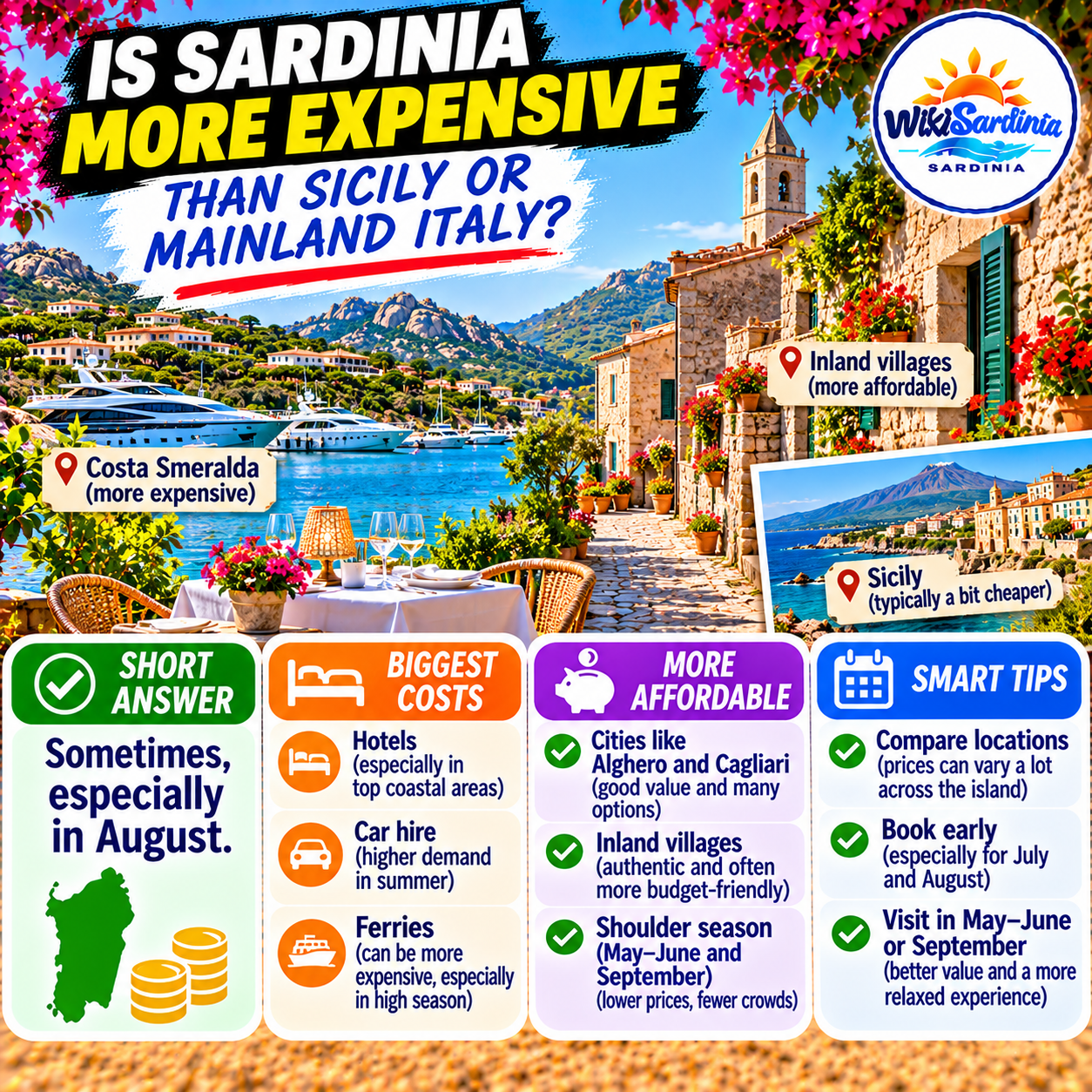
The honest answer is: sometimes, especially during the peak summer season, but not everywhere and not for every kind of expense. A luxury August stay on the Costa Smeralda can be considerably more expensive than a comparable holiday in many parts of Sicily. Yet a modest guesthouse in an inland Sardinian village, a city break in Cagliari or a September stay near Alghero can tell a very different story.
Why does Sardinia have an expensive reputation?
Part of the answer is geography, and part is the island's highly concentrated summer demand. Travellers must reach Sardinia by air or sea, and many choose to rent a car once they arrive. At the same time, famous coastal destinations attract intense demand for a relatively limited number of prime sea-view rooms during the busiest weeks.
An OECD report published in 2025 noted that nearly half of Sardinia's tourist overnight stays were concentrated in July and August, with around 80% occurring between June and September. That seasonal concentration was more pronounced than in Sicily, where the report put the June-to-September share at 59%. These are tourism distribution figures, not direct price comparisons, but they help explain why Sardinian peak-season accommodation can become costly.
Sardinia versus Sicily: which island is cheaper?
For many mainstream summer holidays, Sicily offers more lower-cost accommodation choices, particularly outside its most famous resort towns. However, neither island has one uniform price level. Taormina, Cefalù and other popular Sicilian destinations can be expensive, while Sardinia has affordable areas that receive less international attention.
A Data Appeal comparison of summer 2023 accommodation found Sardinian hotel rates significantly higher in the categories studied: its report described Sicily's three-star and four-star accommodation prices as 27% and 40% lower, respectively. These are historical figures from that study, not a universal 2026 price difference. They illustrate the gap that can emerge in comparable accommodation categories, but individual bookings can differ dramatically.
For an actual trip, compare hotels of similar quality, for the same dates, with the same cancellation policy and location advantages. Comparing a Costa Smeralda beachfront resort with a Sicilian inland apartment would not be a fair measure of the islands' relative costs.
What about mainland Italy?
Mainland Italy is too diverse for one simple comparison. A week in a luxury hotel on the Amalfi Coast or in an exclusive Ligurian resort can cost as much as, or more than, a stay in many parts of Sardinia. Conversely, smaller towns in Calabria, Basilicata and other less tourist-heavy areas may offer excellent value.
The meaningful question is not whether Sardinia costs more than 'Italy' as a whole, but which Sardinian destination you are comparing with which mainland destination, at what time of year, and for what level of comfort.
The biggest expense: accommodation
Hotels and holiday rentals are often the largest source of price differences. In peak August, popular beach destinations such as Porto Cervo, San Teodoro, Villasimius and parts of the north-east coast can command high rates. Smaller inland towns and some urban locations may provide more budget flexibility.
A June 2026 travel-industry comparison published by HM Travel gave indicative summer three-star hotel rates of €180 per night for Sardinia and €95 for Sicily. Those are the publisher's regional estimates for popular coastal areas, not audited islandwide averages or guaranteed booking prices. Treat them as an illustration of how different a peak-season coastal budget can look, and check live prices before making decisions.
Car rental and getting around
Sardinia's beaches, archaeological sites and mountain villages are spread across a large island. Public transport is available, but it does not reach every remote cove or fit every traveller's timetable. As a result, many visitors budget for a rental car, fuel and parking.
Car rental can become especially costly during the summer rush, particularly when booked late. Sicily also has car-hire expenses, of course, but travellers who focus on a well-connected Sicilian city may find it easier to organise parts of their trip without a vehicle. In Sardinia, staying in a walkable city such as Cagliari or Alghero can similarly reduce the number of days for which you need a car.
Flights and ferries: the hidden part of the comparison
When comparing destinations, include the journey, not just the room. Flight prices depend on your departure airport, travel dates, baggage and booking timing. Ferry prices vary with the route, passenger count, vehicle, cabin and season. Bringing a car on a ferry can make the overall holiday substantially more expensive.
There is no reliable rule that Sardinia is always more expensive to reach than Sicily from every starting point. Check the complete round-trip cost for your own itinerary. An attractive hotel deal may not remain attractive once transfers and transport are included.
Are restaurants and groceries much more expensive?
Not necessarily. A simple pizza, sandwich, coffee or traditional lunch in an ordinary Sardinian town can be reasonably priced by Italian holiday standards. The sharpest differences often come from choosing fashionable waterfront locations, upscale restaurants and luxury resorts rather than everyday local businesses.
Sicily has a celebrated street-food culture and abundant inexpensive eating options in many cities, which can make it especially appealing to budget-conscious travellers. Sardinia also has informal pizzerias, bakeries, markets and family-run restaurants, though you may need to look beyond the busiest tourist promenades.
Grocery costs depend on the shop and products chosen. Buying local produce and preparing some meals yourself can help, but it is inaccurate to claim that every supermarket item is automatically more expensive on Sardinia than on the mainland.
Are Sardinian beaches expensive?
Many Sardinian beaches have areas of free public access, so you do not have to rent an umbrella or sunbed to enjoy the sea. Paid beach clubs, reserved equipment, parking and any location-specific access arrangements can increase costs. Some particularly popular beaches may have reservation systems or environmental access rules; verify these individually before visiting.
Visitors should distinguish between paying for optional services and paying an actual required entrance or reservation fee at a regulated site. Never assume that all Sardinian beaches charge admission.
Which parts of Sardinia can offer better value?
Alghero and Cagliari offer a broad range of accommodation and dining choices, although they can still be expensive during major events or high season. Oristano and inland communities may be worth exploring for a different pace and potentially lower accommodation costs. Parts of Ogliastra and less publicised coastal areas can also be alternatives, depending on the exact village and date.
None of these destinations is guaranteed to be cheap. The best approach is to compare several bases rather than focusing only on the island's most internationally famous beaches.
When is Sardinia cheapest to visit?
For many travellers, May, June and September offer a better balance between pleasant conditions, available tourism services and accommodation prices than the busiest August weeks. The weather and sea temperature vary, and not every seasonal business opens at the same time. Nonetheless, travelling outside the peak holiday period is one of the most effective ways to control costs.
October and winter can also be appealing for city breaks, hiking and cultural travel, but beach-focused visitors should check seasonal closures and transport connections carefully.
How to save money without missing Sardinia
Start by choosing the right month. Next, compare accommodation in more than one area, check the total cost of flights or ferries, and reserve a rental car early if you genuinely need one. Consider spending a few days in a city without a car before renting one for inland excursions. Use free beaches when appropriate, shop locally and enjoy casual restaurants as well as occasional special meals.
Most importantly, avoid planning the entire island around a single luxury destination. Sardinia's value lies in its varied landscapes, villages, archaeological heritage, food and coastline—not only its exclusive resorts.
Frequently asked questions
Is Sardinia more expensive than Sicily in August?
It often can be, particularly for accommodation in popular coastal resorts. But specific Sicilian resorts may cost more than particular Sardinian towns, so compare like-for-like offers.
Is Costa Smeralda representative of Sardinia's prices?
No. It is one of the island's most exclusive tourism areas and should not be used as a price benchmark for the whole region.
Can you visit Sardinia on a budget?
Yes. Flexible travel dates, modest accommodation, free beaches, local food and selective use of rental cars can make a substantial difference.
Is food in Sardinia more expensive than mainland Italy?
It depends heavily on where and what you eat. Luxury seafront restaurants can be costly, while everyday cafés and local eateries may be comparable to other Italian destinations.
Which is cheaper: Sardinia in September or Sicily in August?
There is no guaranteed winner. Sardinia in September can offer good value, but the answer depends on destination, hotel type, transport and booking date.
Do I need to rent a car for the entire trip?
Not necessarily. If you stay in a walkable town, you may be able to use public transport or rent a car only for selected excursions.
So, is Sardinia worth the extra money?
If you choose a luxury beachfront resort in August, Sardinia may be a relatively expensive holiday. But that is only one way to experience the island. Plan around your priorities, compare realistic total costs and consider the quieter months or less publicised destinations. The result can be a memorable Mediterranean holiday without paying luxury prices for every day of your stay.