You have just enjoyed a seafood dinner overlooking the Mediterranean in Sardinia. The waiter brings the bill, and your American instincts kick in: should you add 18%, 20%, or even 25%? Will the staff think you are rude if you leave nothing?
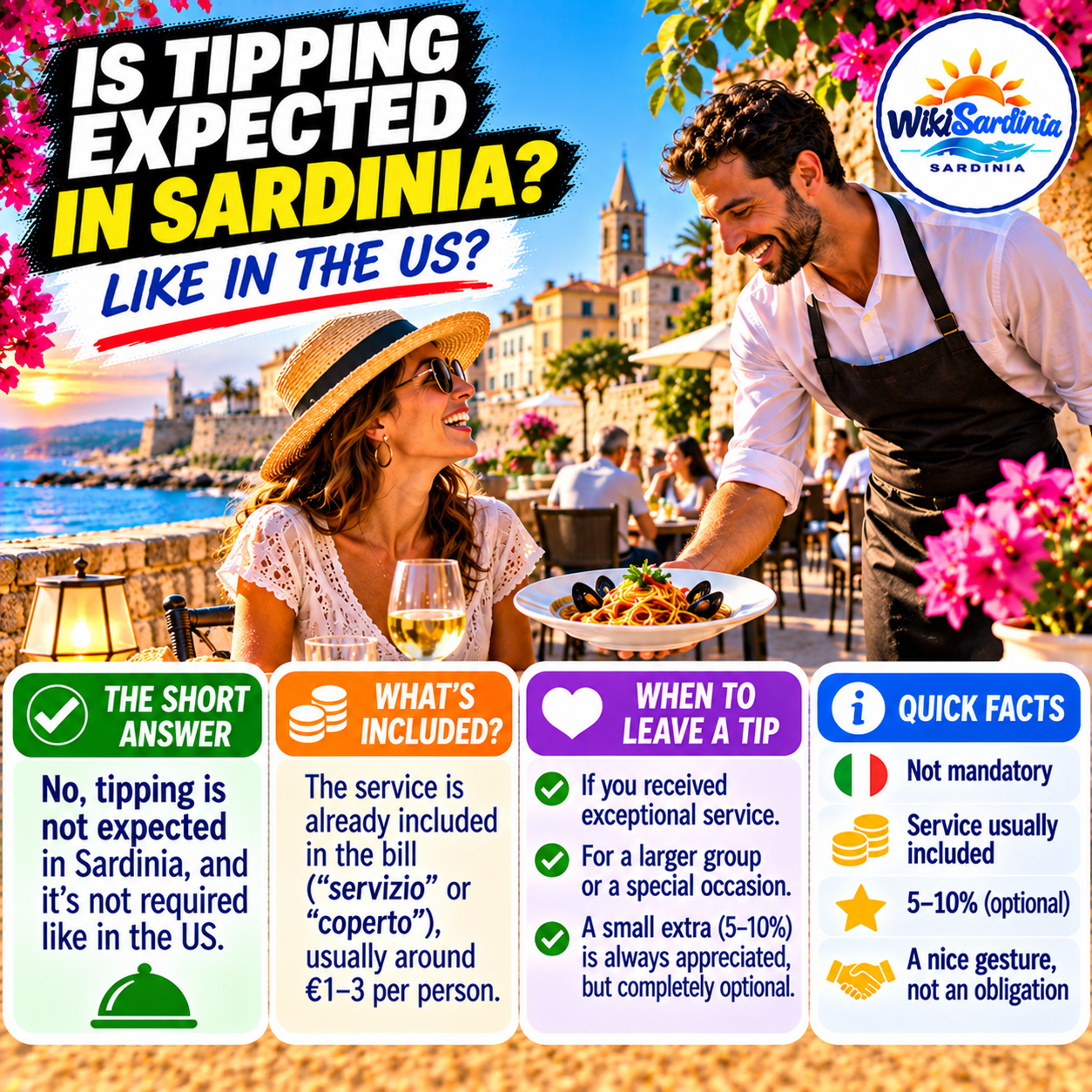
Here is the reassuring answer: tipping at restaurants in Sardinia is generally optional, not expected in the same way it is in the United States. A small gratuity for especially good service is welcome, but you do not need to calculate a standard percentage every time you eat out.
Is tipping customary in Sardinia?
Sardinia follows broadly Italian tipping customs. Restaurant employees receive wages, and the American system of treating a substantial tip as an almost automatic part of the dining bill does not apply in the same way. Customers may leave a few euros, round up a bill or offer a more generous gratuity after exceptional service. Many locals also pay the amount shown on the bill without adding a tip.
Neither choice should be treated as a moral test. Being polite, respecting the staff and understanding the restaurant’s charges matter more than copying US tipping percentages.
How much should you tip?
There is no fixed Sardinian percentage. For a casual meal, leaving the change or rounding up can be a friendly gesture. After a long, attentive dinner, a few extra euros may be appreciated. If you personally want to leave 5–10% for outstanding service, that is a generous voluntary choice, not a local requirement.
For example, on a €47 bill, you might pay €50 and leave the difference. On a €100 bill, you can pay €100 without violating local etiquette, or leave an extra amount if the experience merits it. Avoid assuming that every restaurant expects a particular percentage.
What is “coperto” on an Italian restaurant bill?
Visitors often notice a line marked coperto and assume it is the tip. It is not. Coperto is a cover or place-setting charge applied by some restaurants, often calculated per person. It can relate to table service and the cost of providing the place setting, but it is not a gratuity handed directly to your waiter.
There is no universal €1–3 charge across Sardinia: some restaurants charge nothing, some charge a few euros, and others set different amounts. Charges should be disclosed in the menu or pricing information. If a fee is unclear, ask before ordering.
What does “servizio” mean?
Servizio means service. A separately stated servizio incluso or service charge may appear on some menus or bills, but it should not be confused with coperto. Not every Sardinian restaurant adds a separate service charge, and the presence of coperto does not prove that a tip has already been included.
If you see a service percentage, check the menu and bill and ask what it covers. There is generally no need to add another gratuity automatically on top of an already stated service charge, although you may choose to do so.
Is it rude not to tip in Sardinia?
Usually, no. If you pay the correct bill and thank the staff, you have fulfilled the ordinary expectation. A friendly grazie and courteous behaviour go a long way. A tip is an additional expression of appreciation, not an entrance fee for decent service.
Should you tip in cash or by card?
Small cash tips are often the simplest option. Card terminals do not always offer a dedicated gratuity function, and how card tips are handled can vary by business. If you would like to add a tip to a card payment, ask whether the restaurant can do it and whether the amount reaches the staff.
What about cafés, bars and gelaterias?
At a café counter, gelateria or takeaway shop, tipping is not generally expected. You may see a tip jar, but contributing is entirely your choice. At a table-service bar, charges can differ from counter prices, particularly in tourist areas, so check the price list. A higher table-service price is not automatically a tip.
Does tipping change in Alghero, Costa Smeralda or Cagliari?
In destinations popular with international visitors, some staff may be familiar with American tipping habits. That does not mean you are obliged to tip as you would in the US. Upscale restaurants, private guides and other premium services may inspire guests to leave something extra, but the decision remains yours unless a clearly disclosed mandatory charge applies.
Five useful phrases when paying
“Il conto, per favore.” — The bill, please.
“Il coperto è incluso?” — Is the cover charge included?
“C’è un costo per il servizio?” — Is there a service charge?
“Tenga il resto.” — Keep the change.
“Grazie, era tutto buonissimo!” — Thank you, everything was delicious!
Frequently asked questions
Do Americans need to tip 20% in Sardinia?
No. A 20% tip is not a standard expectation in Sardinian restaurants.
Is coperto the same as a tip?
No. Coperto is a cover charge, not a voluntary gratuity.
Does the bill always include a service charge?
No. Restaurants differ, and a coperto charge should not be mistaken for a separately stated service fee.
Is leaving €2 or €5 acceptable?
Yes, as a voluntary gesture after good service. The appropriate amount depends on the bill and your preference.
Can I leave no tip?
Yes. Paying the bill without an additional tip is normally acceptable.
The bottom line for American travellers
In Sardinia, enjoy your meal without worrying about the US tipping formula. Read the menu, distinguish coperto from servizio, pay the stated bill, and leave a little extra only if you want to thank someone for particularly good service. Your generosity is welcome; it is not compulsory.