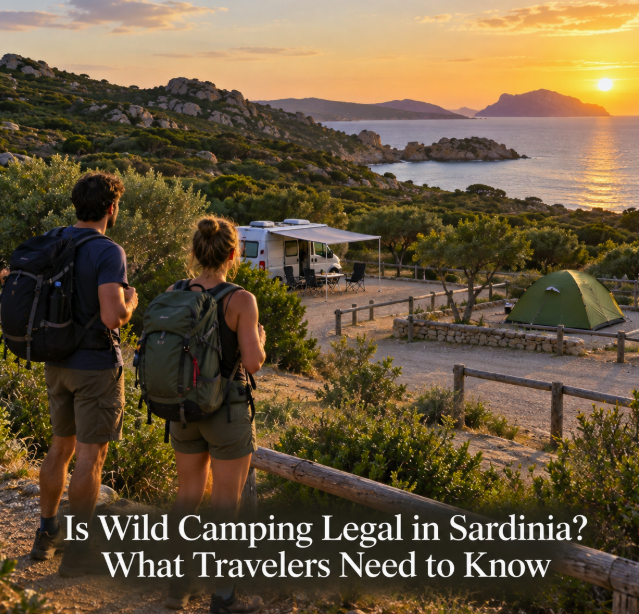
If your Sardinia plan involves pitching a tent beside an empty beach or sleeping overnight in a camper at a remote viewpoint, the legal answer is straightforward: wild camping is generally forbidden outside authorized areas. Sardinia’s regional tourism law prohibits camping with tents, caravans, motorhomes, campers and similar mobile sleeping equipment across the regional territory except in recognized campsites, authorized temporary stopping areas and other areas specifically identified by municipalities.
The question comes up constantly among hikers, cyclists and van travelers because Sardinia appears made for spontaneous camping. Long stretches of coast, mountain roads and quiet countryside can look empty after sunset. But a beautiful pull-off or isolated beach is not automatically a legal overnight campsite.
What Sardinia’s law actually says
Article 22 of Sardinia’s Regional Law 16/2017 establishes the prohibition on campeggio libero. It applies throughout the region and covers tents as well as caravans, motorhomes, campers and similar mobile means of accommodation. The law instead directs travelers toward outdoor accommodation facilities, equipped temporary stopping areas, temporary areas established at traveler services such as agritourism or restaurants, and other places that municipalities may designate. citeturn0search40
The distinction matters for campervan travelers because legal parking and camping are not always the same activity. Sardinian law recognizes temporary areas for caravans and motorhomes, generally for stays of up to 48 consecutive hours, while individual municipalities and the Italian road code can add rules governing where and how a vehicle may stop. citeturn0search40
For a tent traveler, however, sleeping on an undeveloped beach, in a pine forest or beside a trail should not be treated as an informal legal option simply because other travelers report having done it.
The Region repeated the warning in summer 2026
This is not an obsolete rule sitting unnoticed in an old statute. On 14 July 2026, the Region of Sardinia published a beach-protection campaign in both Italian and English explicitly reminding visitors that wild camping and overnight stays outside authorized areas are forbidden. The regional notice lists a fine of €100 to €250 for the prohibited camping behavior covered by that campaign. citeturn0search0
The same campaign also reminds visitors not to walk on dunes, drive vehicles onto protected beach areas, remove sand, stones or shells, or leave rubbish. These restrictions are especially relevant to travelers imagining a secluded overnight camp directly behind a Sardinian beach. citeturn0search0
Why Reddit gives travelers mixed answers
Online discussions often blur the difference between what people have managed to do and what the law allows. In a 2026 Sardinia cycling discussion, one commenter correctly warned that wild camping is prohibited, while another openly acknowledged that the practice is illegal but said they had nevertheless done it by keeping a low profile. That contradiction captures why visitors receive confusing advice: personal experience of avoiding enforcement does not create a legal exception. citeturn0reddit36
Other recent camper discussions describe travelers overnighting outside formal sites while simultaneously acknowledging that the practice can be prohibited. Reddit can be useful for understanding practical road conditions or campsite experiences, but it should not replace regional and municipal rules when deciding whether an overnight stop is lawful. citeturn0reddit42turn0reddit44
What about a one-night bivouac?
Travelers sometimes distinguish bivacco — a minimal overnight stop, often from dusk until dawn — from recreational camping. That distinction can matter in some Italian mountain contexts, but it should not be used as a blanket loophole for Sardinia.
Protected areas and individual sites can impose their own rules. Regional environmental regulations for some protected sites explicitly prohibit both camping and bivouacking. citeturn0search39
A hiker planning an overnight route should therefore check the regulations of the exact park, protected area, municipality or trail authority involved and obtain authorization where required. The fact that a small tent is erected only after sunset does not automatically make the overnight stay lawful.
Beaches are a particularly bad place to improvise
Sardinia’s beaches are environmentally sensitive and heavily protected during the visitor season. Dunes may contain fragile vegetation that stabilizes the coast, and some beaches are associated with nesting wildlife or protected habitats.
The Region’s July 2026 guidance specifically pairs its camping warning with rules protecting dunes and coastal materials. Even when a beach looks empty late in the evening, enforcement and environmental restrictions still apply. citeturn0search0
Do not drive a camper onto sand or dunes, pitch a tent among dune vegetation or assume that a remote cove is exempt because it has no ticket office.
Legal alternatives are more varied than a conventional campsite
A legal Sardinia road trip does not necessarily mean staying every night in a large holiday camping resort. Regional law recognizes equipped temporary stopping areas for campers and caravans, and municipalities can identify additional authorized areas. Some agritourism businesses, restaurants and traveler-service activities may also provide lawful temporary stopping arrangements where properly established. citeturn0search40
For cyclists and hikers with tents, conventional campsites remain the easiest option, but small rural camping facilities and agritourism properties can offer a quieter alternative. Always ask whether tent camping is actually authorized rather than assuming that permission from an individual landowner automatically satisfies every tourism, environmental or municipal rule.
Camper travelers should look for signs such as area sosta camper or area attrezzata and check the conditions of the specific site. Sardinian law defines temporary camper and caravan stopping areas around a maximum 48-hour stay, but local signage and site rules still govern the actual stop. citeturn0search40
Fire risk makes responsible camping especially important
Summer in Sardinia brings serious wildfire risk. Even apart from the legality of an overnight camp, open flames, improvised fires and careless cooking can have severe consequences in dry Mediterranean vegetation.
Anyone staying at an authorized outdoor facility should follow current fire restrictions and the operator’s rules. Never assume that a remote location makes a flame safer; isolation can make a fire harder to detect and control.
How to plan a camping trip without problems
For a cycling or hiking itinerary, map legal overnight options before leaving rather than waiting until sunset. This matters particularly outside the peak summer season, when some coastal campsites close. Confirm opening dates directly with the property and identify a backup option within realistic riding or walking distance.
For campervan trips, combine registered campsites with authorized camper areas. Check municipal signs when arriving in a town because parking restrictions can change seasonally, especially near popular beaches.
Most importantly, do not treat an app pin or an online comment saying “we slept here without problems” as evidence that a location is authorized. Crowd-sourced camping apps can be helpful for finding facilities, but legality still depends on the official status of the site and current local rules.
Sardinia rewards outdoor travelers with extraordinary coastlines and mountain landscapes, but the island is not a general free-camping zone. In 2026 the Region is explicitly reminding visitors that overnight camping belongs in authorized areas. Plan those stops as part of the route, and you can still have a flexible tent, cycling or campervan trip without turning a secluded beach into an illegal campsite.