At the end of a Sardinian meal, you may be offered a small glass of mirto, the aromatic liqueur associated with the island’s Mediterranean scrubland. Most visitors picture a deep red drink served cold. But look a little closer at a restaurant menu or local producer’s shelf and you may find a second version: mirto bianco.
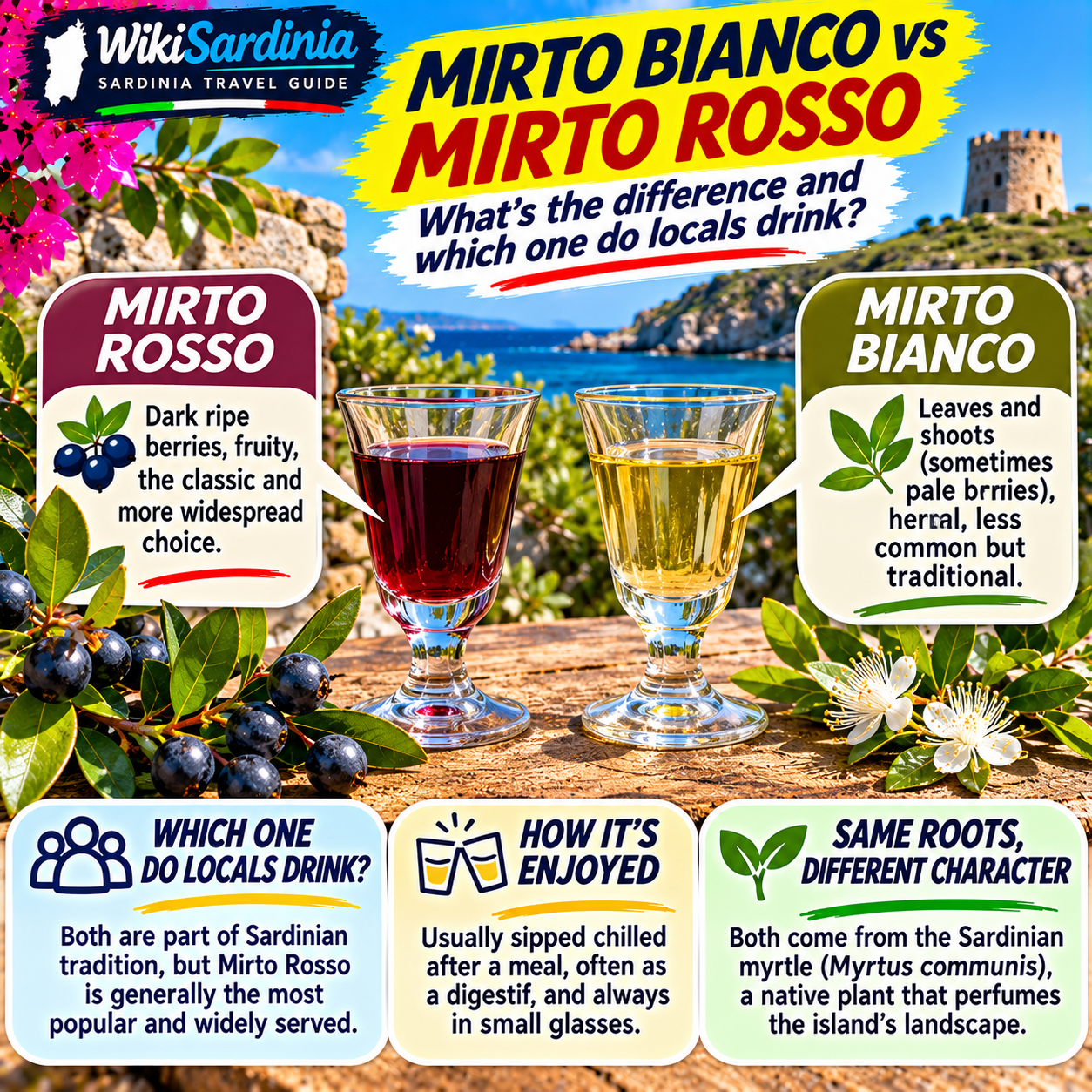
What is the difference between Mirto Rosso and Mirto Bianco, and which one do Sardinians actually drink? Both belong to the island’s culinary traditions, but they use different parts or varieties of the myrtle plant and have distinct flavours. The red version is the best-known and more widespread choice; the white version is less common, not less authentic.
What exactly is mirto?
Mirto is a liqueur associated especially with Sardinia, made by infusing parts of the myrtle plant (Myrtus communis) in alcohol and combining the aromatic infusion with a sweetening component, usually sugar and water. Myrtle is an evergreen Mediterranean shrub with glossy leaves, fragrant flowers and berries that commonly ripen to a dark bluish-black colour.
The plant grows in Sardinia’s macchia mediterranea, the aromatic vegetation found across the island. Its leaves and berries have long been used in local food traditions. The liqueur is typically offered in a small glass after a meal, at restaurants, family gatherings and celebrations.
The Italian national tourism portal Italia.it describes mirto as a symbol of Sardinian food culture and distinguishes its red and white forms.
What is Mirto Rosso?
Mirto Rosso is the familiar dark red or ruby-coloured liqueur produced mainly by macerating ripe, dark myrtle berries. Their natural pigments, including anthocyanins, help give the drink its deep colour. Some traditional recipes also include leaves, but ripe berries define the classic red style.
Depending on the producer and recipe, the taste can be rich, aromatic and fruity, with herbal notes, some tannic grip and a sweet-to-bitter balance. It is not a fruit juice: it is a spirit-based liqueur, and its alcoholic strength varies by brand.
If a Sardinian restaurant offers you “un mirto” without specifying a colour, the red version is generally the one you are most likely to receive.
What is Mirto Bianco?
Mirto Bianco is a lighter-coloured myrtle liqueur made through a different infusion. Many producers use myrtle leaves or tender shoots. Other interpretations use pale or non-pigmented myrtle berries, sometimes with leaves or shoots. This means there is no single universal ingredient formula behind every bottle labelled mirto bianco.
Because it lacks the strong colouring of the dark berries, the drink can be clear, straw-coloured, pale gold or slightly greenish rather than literally white. Leaf-based versions tend to emphasise botanical, balsamic and herbal aromas, and can finish drier or more bitter than red mirto.
For example, Sardinian producer San Martino describes its white mirto as a less familiar liqueur made from hand-picked myrtle leaves. Distillerie Pacini likewise lists a leaf-infusion Mirto Bianco alongside a berry-based Mirto Rosso.
Mirto Rosso vs Mirto Bianco: the main differences
| Feature | Mirto Rosso | Mirto Bianco |
|---|---|---|
| Main ingredient | Ripe dark myrtle berries | Usually leaves or shoots; sometimes pale berries |
| Colour | Deep red to ruby-purple | Clear, pale gold or greenish |
| Typical flavour | Fruity, aromatic, sweet-herbal, gently tannic | Herbal, botanical, often drier or more bitter |
| Availability | More widespread and recognisable | Less common, sometimes a specialist offering |
| Tradition | Classic after-dinner mirto | Traditional alternative with a different character |
These are broad tendencies rather than strict tasting rules. The recipe, sweetness, maceration and producer can make two bottles of the same colour taste surprisingly different.
Which one do Sardinians actually drink?
Both—but Mirto Rosso is the classic and more widespread choice. The national tourism portal calls red mirto the more celebrated form and white mirto rarer. Sardinian agricultural publications also describe red mirto as one of the island’s best-known liqueurs, while white mirto remains part of the traditional range.
That does not mean every local prefers red or that white is reserved for tourists. Families, bars and producers have their own tastes and recipes. Some Sardinians enjoy the berry-rich sweetness of red mirto, while others prefer the sharper botanical character of the white version. There is no reliable island-wide survey establishing what every resident drinks, so claims about a universal local favourite would be misleading.
For a first taste, red mirto is the most representative introduction. If you already know it, trying white mirto is an interesting way to discover another side of the same plant.
Is Mirto Bianco less authentic?
Not at all. The white style has a genuine place in Sardinian production and home liqueur-making. An ISPRA publication on myrtle cultivation and biodiversity identifies red mirto from berries and white mirto from leaves as traditional uses of the plant on the island.
Less common does not mean recently invented. It simply means that the red berry-based liqueur has become the more recognisable expression of the tradition.
How is mirto traditionally made?
The basic process involves collecting the relevant berries, leaves or shoots, allowing their aromas to infuse into alcohol, then filtering and balancing the infusion with water and a sweetening ingredient. Producers vary the maceration time, proportions, sweetness and resting period to create their house style.
Red mirto’s colour and fruity profile come principally from dark berries; leaf-based white mirto draws more of its character from the plant’s aromatic foliage. Commercial bottles may use carefully controlled recipes, while home-made versions can vary widely between families.
The important distinction is not that one colour is made with alcohol and the other without: both are alcoholic liqueurs.
Is Mirto Bianco stronger than Mirto Rosso?
Not necessarily. Colour does not tell you the alcohol content. For example, Pacini lists both its classic red and white mirto at 28% alcohol by volume, while San Martino lists its white mirto at 30%. These are examples from producers, not universal standards.
Check the ABV on the individual bottle or ask the restaurant. A lighter colour or a more herbal taste does not mean a lower alcohol content.
How do locals serve mirto?
Mirto is commonly served in a small glass after lunch or dinner. It may be served chilled, sometimes quite cold, although the exact temperature is a matter of preference and producer advice. It is a drink to sip rather than a large cocktail-style serving.
You may encounter it after a meal featuring roast meats, local cheeses, seafood or traditional Sardinian dishes. It is often described as a digestivo because of the custom of drinking it after food, but that is a cultural serving tradition, not proof that alcohol improves digestion or provides a medical benefit.
What does each version taste like?
Imagine the aromatic Mediterranean landscape in two different forms. Red mirto often leads with dark fruit, warm spice, herbal depth and sweetness, sometimes followed by a gently astringent or bitter finish. White mirto often places leaves, balsamic herbs and a cleaner or drier finish in the foreground.
Some white versions made from pale berries can be more delicate or fruit-led than strongly leaf-based versions. If you are curious, ask whether the particular white mirto was made from leaves, shoots or berries. The answer tells you more about the likely flavour than the colour alone.
Where can visitors encounter Mirto Bianco?
Red mirto is usually easier to find in restaurants, bars and shops across Sardinia. White mirto may appear on a more specialised drinks list, in tastings or among the products of local distilleries. Availability varies by venue and season, so do not assume that every restaurant serving mirto stocks both colours.
If you want to compare the styles, ask for a small tasting where that is offered. You can also look at the producer’s ingredient description to understand how its white mirto is made.
Is mirto the same as limoncello?
No. Both are Italian liqueurs often served after meals, but limoncello is made from lemon peel, while mirto is based on the myrtle plant. Their aromas and traditional regional associations differ: mirto is particularly emblematic of Sardinia.
Is mirto always homemade?
No. Sardinia has a strong tradition of homemade mirto, but there are also established commercial distilleries and artisanal producers. Quality, sweetness and flavour vary among bottles. A commercial version is not inherently less authentic, just as a homemade version is not automatically better or safer.
Frequently asked questions
What is the main difference between Mirto Rosso and Mirto Bianco?
Red mirto is typically made from ripe dark myrtle berries; white mirto is usually made from leaves or shoots, though some versions use pale berries.
Which mirto is more popular in Sardinia?
Mirto Rosso is more widespread and better known. Mirto Bianco is a genuine but less common traditional alternative.
Is Mirto Bianco actually white?
Not usually. It may be transparent, straw-coloured, golden or faintly green.
Is Mirto Rosso made from red berries?
Despite its name, classic red mirto is generally made from ripe berries that are dark blue or almost black. Their pigments give the liqueur its reddish-purple colour.
Is Mirto Bianco made from flowers?
It is usually associated with leaves, shoots or pale berries, rather than being defined as a flower liqueur. Recipes differ by producer.
Is white mirto less alcoholic?
No general rule says so. Alcohol content depends on the producer and must be checked on the label.
Do Sardinians drink mirto before or after dinner?
Traditionally it is served after a meal in a small glass, although it also appears in contemporary cocktails and other settings.
Is mirto a medicine for digestion?
No. Its after-dinner use is a tradition; it should not be presented as a proven digestive treatment.
Which should I try first?
Red mirto is a good introduction to the most familiar Sardinian style. White mirto is worth exploring if you enjoy more herbal, botanical flavours.
The bottom line
Mirto Rosso and Mirto Bianco come from the same aromatic Sardinian plant but reveal different sides of it. The red, berry-based version is the island’s best-known classic; the white version is less common, often leaf-based and more botanical in character. Both belong to Sardinian tradition. If you have the chance to compare them, the most interesting question may not be which one is “real,” but which expression of the island’s landscape you prefer.