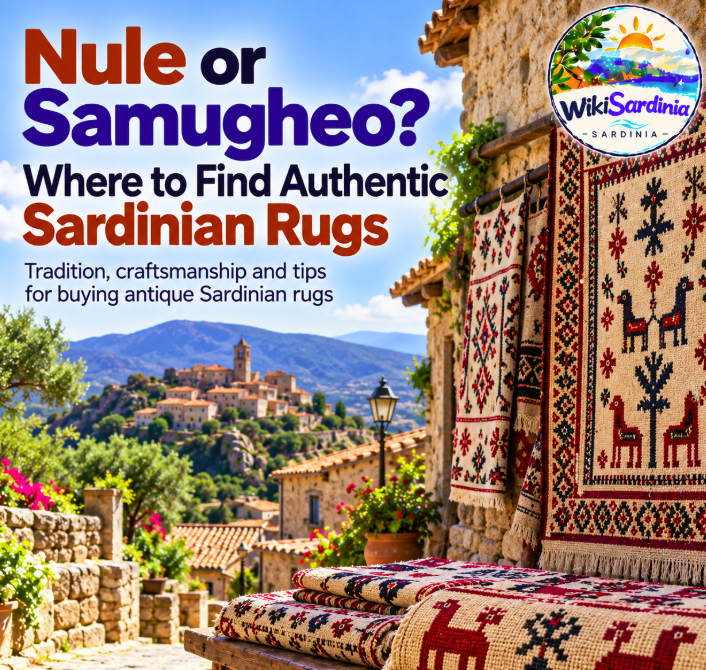
Looking for a genuine Sardinian rug to take home? Two inland towns deserve a place on your itinerary: Nule, in northern Sardinia, and Samugheo, in the island's central Oristano province. Both have strong weaving traditions, but they offer different experiences for visitors interested in handmade textiles, family craftsmanship and historic pieces.
Quick answer: choose Nule if you want to explore a smaller, traditional wool-weaving village, and Samugheo if you want a broader textile-focused visit with an established museum tradition. Neither town guarantees that every item on sale is an antique: confirm age, provenance and condition before paying antique prices.
Nule: a village with a distinctive wool-weaving heritage
Nule is known for its traditional carpets, often associated with wool, geometric designs and techniques passed through generations of weavers. A visit here can be especially rewarding if you want to meet an artisan and understand the labor behind a handwoven rug. Workshops may operate by appointment, so contact producers or local tourism offices before traveling.
Ask how the wool is prepared, which loom is used and whether the design follows a local pattern or is a contemporary interpretation. A newly made Nule rug can be an authentic piece of Sardinian craftsmanship without being an antique.
Samugheo: a strong destination for textile lovers
Samugheo is another important Sardinian weaving center, associated with carpets, tapestries and other textiles. The town is home to the MURATS, the Regional Museum of Sardinian Textile Art, making it an appealing choice for travelers who want cultural context alongside shopping. Check the museum's current opening hours and exhibition program before visiting.
Its artisan tradition offers opportunities to compare styles and discuss techniques, materials and contemporary designs. The presence of a textile museum does not mean the museum itself sells antique rugs.
Nule vs Samugheo: which should you choose?
| Your priority | Better starting point |
|---|---|
| Traditional village weaving experience | Nule |
| Textile museum and cultural context | Samugheo |
| Buying a new, locally made handmade rug | Either, depending on the artisan and style |
| Finding a verified antique | Ask specialist dealers in either area and verify provenance |
| Understanding different weaving traditions | Visit both if your itinerary allows |
What makes a rug genuinely antique?
Handmade, traditional, vintage and antique are not interchangeable. A rug produced this year using historic methods is a contemporary artisan work. An older rug may be vintage without having a documented age. If a seller describes a textile as antique, request an approximate date and the evidence supporting it.
Useful questions include: Who made it? Where was it woven? What is its ownership history? Has it been repaired or restored? Are the fibers wool, cotton or a blend? Is the price based on age, rarity, size, technique or condition?
How to recognize quality in a Sardinian rug
- Inspect the reverse: look closely at the weave, finishing and construction rather than judging only the front design.
- Ask about materials: fiber composition affects texture, care and longevity.
- Check the edges and fringes: repairs, weak points and heavy wear deserve attention.
- Measure carefully: handmade pieces may have small dimensional variations.
- Request a written receipt: include materials, dimensions, maker, declared age and any restoration details.
- Compare workmanship: an inexpensive machine-made souvenir is not equivalent to an artisan-woven piece.
Where to buy: workshops, galleries or antique dealers?
For a new traditional rug, a workshop is often the most informative place to start because you can ask the maker directly about technique and materials. For a documented antique, a reputable specialist or antique dealer may be better positioned to provide provenance, condition details and an invoice. Do not assume a workshop stocks historical pieces, and do not assume every old-looking rug is genuinely old.
Before setting off, check workshop opening hours, arrange appointments when necessary and confirm whether the seller accepts card payments or offers insured shipping.
Can you ship a Sardinian rug home?
Many sellers can discuss delivery options, but availability, insurance, packaging and international customs obligations vary. Ask for a written shipping quotation, delivery terms and tracking information. For valuable older textiles, photograph the condition before dispatch and confirm the insurer's coverage.
How much does a Sardinian rug cost?
Prices vary significantly with size, materials, labor, complexity, age, condition and provenance. There is no reliable single price for an authentic Sardinian rug, and an antique should not be valued solely by its dimensions. Compare quotes for similar workmanship and request an itemized description rather than relying on broad online price ranges.
How to plan your visit
Nule is in northern inland Sardinia, making it a potential cultural detour for visitors exploring the Sassari area. Samugheo is farther south in central Sardinia. These are not neighboring villages, so visiting both is better planned as a dedicated craft itinerary or as stops on separate travel days. Check travel times and workshop availability before departure.
FAQ
Which town is best for antique Sardinian rugs?
Both Nule and Samugheo are worthwhile starting points for Sardinian textile traditions, but neither guarantees antique inventory. If you specifically want an antique, prioritize documented provenance and a trusted seller.
Are Sardinian rugs still woven by hand?
Yes. Traditional weaving remains part of Sardinia's artisan culture, alongside modern production and contemporary designs. Confirm the manufacturing method of the individual rug.
Is a traditional Sardinian rug always made of wool?
No. Materials vary by product and technique. Ask the artisan or dealer to identify the fibers used in the specific piece.
Can I visit a weaving workshop?
Some artisans welcome visitors, but access and schedules vary. Contact workshops ahead of time rather than assuming walk-in availability.
WikiSardinia's recommendation
If you want to learn about weaving and return with a beautiful handmade piece, choose the town that fits your route and arrange a workshop visit. If your goal is a collectible antique, let provenance and condition guide the purchase—not the town name alone. A rug with a documented story is a more meaningful souvenir than one sold only with a vague claim of age.