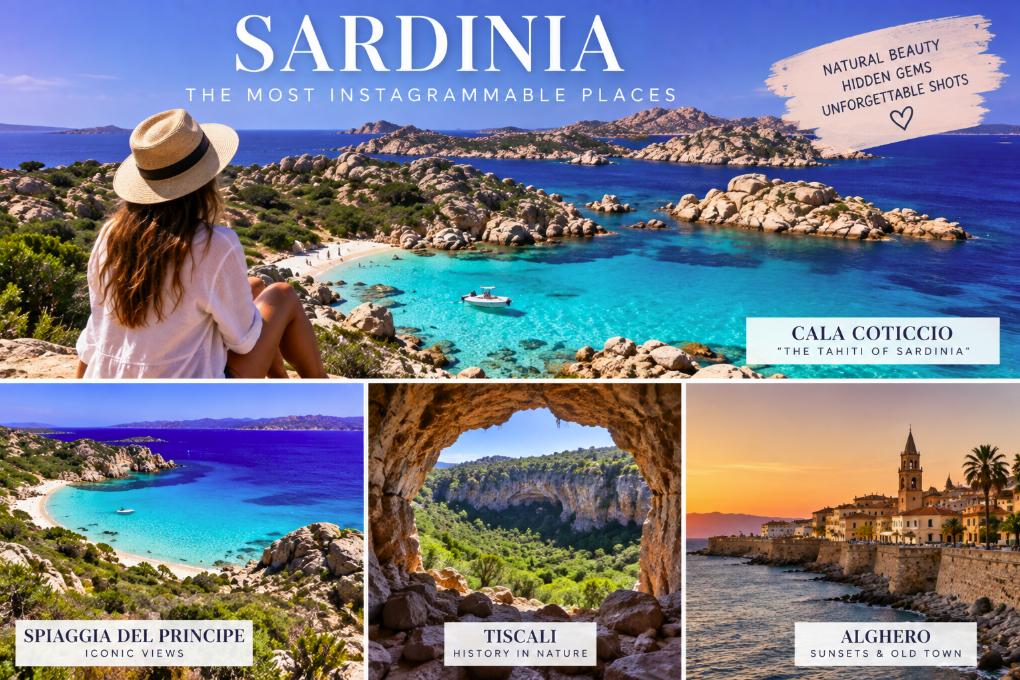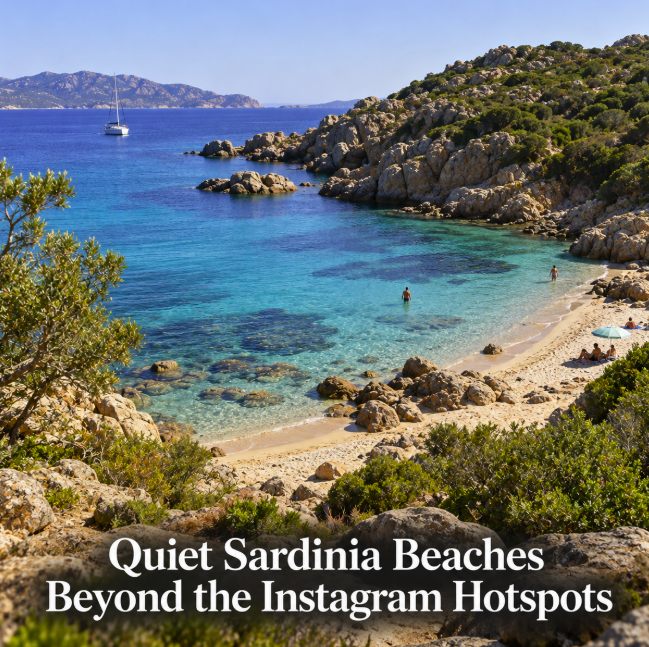
The idea of a Sardinian beach “where only locals go” is appealing, but it is rarely accurate. Sardinia’s coast is extensively mapped, photographed and discussed, and a beautiful cove can become busy quickly in July and August. A better way to find the quieter side of the island is to stop hunting for a supposedly secret beach and instead choose the right coastline, time of day and season.
That approach also avoids turning small, fragile coves into the next social-media destination. Sardinia has plenty of coast where visitors can experience clear water, Mediterranean scrub and a slower beach day without needing to publish the coordinates of a tiny place that cannot absorb large crowds.
Look beyond the famous names
The beaches that dominate international travel feeds represent only a fraction of Sardinia’s shoreline. The regional tourism material for Tortolì, for example, highlights well-known beaches such as Orrì and Cea but also notes that sandy areas alternate with rocky stretches offering quieter, more natural settings. That pattern is common around the island: a celebrated beach may sit within a much longer coastline containing smaller access points and less photographed sections.
Ogliastra is particularly suitable for travelers who want to explore rather than arrive with a checklist of viral locations. The coastline around Tortolì and farther north combines beaches, rocky sections and mountainous landscapes, while the hinterland quickly becomes rural. The best strategy is often to stay several days in one area and make decisions locally according to weather, wind and access conditions.
The west and southwest also deserve attention. Long stretches of coastline can feel very different from the compact coves associated with northeastern Sardinia. A broad beach gives people room to spread out, which can create a much quieter experience even when you are not literally alone.
Timing matters more than secrecy
A beach can feel completely different at 8 a.m. and at noon. Travelers who genuinely want quiet should arrive early rather than expecting a hidden location to solve the crowd problem. The same applies to the calendar: late spring and early autumn can offer a different atmosphere from the peak weeks of August, although sea and weather conditions vary and services may be reduced outside high season.
Weekdays can also be calmer than weekends, particularly on beaches popular with residents from nearby towns. Local families use the coast too, so “where locals go” does not automatically mean “where nobody goes.” In fact, a beach loved by Sardinians may be extremely busy on a summer Sunday.
Wind is another important part of the equation. Sardinia is exposed to changing conditions, and the most comfortable coast on a particular day depends partly on wind direction and sea state. Rather than driving across the island for a beach seen online, ask locally which nearby side of the coast is more sheltered that day.
Choose space over the perfect photograph
Social media tends to reward compact coves because turquoise water surrounded by rock fits neatly into a photograph. Those same physical characteristics can make a place feel crowded with surprisingly few visitors.
Longer beaches often work better for people who value peace. Walking several hundred meters away from the principal access point, where permitted and safe, can change the atmosphere without requiring an obscure destination. The busiest concentration is frequently close to parking, beach bars and the easiest access.
This is also a more sustainable way to explore. Tiny coves can have limited parking, delicate dunes or narrow paths, and sudden online popularity can put pressure on places that were never designed for large visitor numbers.
Respect access rules and protected landscapes
Quiet does not mean unrestricted. Parts of Sardinia’s coast lie within protected areas or landscapes where access, parking, anchoring or other activities may be regulated. Conditions can also change because of fire risk, maintenance, environmental protection or local ordinances.
Follow signs and barriers even when a map or old blog post suggests another route. Do not drive onto dunes, create improvised parking spaces or leave marked paths simply because a beach appears empty. If access requires crossing private land, an absence of fences should not be interpreted as permission.
Visitors should also take rubbish away with them and avoid removing sand, shells or other natural material. A beach staying beautiful depends partly on visitors leaving it as they found it.
The most useful local tip is often not a beach name
Hotel owners, hosts, restaurant staff and residents can be excellent sources of practical advice, but asking “What is your secret beach?” is not necessarily the best question. Ask instead where the sea is calm today, which nearby beach has easier parking, where there is natural shade, or which stretch tends to have more space.
Those questions produce information that is useful for the actual day rather than another location to add to a viral list.
It is also worth accepting that some local knowledge does not need to become online content. Sardinia does not need every small swimming spot to acquire a searchable English-language nickname, a geotag and a queue of rental cars.
How to have a quieter Sardinian beach day
For travelers who want an “anti-Instagram” experience, the formula is surprisingly simple: choose a less concentrated coastal area, go early, avoid peak weekends when possible, walk beyond the main access point on larger beaches, and adapt the plan to wind and sea conditions.
Ogliastra’s mixture of sandy and rocky coast is one good region in which to use that approach, but the principle works around Sardinia. The goal is not to discover a beach that Sardinians have somehow kept off the internet. It is to experience the island’s coast without treating every beautiful place as something that must be collected, photographed and geotagged.
Sometimes the best “hidden beach” in Sardinia is simply a perfectly public beach at the right hour, on the right day, with enough space to hear the sea.