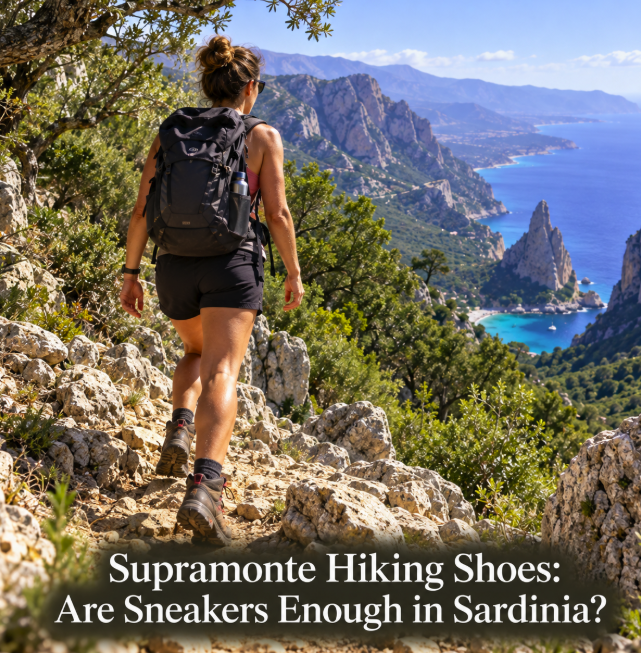
If the Supramonte is part of your Sardinia itinerary, ordinary city sneakers should not be your default hiking footwear. This limestone mountain region is full of loose rock, uneven paths, steep descents and dry surfaces that can become surprisingly slippery. For established hikes, a lightweight hiking shoe or trail shoe with a genuinely grippy sole is the most versatile choice. Heavy backpacking boots are not compulsory for every route, but smooth-soled fashion sneakers are a poor substitute.
The distinction becomes especially clear at Cala Goloritzé. The official Baunei tourism service states that closed-toe shoes with good grip are compulsory on the trail and explicitly says hiking footwear is preferable. That is useful guidance for the Supramonte more generally: choose shoes according to the terrain, not according to how short the hike looks on a map.
Why the Supramonte is hard on footwear
The Supramonte is not a single maintained park trail. Around Baunei, Urzulei, Dorgali and Oliena, routes cross limestone plateaus, gorges, old mule tracks, woodland and rocky descents toward the sea. Some trails are clearly marked and accessible to regular hikers; others require experience, navigation skills or a guide.
Baunei's municipal tourism service describes its Supramonte as a network of natural paths through limestone uplands, canyons and gorges. It advises visitors to choose routes according to their physical and technical ability, use a local guide for more demanding itineraries and carry clothing and equipment appropriate to the length and difficulty of the hike.
Footwear matters because limestone is unforgiving. A shoe with good tread improves traction on loose stones and polished rock, while a firmer sole protects the foot better than a thin casual sneaker when walking for hours over irregular surfaces.
Cala Goloritzé: sneakers need to pass the grip test
The hike from Su Porteddu on the Golgo plateau to Cala Goloritzé is one of the most popular introductions to the Baunei Supramonte. The current official route information gives a distance of roughly 3.5–3.6 kilometres each way and about 500 metres of elevation difference. The descent takes around an hour and a half for many visitors, while the return climb is commonly estimated at about two hours.
For this trail, Baunei's official guidance requires closed shoes with good grip and recommends hiking shoes. It also tells hikers to carry a substantial supply of water; another official route page specifies at least two litres per person.
So can you wear sneakers? A sturdy trail-running shoe with an aggressive outsole may satisfy the practical requirement very well. A flat fashion sneaker, canvas shoe or worn running shoe with little tread does not. The category printed on the shoebox matters less than traction, support, fit and condition.
Do not plan to hike down in flip-flops simply because the destination is a beach. Pack sandals separately if you want them at the water.
Gorropu and longer Supramonte hikes
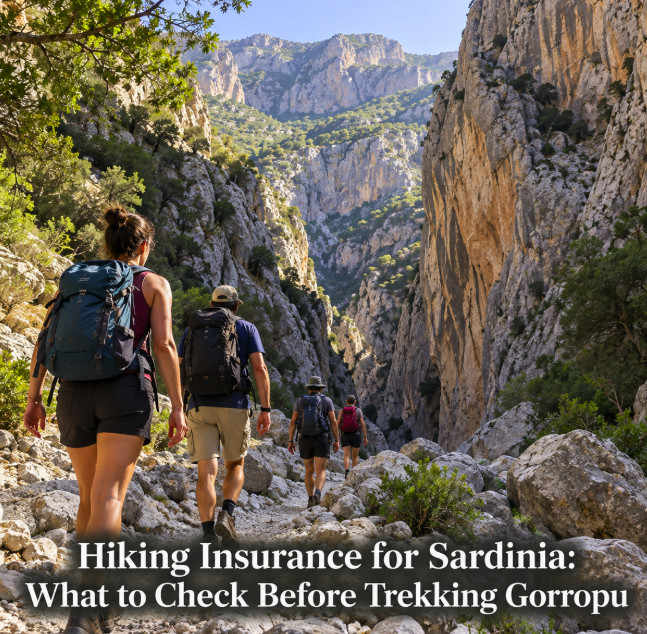
Gorropu offers routes of different difficulty, and the official concessionaire currently advertises easy, panoramic and expert-level excursions both with and without guides. The canyon environment includes rocks and uneven ground, while approach routes can turn the visit into a substantial day on foot.
For Gorropu and longer Supramonte days, proper hiking shoes or trail shoes are the sensible baseline. Mid-height boots can be worthwhile for hikers who prefer ankle support, carry a heavier pack or know that their ankles fatigue easily, but a boot is not automatically safer simply because it is taller.
For advanced itineraries such as sections associated with Selvaggio Blu, footwear is only one part of the equipment question. Baunei lists some Supramonte excursions as routes for experienced hikers and recommends expert guidance where appropriate. Those trips should not be approached as ordinary sneaker-friendly coastal walks.
Trail runners versus hiking shoes
Trail-running shoes are a good option for experienced hikers who prefer light footwear. Look for deep tread, secure heel hold and enough underfoot protection for sharp limestone. They dry quickly and are comfortable in hot weather.
Low hiking shoes are arguably the easiest recommendation for a first Supramonte trip. They provide a more protective sole and durable upper without the weight and heat of a full boot.
Mid-height hiking boots make sense for rougher itineraries, cooler or wet conditions, heavier packs or hikers who simply feel more stable in them. In summer, however, waterproof boots can feel hot, so breathability deserves consideration.
Ordinary road-running shoes vary enormously. A relatively new pair with decent tread may cope with an easy dry path, but road soles are designed for pavement rather than loose limestone. If you already know that several serious hikes are on the itinerary, bringing purpose-built trail footwear removes the uncertainty.
What else to pack for the Supramonte
Footwear gets most of the attention, but water is just as important. Many routes are exposed and can be strenuous on the return climb. For Cala Goloritzé, the official Baunei information specifically calls for a substantial water supply, with guidance of at least two litres per person on its detailed trail page.
Carry sun protection, a hat, food, a charged phone and an offline map or route information appropriate to the hike. A small first-aid kit and blister treatment weigh very little. Trekking poles can help on long descents if you are accustomed to using them, but they are not a replacement for appropriate shoes.
Do not rely on finding drinking water along a remote route unless the current official information for that specific trail confirms it. Likewise, mobile coverage should not be treated as guaranteed in every gorge or mountain section.
Heat changes the difficulty
A trail that feels moderate on a cool spring morning can become much harder in summer. The official Cala Goloritzé service encourages hikers to reach the trail entrance by 10:00 to reduce exposure during the hottest hours and to make the most of the permitted access period.
Check the weather before leaving and be prepared to change plans in extreme heat, storms or other adverse conditions. Starting early is useful, but it does not make an unsuitable route safe.
New hiking shoes can also create their own problem. Do not make a steep Supramonte trek the first day you wear them. Break them in at home, use the socks you intend to hike in and make sure there are no pressure points before traveling.
The simple packing answer
If your Sardinia holiday consists of towns, beaches and short viewpoints, comfortable sneakers are fine. If you intend to hike in the Supramonte, pack one pair of shoes designed for trails.
For most visitors, that means lightweight hiking shoes or good trail runners with closed toes and a grippy outsole. You do not need expedition boots for Cala Goloritzé simply because it is in the mountains, but you do need footwear that can handle loose limestone, elevation and several hours of walking.
Think of it as a small packing compromise: one pair of proper trail shoes takes more suitcase space than casual sneakers, but it opens up some of Sardinia's most memorable landscapes with far greater comfort and confidence.