High in the hills of central Sardinia, beneath the granite slopes of Monte Ortobene, Nuoro has a history unlike that of the island’s coastal capitals. Its story is not primarily one of harbours and foreign fleets, but of pastoral communities, medieval neighbourhoods, struggles over land and an extraordinary literary tradition. Often called the cultural heart of Sardinia, Nuoro is the birthplace of Nobel Prize-winning novelist Grazia Deledda and a gateway to the traditions of Barbagia.
Ancient roots before the medieval town
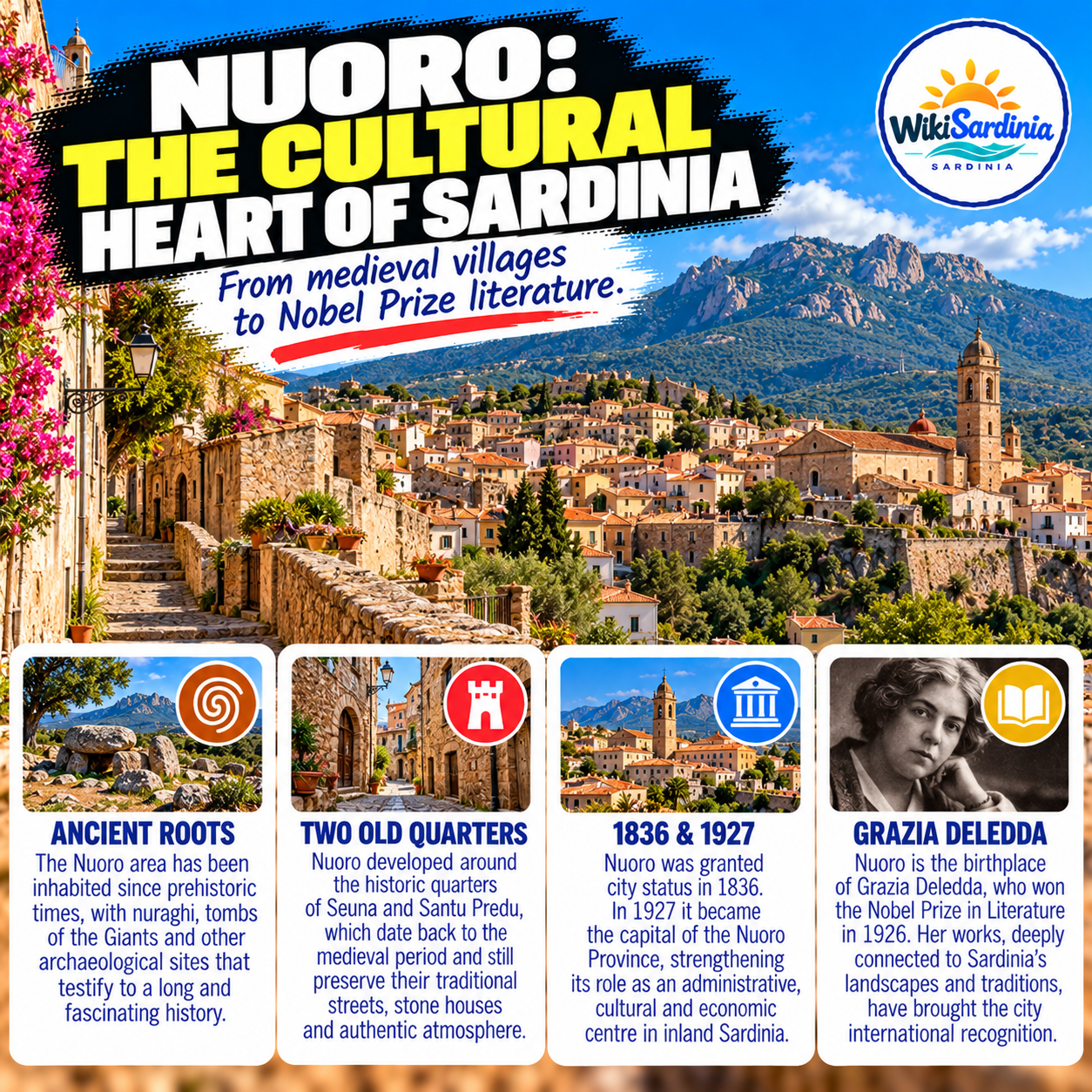
The Nuoro area was inhabited long before the town took its present form. Archaeological remains in the surrounding territory, including nuraghi and prehistoric settlements, show the region's long human history. Finds associated with the Roman period have also been identified near Ribu de Seuna. However, this does not mean the present-day city was founded by the Romans: its recognisable urban identity emerged much later.
Two neighbourhoods that became a town
Medieval Nuoro developed around Sèuna and Santu Predu (San Pietro), the historic quarters that still shape its identity. Sèuna was traditionally associated with farmers, while Santu Predu was associated with shepherds and pastoral families. Narrow lanes, stone houses and religious landmarks recall the older settlement. Medieval records preserve several spellings of its name, including Nugoro, Nuro and Nuru. The village belonged to the Giudicato of Torres, within the curatoria of Dore-Orotelli, before subsequent political changes in medieval Sardinia.
Aragonese rule and the centuries of feudalism
Like much of inland Sardinia, Nuoro experienced the expansion of Aragonese power and the long period of feudal administration that followed. Life remained closely tied to grazing, farming, seasonal rhythms and local networks of kinship and exchange. Its position inland, away from the main ports, helped preserve strong cultural traditions, although the community was never completely isolated from the wider island.
From mountain village to recognised city
Nuoro's administrative role expanded under the House of Savoy. In 1779 it became the seat of the re-established diocese of Galtellì, and in 1807 it was chosen as a prefectural judicial centre. On 15 November 1836, a royal decree elevated Nuoro to the rank of city. It became an administrative divisional centre in 1848, but reforms in 1859 reduced its status. The changing designations show how Nuoro's role within Sardinia evolved rather than following a simple path of uninterrupted growth.
1868: the revolt of Su Connottu
One of the most dramatic chapters in Nuoro's history came in April 1868. During the uprising remembered as Su Connottu — roughly, 'the old customary ways' — local people protested the enclosure and division of communal land. The conflict was linked to longstanding tensions over land rights, access and the consequences of changing property systems. Protesters attacked municipal offices and destroyed land-allocation records. The revolt is associated in local memory with Paskedda Zau, a woman remembered for her role in the protests. Its legacy remains a symbol of resistance to the loss of communal rights.
How Nuoro became Sardinia's literary capital
At the turn of the twentieth century, Nuoro was still a relatively small agro-pastoral town, yet it produced an astonishing generation of writers and artists. Grazia Deledda, born here in 1871, drew on Sardinian landscapes, customs, moral dilemmas and family life in her novels. She received the 1926 Nobel Prize in Literature, becoming one of the best-known Sardinian authors internationally. Poet Sebastiano Satta, novelist and jurist Salvatore Satta, and sculptor Francesco Ciusa also helped establish Nuoro's reputation as a centre of artistic and intellectual life.
Deledda's childhood home in Santu Predu is now the Museo Deleddiano, where visitors can discover objects, documents and stories connected with her life. The museum is an especially rewarding stop for readers interested in the relationship between literature and place.
1927: Nuoro becomes a provincial capital
In 1927, Nuoro became the capital of a newly established province, marking a major turning point in its modern development. Administrative offices, public buildings and new neighbourhoods expanded the city beyond its historic core. The twentieth century brought improved connections, new employment and the growth of education and services, although pastoral culture remained central to local identity.
Nuoro today: museums, granite mountains and living traditions
Modern Nuoro combines its role as an inland administrative centre with an unusually rich cultural life. The Museo del Costume (Sardinian Museum of Ethnography) explores traditional clothing and everyday customs, while MAN focuses on art. Piazza Sebastiano Satta, redesigned by artist Costantino Nivola, offers an original tribute to the city's poet. The historic streets of Sèuna and Santu Predu remain essential for understanding the town's roots.
Just outside the city, Monte Ortobene offers granite scenery, walking areas and views across central Sardinia. For travellers seeking a different side of the island, Nuoro is a place to discover literature, mountain landscapes, craft traditions and the deeper history of Barbagia rather than beaches alone.
Why Nuoro matters
Nuoro's story explains how a relatively small inland settlement became a city of major cultural importance. From its medieval quarters and nineteenth-century land struggles to Grazia Deledda's Nobel Prize, it represents a Sardinia shaped as much by its people and ideas as by its monuments. Spend time in its streets and museums, and the island's interior begins to tell its own remarkable story.