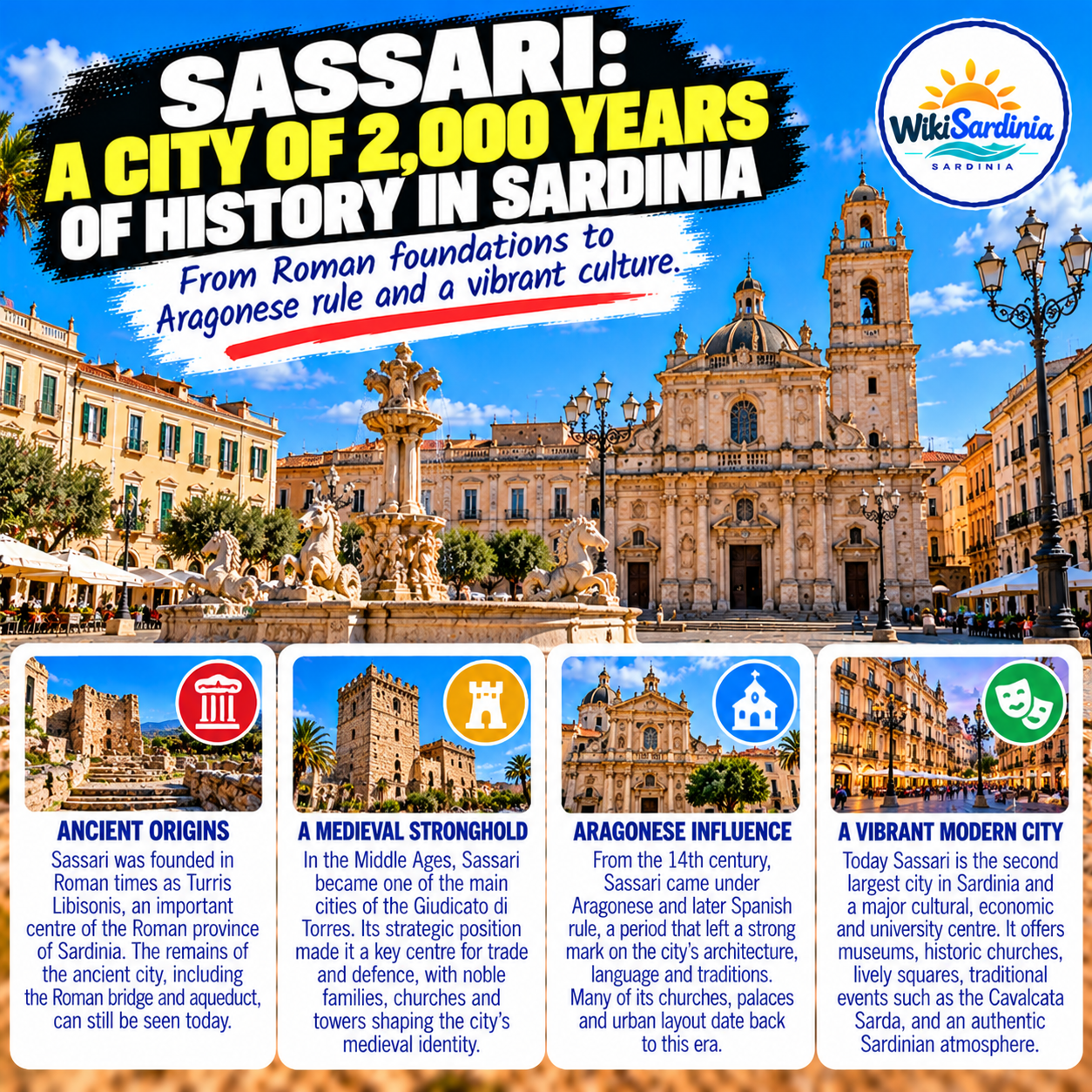
Sassari, one of Sardinia's largest cities, has a story shaped by medieval independence, maritime trade, universities, epidemics, political struggles and enduring traditions. Unlike some ancient Sardinian towns, Sassari did not originate as the Roman city of Turris Libisonis: that settlement was located at today's Porto Torres, on the coast. Sassari emerged as an important urban centre in the Middle Ages, and its rise is one of northern Sardinia's most fascinating historical stories.
Before Sassari: prehistoric settlements and Roman Turris Libisonis
The territory around Sassari has been inhabited since prehistoric times, as the region's nuraghi, tombs and other archaeological sites demonstrate. During the Roman period, the major urban and port centre in this part of the island was Turris Libisonis, modern Porto Torres, linked to the surrounding countryside by roads and trade. Roman remains in Porto Torres include a bridge and baths. These monuments belong to the nearby coastal city, not to a Roman foundation of Sassari itself.
The medieval birth of Sassari
The first written references to Sassari date to the twelfth century. Its growth was connected with the political world of the Giudicato of Torres and the changing settlement pattern of northern Sardinia. As the older coastal centre declined in importance, Sassari developed inland as a commercial and administrative hub. Its location made it useful for agricultural exchange and connections with the port of Porto Torres.
The free commune and the Statutes of Sassari
During the thirteenth century, Sassari developed institutions associated with a self-governing commune. The city experienced strong influence from Pisa and later Genoa, but its civic identity was also expressed through local institutions and laws. The celebrated Statutes of Sassari, preserved in a vernacular Sardinian version from 1316, are an exceptional source for medieval legal and everyday life. They regulated aspects of commerce, property, public order and civic responsibilities.
Medieval Sassari was defended by substantial walls, with gates and towers controlling entry. Surviving traces and historical documents help reconstruct a city that was far more than a collection of rural villages.
Aragonese conquest and Spanish rule
In the fourteenth century, the Crown of Aragon expanded into Sardinia. Sassari came under Aragonese control in 1323, but tensions and uprisings continued during the following years. The city experienced political instability as competing Sardinian, Genoese and Aragonese interests struggled for influence. Under later Spanish rule, religious institutions, architecture and civic life changed, while Sassari retained its role as a major northern urban centre.
Plague, churches and the growth of the city
Like many Mediterranean cities, Sassari suffered devastating epidemic outbreaks, including plague during the early modern period. Its urban history is also visible in religious buildings. The Cathedral of San Nicola, whose facade reflects later Baroque rebuilding, stands on the site of earlier churches and embodies centuries of architectural change. The city's streets and palaces preserve further traces of its medieval and early modern development.
1562 and the origins of the University of Sassari
Sassari became an important centre of learning. Its university traces its origins to a college established in 1562 through the initiative and legacy of Alessio Fontana, a Sassari official associated with the Spanish court. The institution subsequently gained university privileges and developed into one of Sardinia's principal centres of higher education. Its history helps explain why Sassari remains a university city today.
From the House of Savoy to modern Italy
Sardinia passed to the House of Savoy in 1720. During the eighteenth and nineteenth centuries, Sassari experienced administrative reform, new infrastructure and the gradual expansion of modern civic institutions. After Italian unification in 1861, it continued to grow as an economic, educational and cultural centre of northern Sardinia. The city was affected by the upheavals of the twentieth century but retained its distinctive local traditions and language.
The Faradda: Sassari's remarkable Candelieri festival
One of Sassari's best-loved traditions is the Faradda di li Candareri, the Descent of the Candlesticks, held each year on 14 August. Representatives of traditional guilds carry enormous decorated wooden columns through the streets in a celebration connected with devotion to the Virgin Mary and the memory of deliverance from plague. The event belongs to the UNESCO-recognised network of Italian celebrations of large shoulder-borne processional structures. It is a striking example of how the city's historical guild culture continues in public life.
What to see in Sassari today
Begin at Piazza d'Italia, the monumental nineteenth-century square, then explore the old town and the Cathedral of San Nicola. Visit the Fontana di Rosello, a celebrated early seventeenth-century fountain and one of Sassari's symbols. The National Archaeological and Ethnographic Museum G. A. Sanna introduces visitors to the wider region's prehistoric, ancient and traditional heritage. For an excursion, nearby Porto Torres offers Roman archaeology that complements Sassari's medieval history.
Why Sassari's history is special
Sassari's identity is not defined by one ancient empire. Its story is that of a medieval city that built its own institutions, navigated the ambitions of Mediterranean powers and developed a powerful cultural life. From its medieval statutes and university to the Candelieri procession, Sassari offers visitors a rich perspective on Sardinia beyond the beaches.