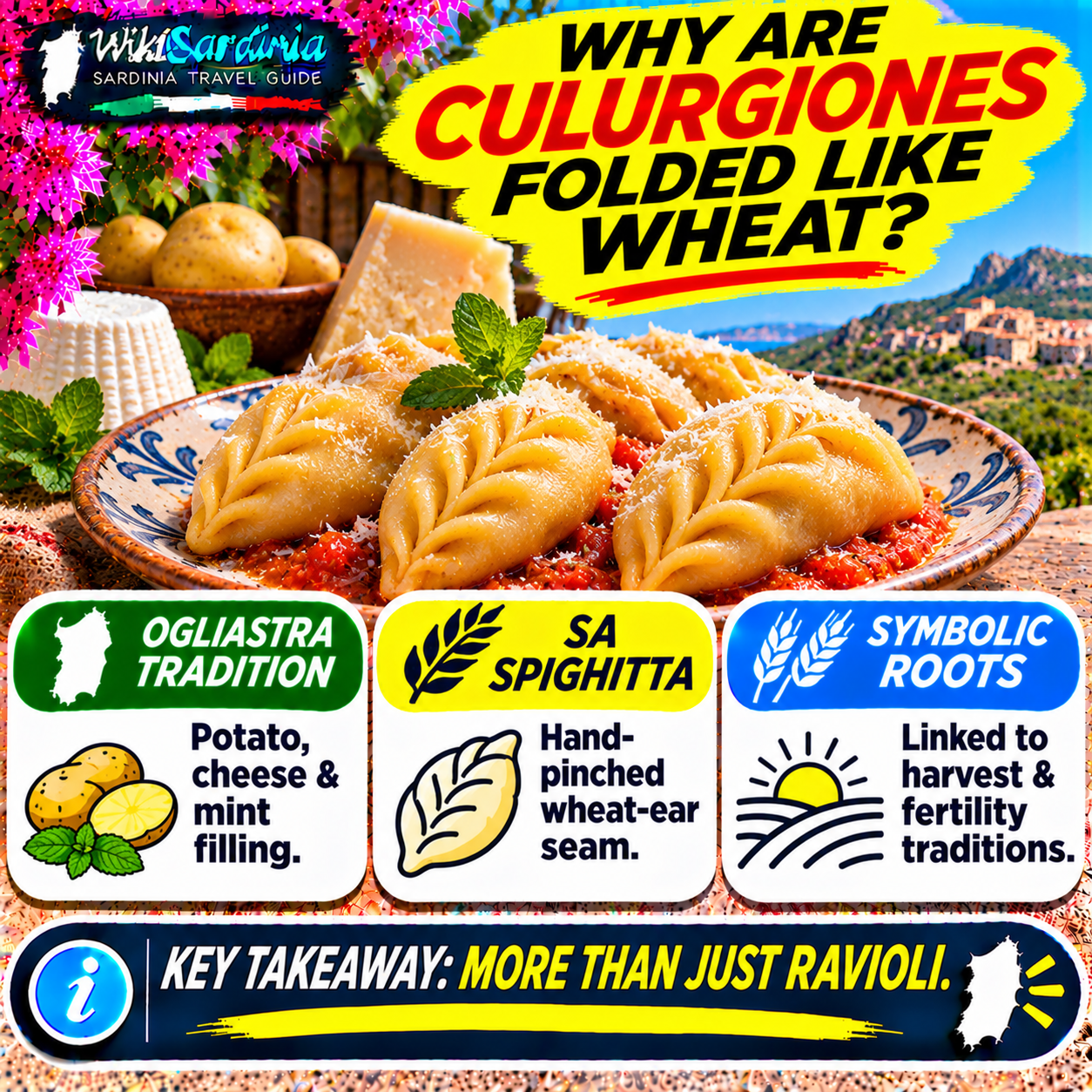
If you order culurgiones in Sardinia, look closely at the seam. These little parcels of pasta are not simply folded shut like ordinary ravioli. Along one edge, tiny overlapping pinches form a delicate pattern resembling an ear of wheat. Sardinians call this distinctive hand-sewn closure sa spighitta—literally, the little ear of grain.
Culurgiones, also written culurgionis, are a traditional stuffed pasta associated especially with Ogliastra, the mountainous and coastal region of eastern Sardinia. Their familiar filling combines potatoes, local cheese and aromatic herbs, often mint. The braided seal is both practical, holding the filling inside during cooking, and a recognizable expression of the area's food heritage. The protected product, Culurgionis d'Ogliastra IGP, is officially described in European Union documentation as a hand-closed bundle with a stylized wheat-ear seam.
What exactly are culurgiones?
Think of a soft, generously filled pasta parcel, usually larger than a typical raviolo, with a slightly elongated shape and a raised plait down one side. The dough is traditionally made with durum wheat semolina and water, sometimes with flour or a little fat depending on the family recipe. Inside is a creamy mixture of cooked potatoes and cheese, commonly seasoned with mint, garlic or other local aromatics.
There is no single filling used in every Sardinian home. The EU specification allows variations in cheeses, fats and flavorings, reflecting the different traditions of Ogliastra's villages. The protected Culurgionis d'Ogliastra IGP designation applies only to pasta produced within the specified geographic area and according to the official requirements. Homemade culurgiones elsewhere are still delicious, but they should not automatically be described as certified IGP products.
Why are they folded like an ear of wheat?
The answer begins with the name sa spighitta. The seam is made by pinching one side of the pasta over the filling, then the other, repeatedly, so the overlapping folds resemble the grains on a wheat ear. It is not a pattern stamped by a machine or pressed with a fork. It is created with the fingers, one small movement at a time.
In Ogliastra's agricultural traditions, wheat has long been associated with food, harvest and the continuity of family life. Local storytelling also connects the culurgione's shape with good fortune, abundance and protection. Some accounts describe the pasta as a symbolic gift or a food prepared for significant occasions. These meanings belong to the region's living oral and cultural traditions; they should not be treated as one universally documented origin story shared by every village.
The historical evidence is firmer on the shape and technique. The EU's official product specification explicitly identifies the wheat-ear closure as the distinctive feature linking Culurgionis d'Ogliastra to their place of origin. It describes the alternating left-and-right pinches as an elaborate manual skill comparable to stitching or embroidery.
How to make traditional-style culurgiones at home
This approachable home recipe makes approximately 24–30 pieces, enough for four people as a generous first course. Quantities and timings are practical kitchen guidance, not a claim to reproduce every village's traditional recipe or the certified IGP production method.
Ingredients for the pasta dough
- 300 g fine durum wheat semolina (semola rimacinata)
- Approximately 140–160 ml lukewarm water, added gradually
- 1 tablespoon extra-virgin olive oil, optional
- 1 small pinch of salt
Ingredients for the filling
- 500 g potatoes
- 120–150 g finely grated Sardinian pecorino, adjusted to taste
- 8–12 fresh mint leaves, finely chopped
- 1 small garlic clove, finely minced or gently infused in oil
- 1–2 tablespoons extra-virgin olive oil
- Salt and black pepper, only as needed
For serving
- A simple tomato sauce or melted butter
- Extra grated pecorino
- Optional fresh mint leaves
Step 1: Prepare the potatoes
Boil the potatoes until tender, usually around 20–30 minutes depending on size. Drain thoroughly, peel when safe to handle and mash until smooth. Avoid adding milk or too much liquid: the filling should be soft but firm enough to hold its shape.
Step 2: Mix the filling
Combine the mashed potatoes with pecorino, mint, garlic and olive oil. Taste before adding salt, since pecorino may already be salty. Leave the mixture to cool completely. A warm or watery filling makes the dough harder to seal.
Step 3: Make and rest the dough
Mix the semolina with salt and gradually work in the water, adding the optional olive oil. Knead for approximately 8–10 minutes until the dough is smooth, cohesive and elastic. Cover and rest for at least 30 minutes so it becomes easier to roll without springing back.
Step 4: Roll and cut
Roll the dough into a thin, even sheet, approximately 1–2 mm thick. Use a round cutter or glass to make circles about 7–8 cm across. Keep unused dough covered to prevent drying. Put roughly one heaped teaspoon of filling in the middle of each circle, leaving enough uncovered edge for the closure.
How to fold the spighitta: step by step
This is the part that makes culurgiones unmistakable. It takes practice, and your first attempts may look more like little leaves than perfect wheat ears. That is normal.
- Hold the pasta upright. Place a filled circle in your non-dominant hand, gently cupping it so the filling stays centered.
- Start at one end. Pinch together a small section of dough at the bottom to anchor the seam.
- Fold from one side. With the thumb and forefinger of your other hand, bring a tiny flap of dough from the left toward the center.
- Alternate to the other side. Bring a similarly small flap from the right over the previous fold, slightly overlapping it.
- Repeat in a rhythm. Continue left, right, left, right, moving upward while gently supporting the filling.
- Finish the tip. Pinch the remaining dough together firmly to close the final opening. The overlapping folds should resemble a little braided wheat ear.
Keep the dough pliable but not wet. If the edges are drying out, cover the remaining circles and work in smaller batches. Avoid overfilling, which can make the seam burst open. For the protected IGP version, the official specification requires at least ten pinches in the wheat-ear closure; home cooks can use that as a useful reference for the fineness of the pattern.
How long should culurgiones cook?
Bring a large pot of salted water to a gentle boil. Lower in the culurgiones carefully and stir only enough to prevent sticking. Fresh homemade pieces often cook in about 4–6 minutes, but the exact time depends on dough thickness, size and filling temperature. They may float before they are fully cooked, so taste one and check that the dough is tender and the center is hot.
Lift them out with a slotted spoon rather than pouring them roughly into a colander. Toss gently with a light tomato sauce and pecorino, or with butter and a little mint. A heavy sauce can overwhelm the potato, cheese and herb flavors that make the filling special.
What does the authentic Ogliastra filling taste like?
The combination is comforting but surprisingly aromatic. Potato provides a mild, creamy base; pecorino adds saltiness and depth; mint or other herbs bring freshness. Some traditional recipes use more pungent local cheeses or different seasonings, producing a sharper, slightly tangy flavor.
The official IGP specification describes the filling as aromatic and sometimes pleasantly acidic, with the sweetness of potato balancing the cheese. If you have only tasted supermarket ravioli, the contrast is worth discovering: culurgiones can be rich without relying on meat or a complicated sauce.
Are all Sardinian culurgiones the same?
No. Different communities use different fillings and, in some cases, different shapes. Ogliastra is particularly associated with the elaborate spighitta seam, but Sardinian stuffed pasta traditions extend beyond one village and one standardized recipe. Ingredients historically reflected what families could grow, make or obtain locally.
For travelers, the best approach is to ask which local style is being served. A restaurant in Tortolì may prepare them differently from a family in a mountain village such as Arzana or Lanusei. These differences are part of the appeal, not evidence that one home recipe must be wrong.
What does IGP mean on a packet or restaurant menu?
IGP stands for Indicazione Geografica Protetta, or Protected Geographical Indication (PGI) in English. The European Union registered Culurgionis d'Ogliastra as a protected product in 2016. The designation ties the name to a defined production area and specification, including the characteristic shape, filling and hand-formed seam.
Under the specification, individual IGP culurgiones weigh between 20 and 33 grams, and the wheat-ear seam includes at least ten closing pinches. A homemade culurgione can be traditional and excellent without being certified. If the protected designation matters to you, look for the full product name and the official PGI/IGP labeling rather than relying on appearance alone.
Where should visitors try culurgiones in Sardinia?
For the strongest connection to their place of origin, look for traditional restaurants, agriturismi and pasta makers in Ogliastra. Towns such as Tortolì, Lanusei, Bari Sardo, Baunei and Arzana are useful starting points when exploring the region. Ask whether the culurgiones are made by hand, which filling is used and whether they are served in a local style.
You can also find culurgiones in restaurants elsewhere on the island, including Cagliari, Alghero and Olbia. Outside Ogliastra, the menu may simply say culurgiones; that does not by itself indicate whether the pasta is certified IGP. Menus and availability change, so check with the restaurant before making a special journey.
Common mistakes when making culurgiones
- Too much filling: leaves too little dough for the braid and can cause leaks.
- Dry pasta circles: crack instead of folding. Cover unused dough while working.
- Wet filling: softens the seam and makes it difficult to seal. Drain the potatoes well.
- Thick dough: makes the finished pasta chewy and the braid bulky.
- Boiling too aggressively: can break delicate fresh pasta. Use a steady but gentle boil.
- Expecting perfection immediately: the wheat-ear closure is a learned hand skill. Make a few practice pieces before preparing the whole batch.
Frequently asked questions
What are culurgiones made of?
They are stuffed pasta parcels made with a semolina-based dough and a filling commonly containing potatoes, pecorino or other local cheese, mint and sometimes garlic or other aromatics. Recipes vary across Sardinia.
Why do culurgiones look like wheat?
The seam, called sa spighitta, is made by alternating hand pinches to resemble an ear of wheat. It is both a distinctive sealing technique and a cultural symbol connected in local tradition with agriculture, abundance and good fortune.
Is the wheat-ear closure required for IGP culurgiones?
Yes. The official specification for Culurgionis d'Ogliastra IGP describes a hand-made wheat-ear seam and requires at least ten pinches. This applies to the protected product, not necessarily every homemade stuffed pasta variation in Sardinia.
Are culurgiones vegetarian?
Many recipes are meat-free, but they are not automatically suitable for all vegetarians. Some traditional variations use animal fats, and cheeses made with animal rennet may be unsuitable for strict vegetarians. Ask about the ingredients if this matters to you.
Are culurgiones vegan or gluten-free?
Traditional versions contain wheat and cheese, so they are neither gluten-free nor vegan. Adapted recipes exist, but they should not be confused with the traditional or IGP specification.
Can I freeze homemade culurgiones?
Yes. Arrange them separately on a lightly floured tray, freeze until firm, then transfer to a freezer-safe container. Cook directly from frozen, allowing extra time and checking that the center is thoroughly hot.
How are culurgiones different from ravioli?
Both are stuffed pasta, but culurgiones are especially associated with a potato-and-cheese filling and a distinctive braided closure resembling wheat. Their shape and cultural context make them a recognizable Ogliastra specialty.
Where do culurgiones come from?
They are a traditional Sardinian food particularly associated with Ogliastra, on the eastern side of the island. The protected Culurgionis d'Ogliastra IGP name refers to production in a defined geographic area.
A little wheat ear with a big story
The beauty of culurgiones is that a simple combination of flour, potato and cheese becomes something instantly recognizable through a skilled gesture. The spighitta is a seal, a decorative craft and a reminder of the agricultural world from which the dish emerged. Whether you learn to fold one yourself or taste them in Ogliastra, take a moment to look at the braid before your first bite: it is the detail that carries the story.
Sources
- European Union — Culurgionis d'Ogliastra PGI product specification (2019).
- Gazzetta Ufficiale della Repubblica Italiana — Culurgionis d'Ogliastra production specification.
- Regione Sardegna — Traditional regional foods, fresh pasta and culurgiones.
- La Cucina Italiana — Culurgiones recipe and folding technique.