You have finished a wonderful dinner in Sardinia. Perhaps it was seafood by the sea in Alghero, roast meat in a village trattoria, or a long family meal featuring pecorino and traditional pasta. Then your host brings a tiny glass filled with a dark ruby-coloured drink. “Mirto?” they ask. What exactly is it—and are you supposed to drink it before or after dinner?
The short answer: mirto is a traditional Sardinian liqueur, and it is most commonly enjoyed after a meal. It is part of the island’s hospitality culture, but it is not a compulsory ritual, and you can always decline.
What is mirto?
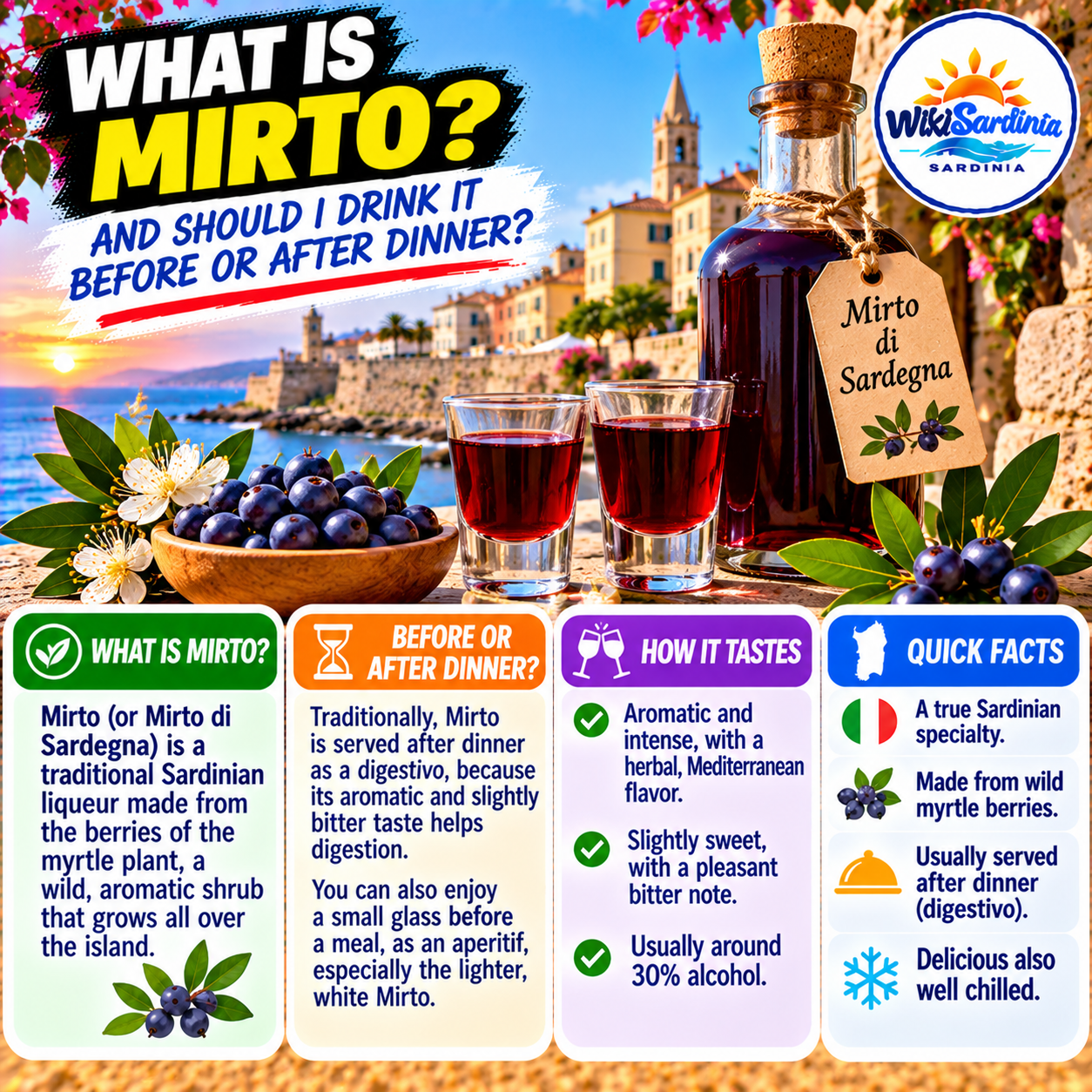
Mirto is a liqueur associated especially with Sardinia, made by infusing parts of the common myrtle plant (Myrtus communis) in alcohol, then balancing the infusion with water and sugar. Myrtle is an aromatic evergreen shrub found around the Mediterranean. Its leaves and berries carry distinctive herbal fragrances, and the plant has long been part of local landscapes and traditions.
The best-known version, mirto rosso, uses ripe, dark myrtle berries. It typically has a deep red-purple colour, a pronounced herbal aroma and a flavour combining sweetness, gentle bitterness and fruity notes. The exact balance depends on the recipe and producer.
Why is mirto so closely associated with Sardinia?
On Sardinia, myrtle grows in the Mediterranean scrubland known as macchia mediterranea, alongside plants such as lentisk, rosemary and juniper. Its aroma is a familiar part of the island’s countryside. Transforming berries and leaves into a liqueur became a way of bringing that landscape to the table.
Homemade mirto is a recognised tradition in many Sardinian families, with recipes differing in steeping times, sweetness and strength. Commercial producers now sell it throughout the island, making it an accessible souvenir as well as a restaurant staple.
Should you drink mirto before or after dinner?
After dinner is the traditional choice. Mirto is commonly offered as a digestivo, the Italian term for a drink enjoyed at the end of a meal. It may arrive after dessert or alongside coffee, sometimes as a gesture of hospitality from the restaurant or host.
The word digestivo reflects cultural custom, not a medical guarantee. Alcoholic drinks have not been established as a way to improve digestion, and alcohol may worsen digestive symptoms in some people. Enjoy mirto for its flavour and tradition, not as a treatment for a heavy meal.
Can you drink it before dinner? Certainly, if you enjoy it that way. A small serving may be taken as an aperitif, although mirto is much more strongly associated with the end of a meal than with the pre-dinner aperitivo ritual.
Mirto rosso versus mirto bianco
Two names appear frequently on menus and in shops. Mirto rosso is the familiar dark liqueur made from myrtle berries. Mirto bianco is a lighter-coloured variation often made by infusing myrtle leaves or tender shoots, depending on the recipe. It can taste more distinctly herbal and less fruity.
Despite the name, mirto bianco is not white wine. Both are liqueurs, and their alcoholic strength can be substantial. There is no single universal recipe or alcohol percentage: always check the bottle label.
What does mirto taste like?
Imagine an aromatic blend of wild herbs, dark berries and Mediterranean vegetation. Mirto rosso is generally sweet but not simply sugary; it can have an earthy, slightly bitter finish. Some versions are smooth and rounded, while others are more intense and resinous. Mirto bianco often emphasises leafy, botanical notes.
If you enjoy herbal liqueurs, you may find mirto intriguing. If you dislike bitter or aromatic drinks, a tiny taste is enough to decide whether it is for you.
How is mirto served?
Mirto is usually served in a small liqueur glass. Many people prefer it chilled, and some producers recommend serving it very cold. It is meant to be sipped rather than consumed as a large drink. In restaurants, you may receive it in a small individual glass or be offered a choice of digestivi.
Some hosts offer a complimentary glass, but this is not universal. If you are unsure whether it is included in your meal, it is perfectly reasonable to ask.
How strong is mirto?
Mirto is an alcoholic liqueur, not a fruit juice. Bottles commonly fall somewhere around 25–35% alcohol by volume, but strength varies. A small glass can contain a meaningful amount of alcohol, especially after wine with dinner. There is no need to finish a serving to be polite.
For visitors who will be driving, the simplest safe choice is not to drink alcohol. Do not rely on the idea that a small digestivo cannot affect your ability to drive.
Can you buy mirto to take home?
Yes. You can find mirto in supermarkets, speciality food shops, delicatessens and shops selling Sardinian products. Look for the producer, ingredients and alcohol content. If flying, check your airline’s baggage rules and the relevant customs allowances for your destination; alcohol restrictions vary by route and country.
Is mirto only for tourists?
No. Although it is widely marketed as a Sardinian speciality, mirto also belongs to local family and social traditions. Not every Sardinian drinks it, of course, and there is no obligation to participate. Its popularity comes from its connection to the landscape and the familiar custom of lingering at the table after a meal.
Useful Italian phrases
“Un mirto rosso, per favore.” — A red mirto, please.
“Avete anche il mirto bianco?” — Do you also have white mirto?
“È fatto in casa?” — Is it homemade?
“Quanto è alcolico?” — How strong is it?
“No grazie, sto guidando.” — No thanks, I’m driving.
Frequently asked questions
Is mirto an aperitif or a digestif?
It is traditionally served as an after-dinner digestif, although some people enjoy it at other times.
Does mirto actually help digestion?
That is a traditional association, not an established medical benefit. Alcohol may aggravate digestive problems.
Is mirto always red?
No. Mirto rosso is made from dark berries, while mirto bianco is generally based on myrtle leaves or shoots.
Is mirto very sweet?
It can be sweet, but many versions balance sweetness with herbal bitterness and aromatic notes.
Do I have to accept mirto when offered?
Not at all. A polite “No, grazie” is perfectly acceptable.
The Sardinian way to end an evening
Mirto is more than an unusual liqueur on a drinks menu. It carries the scent of Sardinia’s wild shrubs, the ingenuity of homemade recipes and the relaxed pleasure of a meal that does not end the moment the plates are cleared. If you choose to try it, a small glass after dinner is the classic introduction. Sip slowly, enjoy the flavour and remember that the tradition is about hospitality—not obligation.