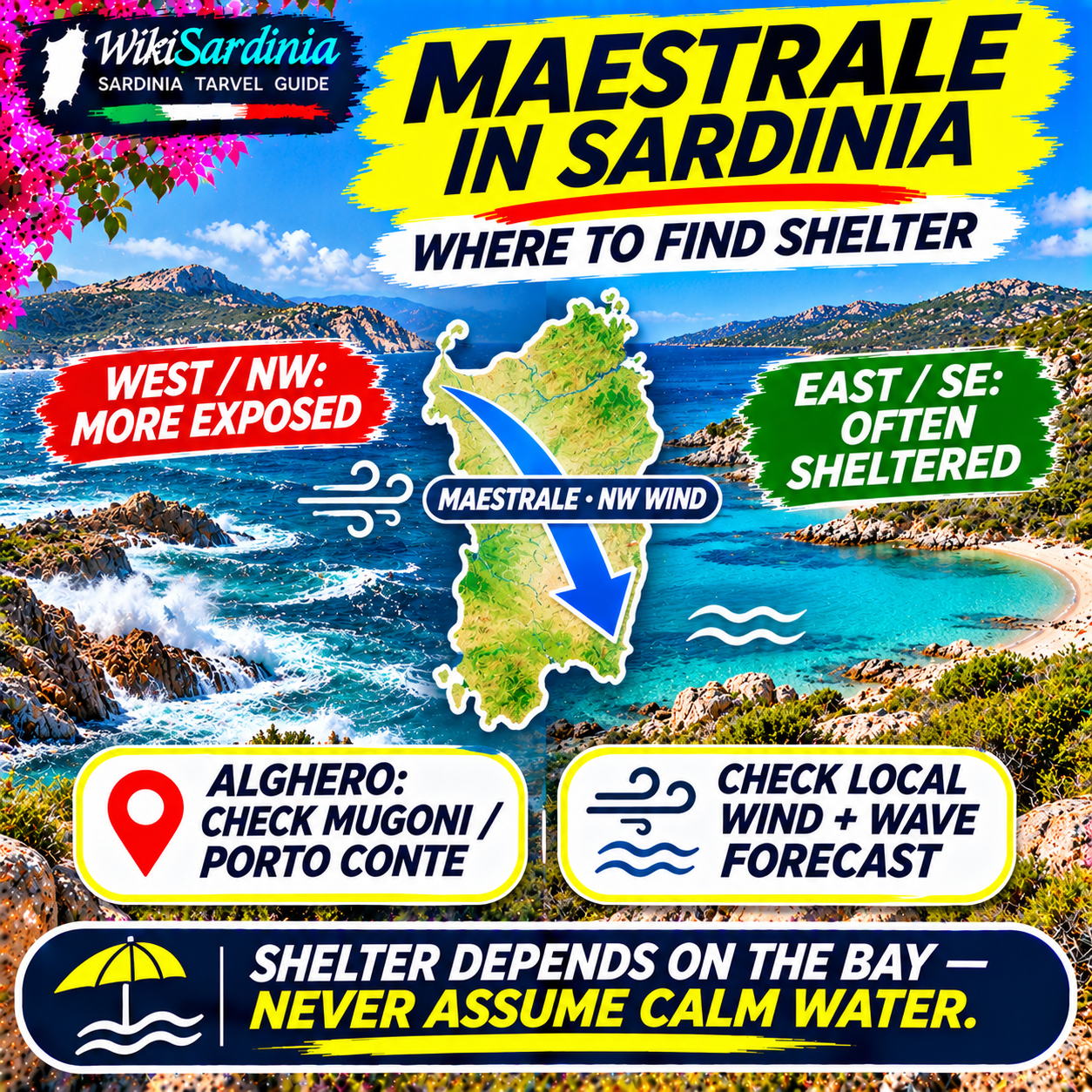
When the Maestrale blows in Sardinia, look first for a beach sheltered from the northwest—not simply for a beach in the south of the island. This northwesterly wind can bring clear skies, fresher air and powerful gusts while making exposed western and northern shores rough. East- and southeast-facing beaches are often better protected, but headlands, hills, offshore waves and the precise wind direction matter. A beach can look sunny and still be unsafe for swimming.
What is the Maestrale?
The Maestrale, called the Mistral in English and French, is a wind blowing from the northwest, conventionally around 315 degrees. It is a familiar feature of Sardinian weather and can occur in summer as well as in cooler months. It often sweeps away humid air, improves visibility and makes hot days feel cooler. But strong episodes may raise dust and sand, make umbrellas difficult to manage and produce rough seas on exposed coasts. Costa Smeralda tourism guide — sheltered beaches.
Which side of Sardinia is usually best?
The east and southeast coasts are a sensible starting point. In many Maestrale conditions, beaches around Olbia, San Teodoro, parts of the Costa Smeralda, Ogliastra and the southeastern coast benefit from land shelter or a shorter stretch of open water facing the wind. The west and northwest coasts often receive more direct wind and waves. However, these are tendencies, not guarantees: a local bay can funnel gusts, and residual swell can arrive from a different direction. Check a beach-specific wind and wave forecast before driving across the island.
What happens to the weather during a Maestrale?
Typical effects include clearer skies, reduced humidity, a drop in perceived temperature, gusty conditions and more pronounced waves on windward shores. Strong gusts can blow fine sand into faces and make inflatable toys or beach umbrellas hazardous. The wind can persist beyond a single afternoon, but there is no dependable rule that every episode lasts exactly three days. A sunny forecast is not proof of calm sea conditions.
Where should you go if you're staying in Alghero?
Try the Porto Conte area before considering a long cross-island drive. Mugoni, on the sheltered side of Porto Conte Bay, is a commonly recommended alternative to more exposed sections of Alghero's coast. The smaller Tramariglio area may also be worth checking depending on wind and wave direction. This is a conditional recommendation: strong gusts can still reach these bays, and wind shifts may change the picture. Do not assume Bombarde, Lazzaretto or the urban seafront will always be calm merely because they are near Alghero. Local guide — Porto Conte alternatives.
What about Stintino and La Pelosa?
Stintino's peninsula creates sharply different exposures. La Pelosa and some beaches on the Gulf of Asinara side can be relatively sheltered compared with the open western shore, but strong Maestrale gusts may still make the fine sand uncomfortable and the water unsuitable. Beaches on the Mar di Fuori side face more direct westerly wave action. Check conditions locally, and remember that La Pelosa has seasonal visitor-access rules that are separate from the weather. Stintino coastal exposure guide.
Best places around Olbia and the Costa Smeralda
Consider Porto Istana and other east-facing coves around Olbia and Capo Ceraso, plus selected sheltered beaches near Golfo Aranci and the Costa Smeralda. Their orientation can reduce direct exposure to northwesterly waves. Porto Cervo and the northern Gallura coast are not uniformly sheltered: a cove facing north or northwest can remain uncomfortable even when another beach a short drive away is pleasant. Check the specific beach, not just the resort name. Gallura beach-by-beach wind guide.
Is San Teodoro a good choice during Maestrale?
Often, yes, especially at more protected coves near Capo Coda Cavallo. Cala Brandinchi and Cala Suaraccia are frequently recommended because the headland can offer shelter. But broad beaches such as La Cinta and some stretches of Lu Impostu may still experience strong sand-blowing gusts or difficult local conditions. The shape of the coastline matters as much as the general compass direction. Certain popular beaches also require advance reservations during their regulated summer season; verify access separately. Local San Teodoro guide — beach exposure.
What about Cala Gonone, Cala Luna and the Gulf of Orosei?
The eastern Gulf of Orosei coast can offer spectacular shelter from some northwesterly winds because of its high limestone cliffs. Yet the sea and the boat route may be unsafe even when a particular cove appears calm. Boat excursions can be changed or cancelled because of wind, swell or difficult landing conditions. Never assume a sheltered-looking beach guarantees safe boat access or a return crossing. Follow the operator's decision and check marine forecasts before hiking to a beach with a planned boat return.
Where should you go in southeast Sardinia?
In the Villasimius and Costa Rei area, look for coves sheltered by hills or promontories and facing away from the northwest. Cala Pira, Porto Sa Ruxi and some smaller bays around Villasimius can be worth evaluating. The broad beaches of the area may behave differently from nearby coves, and a beach that is comfortable with Maestrale may be exposed to Scirocco from the southeast. The right choice depends on that day's forecast and exact local orientation.
Are Chia, Pula and the south coast sheltered?
Some south-facing beaches and enclosed coves can offer shelter from a northwesterly wind. Cala Cipolla and parts of the Chia coast are options to investigate, while other beaches may experience crosswinds or swell. Do not assume that every southern beach is sheltered. A change of just a few degrees in coastline orientation or a nearby headland can make a noticeable difference.
Which areas should you be cautious about?
During strong northwesterly winds, pay particular attention to exposed parts of the western and northwestern coasts, including open shores near Buggerru, Portixeddu, Costa Verde and the outer west-facing Stintino coast. These areas can develop rough surf, strong shore break and difficult conditions for casual swimmers. That does not mean every beach there is always unsafe; sheltered coves exist. Use the local forecast, sea state and any lifeguard instructions rather than a blanket island-wide rule.
Can you still swim when the Maestrale is blowing?
Sometimes, but only where the actual sea conditions are safe. Offshore wind can make the water close to shore look deceptively flat while pushing inflatables, paddleboards and swimmers away from land. Onshore wind may create breaking waves and rip currents. A sheltered cove is not automatically safe for children or inexperienced swimmers. Respect red flags, local closures and lifeguard advice. If conditions are uncertain, stay out of the water.
Is the Maestrale good for surfing or windsurfing?
It can create exciting conditions for experienced windsurfers, kitesurfers and surfers at suitable locations, but the same conditions can be hazardous for casual beachgoers. Strong wind, offshore drift, crowded launch areas and changing waves require appropriate skills, equipment and local knowledge. Never launch a paddleboard or inflatable in strong offshore winds just because the water looks smooth close to shore.
How can you read the wind direction?
Weather forecasts describe wind by the direction it comes from. A northwesterly wind blows toward the southeast. On a map, look for beaches whose shoreline and surrounding land block that incoming wind, often east- or southeast-facing bays. Also check whether the sea has a long open fetch toward the northwest, since that can allow waves to build. Use a compass map, a wind forecast and a wave forecast together. Wind arrows and icons can vary between apps, so read the legend.
Where can you check reliable forecasts?
Start with ARPAS, Sardinia's regional environmental agency, which publishes weather and marine bulletins, including wind and wave conditions. The Italian Air Force's Meteo Aeronautica Militare also provides marine-weather information. Apps such as Windy can help visualize the forecast across the coast, but a colourful wind map should be interpreted alongside official warnings and local conditions. Useful starting points: ARPAS meteorological service and Meteo Aeronautica Militare.
How strong is too strong for a beach day?
There is no universal wind-speed cutoff that makes every Sardinian beach safe or unsafe. Gusts, waves, shoreline shape, swimmers' ability and available lifeguards all matter. Even moderate wind can be problematic when it blows offshore, while a sheltered cove may remain pleasant during stronger regional wind. If you see breaking waves, flying sand, struggling swimmers or unsecured umbrellas, reconsider the beach or choose a land-based activity.
What if the wind changes to Scirocco?
Reverse your thinking. Scirocco generally comes from the southeast and can make east- and southeast-facing beaches more exposed. West-facing coves or locations sheltered from southeast wind may then become more comfortable. Do not save a fixed list of “wind-proof beaches” without considering the direction: a perfect Maestrale beach may be a poor Scirocco beach.
Should you change hotels because of Maestrale?
Usually not for a short episode. Sardinia has many different coastal orientations, and it may be easier to drive to a nearby sheltered bay, visit an inland village or plan a museum day than to move accommodation. If you are planning a longer beach-focused holiday and expect to be flexible, staying within reach of several differently oriented beaches can be helpful. Always calculate the real driving time before setting out; a sheltered coast on the other side of the island may be hours away.
What should families with children do?
Choose a beach with verified calm conditions, safe entry to the water and available services rather than relying only on its reputation for shelter. Strong gusts can make beach umbrellas dangerous and blow toys into the sea. Avoid inflatables in offshore winds, supervise children closely and check lifeguard flags. If you cannot find a comfortable, safe beach, switch to a village walk, archaeological site or other sheltered activity.
A simple morning checklist
- Check the wind: is it really Maestrale from the northwest, or has the direction shifted?
- Check gusts: not only the average wind speed.
- Check waves and swell: a beach can be sheltered from wind but still receive waves.
- Compare nearby bays: prioritize protected orientations and headlands.
- Check access: parking, reservations, boat cancellations and local closures.
- Decide on site: if the sea is unsafe, do not enter, regardless of the forecast.
Useful Italian phrases
“Oggi c'è Maestrale?” — Is the Maestrale blowing today? “Quale spiaggia è riparata dal vento?” — Which beach is sheltered from the wind? “Com'è il mare a Mugoni?” — What are sea conditions like at Mugoni? “Il vento soffia da terra o dal mare?” — Is the wind blowing offshore or onshore? “Ci sono onde forti?” — Are there strong waves? “La gita in barca è confermata?” — Is the boat trip still going ahead?
Sources and further reading
ARPAS — Sardinian weather and marine bulletins; Italian Air Force weather service; Costa Smeralda — sheltered beaches during Maestrale; Gallura — beaches sheltered from northwesterly winds; San Teodoro — local beach and wind guide; Alghero and Porto Conte — local alternatives. Beach recommendations describe typical exposure, not real-time guarantees.
The WikiSardinia takeaway
When the Maestrale blows from the northwest, the eastern and southeastern sides of Sardinia often offer better beach conditions—but the best choice is the right bay, not simply the right half of the island. Around Alghero, start by checking Mugoni and Porto Conte. In the northeast, evaluate Porto Istana and protected San Teodoro coves; farther south, look at selected bays near Villasimius. Always check local wind, gust and wave forecasts, and never confuse calm-looking water with safe swimming.