Ogliastra, in eastern Sardinia, is one of the places that helped make the island famous for exceptional longevity. The mountainous inland communities of central-eastern Sardinia were identified by researchers studying unusually high concentrations of people reaching age 100, particularly men. The term Blue Zone refers to a demographically investigated longevity area—not a place where everyone lives to 100, or a scientifically proven formula for immortality. For visitors, the real story is more interesting than a miracle diet: a combination of long-established habits, social relationships, environment and possibly inherited traits.
What is a Blue Zone?
The expression Blue Zone emerged from demographic research by Gianni Pes and Michel Poulain and their collaborators, who mapped Sardinian villages with unusually high longevity. The label later became widely known through books, documentaries and travel coverage about other longevity regions. In Sardinia, the underlying research examined historical birth and death records and sought to verify ages, rather than simply repeating local legends about centenarians. It is important to distinguish this original demographic research from later lifestyle marketing, which can make stronger causal claims than the evidence supports.
Where is Sardinia's Blue Zone?
The classic Sardinian longevity area lies in the mountainous central-eastern interior, encompassing communities in Ogliastra and neighboring Barbagia. Villages frequently associated with the research and the broader Blue Zone story include Villagrande Strisaili, Arzana, Talana, Urzulei, Baunei and Seulo, although administrative boundaries and the precise research-defined area are not identical. Seulo is in the Barbagia di Seulo area, not in today's Ogliastra administrative territory. The label should not be applied automatically to every town in Ogliastra or to the whole island.
Why did researchers focus on this area?
Early research found an unusually high concentration of centenarians in some Sardinian mountain villages, with a particularly noteworthy pattern of male longevity. In many populations, women considerably outnumber men at extreme old age. Researchers used local records and demographic indicators to identify and validate the phenomenon. The observation is significant, but high centenarian concentration does not establish that every habit attributed to local residents causes longer life. Small populations, historical migration and changes over generations also complicate comparisons.
Is there a secret to living past 100?
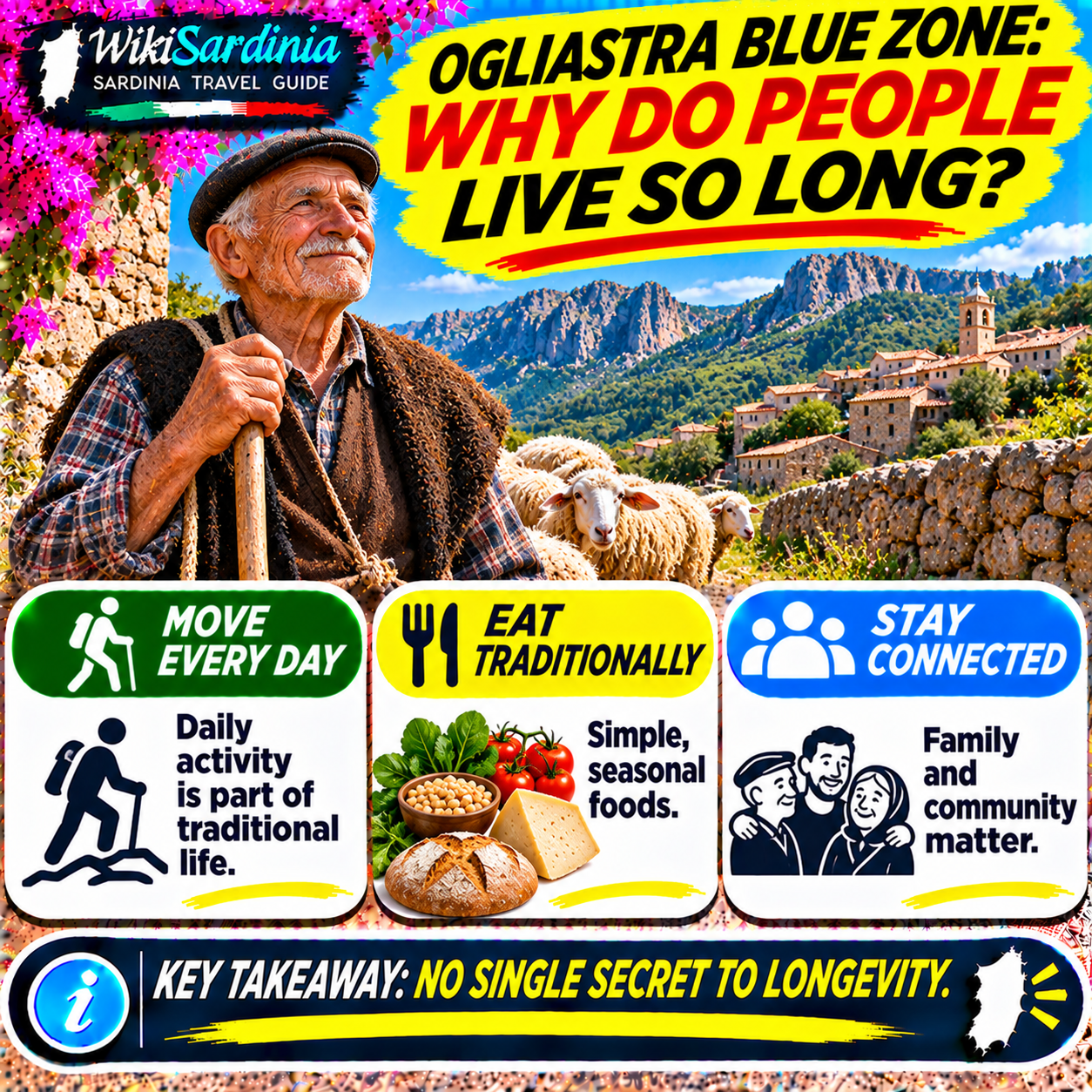
No single secret has been scientifically demonstrated. The most plausible explanation is multifactorial: everyday movement, food patterns, family and community networks, lifetime work and environmental exposures may interact with genetic and historical factors. Researchers have investigated these possibilities, but observational evidence cannot isolate one village habit as the cause of an individual's lifespan. Be cautious of claims that one cheese, wine, herb or daily ritual guarantees longevity.
1. Everyday physical activity rather than a gym routine
Historically, many residents worked in farming, shepherding or other physically demanding occupations. Mountain paths, uneven streets, tending animals, gardening and walking between homes and fields made movement part of daily life. This is different from claiming every older person was a marathon runner. Regular activity is consistent with established health guidance, but it is only one potential contributor to the observed longevity patterns. Visitors can appreciate this aspect by walking village lanes or taking appropriately graded guided hikes—without treating strenuous mountain exercise as a health prescription.
2. A traditional, relatively simple diet
Historical rural diets in inland Sardinia often included bread and grains, beans and other legumes, seasonal vegetables, olive oil and locally produced dairy, with food choices shaped by household resources and farming practices. Some communities also consumed meat and wine, so the popular claim that everyone followed an identical plant-only Mediterranean diet is misleading. Dietary habits have changed substantially with modernization. What researchers describe is a historical pattern, not a standardized menu followed by every centenarian today.
Does pecorino cheese make Sardinians live longer?
Sheep's-milk cheese is a recognizable part of traditional inland Sardinian food culture, and it often features in stories about longevity. However, there is no convincing evidence that eating pecorino alone extends lifespan. Cheese can contribute protein and other nutrients but also varies in salt and saturated-fat content. Enjoy it as a regional food rather than a medicinal product. Claims about special cheese bacteria or an exact number of daily grams should be treated skeptically unless backed by robust human evidence.
What about Cannonau wine?
Cannonau is a celebrated Sardinian red wine, and its polyphenols are frequently mentioned in Blue Zone storytelling. That does not prove that drinking Cannonau prevents disease or increases lifespan. Alcohol carries health risks, including cancer risk, and people who do not drink should not start for longevity. Some historical communities consumed wine socially, but the association between wine drinking and long life is not proof of benefit. If you visit a winery, appreciate the cultural experience without treating alcohol as an anti-aging therapy.
3. Family ties and everyday social connection
In many inland villages, extended families, neighbors and community networks historically played important roles in daily life. Older residents could remain connected through shared meals, public squares, religious events and intergenerational households. Social relationships are associated with health and wellbeing in broader research, although it is difficult to measure their independent contribution to Sardinia's longevity. It is better to describe strong community ties as a plausible supportive factor than to claim every village has low loneliness or stress.
4. A sense of purpose and useful work
Blue Zone narratives often highlight older residents who continue gardening, preparing food, helping relatives or taking part in village life. Meaningful roles can support wellbeing, but individual experiences differ. Some older residents remain active, while others live with disability or illness. The idea that all centenarians stay healthy and productive until the very end is a romanticized picture, not a reliable scientific finding.
5. Genetics and family history
Scientists have also studied genetic and family factors in Sardinian longevity. Some traits may be more common in particular communities because of population history and relative geographic isolation. Genetics may help explain part of the pattern, but there is no single established “Sardinian longevity gene” that guarantees reaching 100. Environmental, social and genetic influences interact, and findings from small populations do not automatically generalize to everyone.
Does mountain air or low stress explain it?
Fresh air, quieter settlements and access to nature can be attractive features of the inland landscape. However, there is no proof that mountain air alone creates centenarians, nor that historic rural life was uniformly stress-free. Shepherding and farming involved physical strain, financial uncertainty and hardship. Tourism stories sometimes idealize the past; a more accurate account acknowledges both the supportive and demanding aspects of village life.
Are people in Ogliastra still living unusually long today?
The region's historical longevity pattern is well documented, but contemporary life expectancy and centenarian rates require up-to-date population data and careful age verification. Younger generations have different diets, occupations, migration patterns and healthcare access. It would be misleading to present old centenarian counts as a current annual rate or promise that today's residents share exactly the same lifestyle as their grandparents. Researchers continue to investigate how the phenomenon changes over time.
Can tourists visit Blue Zone villages?
Yes. Inland Ogliastra and neighboring Barbagia offer memorable cultural day trips or overnight stays, with stone villages, mountain scenery, traditional food and local history. Villagrande Strisaili is often associated with the longevity research; Arzana and Talana provide other glimpses of mountain life. Baunei offers a connection between dramatic limestone landscapes and the coast, while Seulo belongs to a neighboring inland area associated with the broader longevity story. None is an open-air theme park devoted to centenarians: these are communities where people live and work.
Which village is best for a first visit?
If you are staying on the eastern coast, choose based on your starting point and available time rather than attempting to see every village in one day. Villagrande Strisaili is an appealing choice for visitors especially interested in the longevity story. Baunei combines mountain character with access to the famous coastal landscape, although the beach excursions and village visit are separate activities. For a more immersive trip, spend a night inland and explore at a slower pace. Mountain roads are winding, so check realistic driving times, road conditions and seasonal business hours before leaving.
Can I meet a centenarian?
Do not expect or request access to an older resident as if they were a tourist attraction. A person's age, health and home are private matters. Some communities organize public cultural events or talks about longevity, but these are different from approaching elderly residents for photographs or interviews. If you want to learn directly from local people, choose a legitimate guided cultural experience or public event and ask permission before photographing anyone.
What should I eat during a Blue Zone visit?
Look for seasonal, locally prepared dishes rather than a restaurant claiming to serve a guaranteed “100-year diet.” Depending on the venue and season, you might encounter vegetable soups, legumes, handmade bread, local cheese, pasta, olive oil and traditional dishes. Not all inland restaurants offer the same menu, and some require advance booking. Ask about vegetarian options, allergens and opening days. The best food experience is one that reflects the actual place, not a rigid longevity checklist invented for visitors.
Can you copy the Blue Zone lifestyle at home?
You can draw reasonable inspiration from broadly supported habits: move regularly in ways suited to your abilities, eat a balanced diet with plenty of plant foods, maintain meaningful social connections, sleep adequately and follow evidence-based preventive healthcare. None of these guarantees a particular lifespan, and the Ogliastra research does not replace medical advice. Avoid starting alcohol use, supplements or restrictive diets because a travel article calls them longevity secrets.
Is the Blue Zone concept scientifically settled?
The original Sardinian demographic work is an important contribution to longevity research, but the broader Blue Zones brand mixes research findings with lifestyle interpretation. Some claims about exceptional age and causal habits have been challenged or debated, and methods differ between regions. Good reporting separates verified age patterns from hypotheses about why they occur. The strongest conclusion is not that Ogliastra has discovered a magic formula, but that it offers a valuable population in which to study healthy aging and the interplay of biology and society.
Useful Italian phrases
“Che cosa significa Zona Blu?” — What does Blue Zone mean? “Quali sono i piatti tradizionali del paese?” — What are the village's traditional dishes? “C'è una visita guidata sulla storia locale?” — Is there a guided tour about local history? “Questo sentiero è adatto ai principianti?” — Is this trail suitable for beginners? “Serve prenotare per pranzo?” — Do we need to book lunch?
Research and official sources
PubMed — Pes, Poulain and colleagues' research on Sardinian longevity; PubMed — scientific literature on Ogliastra centenarians; SardegnaTurismo — Ogliastra travel information; World Health Organization — physical activity; World Health Organization — alcohol and health. These sources support the distinction between documented longevity, proposed contributing factors and unsupported claims of a single secret.
The WikiSardinia takeaway
Ogliastra's Blue Zone is a real and fascinating longevity research story, but there is no proven secret ingredient. Traditional movement, local foods, community relationships and family history may all play a part, and none explains everything. Visit the inland villages to experience their landscapes, cuisine and living culture, not to hunt for a miracle diet or treat centenarians as attractions. The most useful lesson is the value of everyday habits and human connection—without promising that any one lifestyle guarantees a longer life.