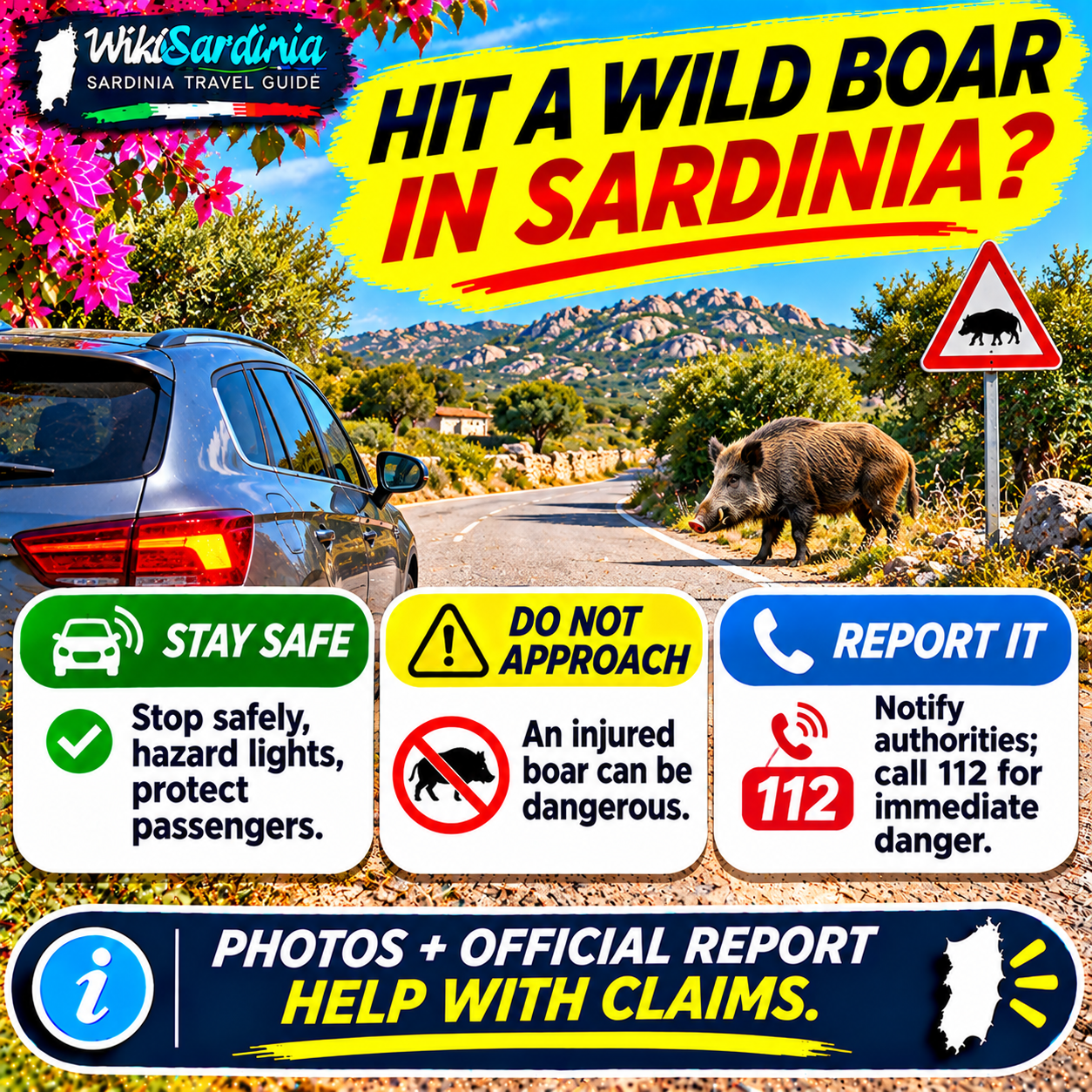
If you hit a wild boar while driving in Sardinia, stop safely, protect everyone in the vehicle and report the collision to the competent authorities. Never approach or touch the boar, even if it appears motionless: a wounded wild animal may suddenly move or attack. Call 112 if anyone is injured or there is an immediate danger to road users. Even if nobody is hurt, arrange a report to the police or appropriate wildlife authorities and document the scene when it is safe. These steps are particularly important if you are driving a rental car or later need to make an insurance claim.
What should I do immediately after hitting a wild boar?
- Stop as safely as possible. Switch on your hazard warning lights and, if the car can move safely, pull away from the flow of traffic.
- Check whether anyone is injured. For injuries, fire, an unsafe obstruction or an imminent collision risk, call 112 and give your location.
- Wear a reflective vest before exiting where required and use a warning triangle when applicable and safe to deploy. Never step into moving traffic or walk around a blind bend to place it.
- Keep passengers at a safe distance from traffic and from the animal. Do not attempt to approach, move, feed or rescue the boar yourself.
- Report the animal collision to the competent police or wildlife/veterinary authorities. Ask how to obtain a record of the incident.
- When safe, photograph the vehicle, road conditions, nearby signs, location and any visible animal from a distance.
- Contact your insurer or rental company's emergency assistance before arranging repairs or towing, unless immediate safety requires intervention.
The Italian Highway Code, Article 189, addresses stopping and arranging timely help after road incidents involving animals. Reporting the accident is the safe and responsible way to obtain specialist assistance without exposing yourself to a wounded boar.
Should I call 112 if nobody is hurt?
Use 112 when the situation presents an immediate emergency, such as injuries, an animal or vehicle obstructing a dangerous bend, a serious collision hazard, fire or another urgent threat. If the vehicle is safely parked and there is no imminent danger, contact the local police, Carabinieri, Polizia Stradale or other competent authority through their ordinary contact channels for reporting and guidance. Do not use the emergency line merely to accelerate an insurance claim or request an ordinary tow.
What if the boar is alive or injured?
Keep your distance and leave intervention to trained personnel. An injured boar can be unpredictable, and an animal that seems dead may still be alive. Do not try to pull it off the road, transport it or treat it yourself. Explain the animal's position and condition to the authorities so they can coordinate with veterinary or wildlife services. The Italian Ministry of Health specifically says wild-boar carcasses, including those found after road collisions, should be reported to veterinary services, law enforcement, park authorities or forest guards.
What if the boar dies?
Do not touch, move or take the carcass. Notify the authorities so they can arrange veterinary assessment and safe removal. This also matters for animal-disease surveillance, including African swine fever. The Ministry of Health's guidance identifies the local ASL veterinary service, provincial police and municipal police as appropriate contacts for a wild-boar carcass. Do not assume you may keep the animal or dispose of it yourself.
Do I have to stop even if the animal runs away?
Yes, stop safely and assess the situation. A boar that runs away may still be injured. Note the direction it went and report the incident without pursuing it. If your vehicle is damaged, record the location and notify the insurer or rental provider. Never chase an injured animal into the countryside.
What information should I give the police?
Provide the road name or number (SS, SP or local road), approximate kilometer marker, direction of travel, nearest village or junction, time, vehicle registration, whether anyone is hurt and the animal's location. If available, share GPS coordinates from an offline map. Explain whether the road is blocked or dangerous. Ask the officer or dispatcher which authority will record the incident and how to obtain the report number or copy.
How can I document the collision for insurance?
Photograph the damage, road layout, nearby wildlife-warning signs, skid marks if visible and any animal from a safe distance. Note the time, weather and exact position. Keep witnesses' contact details if they willingly provide them, and preserve dashcam footage if available and lawful to use. Request an official report or incident reference from the competent authorities. Do not risk your safety to collect evidence; a photograph is never worth stepping into traffic or approaching a wounded animal.
Will the Sardinian Region pay for the damage?
The Sardinian regional environmental portal confirms that the Region has arranged insurance coverage relating to road collisions involving wildlife, including boars, deer and other species, and points to an official compensation procedure. This does not mean reimbursement is automatic. Eligibility, proof of the collision, applicable coverage, the correct claimant and any liability issues must be assessed under the current procedure and policy. Preserve evidence and seek the official instructions before submitting a claim. If you are in a rental car, coordinate with the rental company, which may own the vehicle and handle the property-damage claim.
What if I am driving a rental car?
Contact the rental provider's accident or roadside-assistance number as soon as it is safe. Follow the contract's reporting deadline and ask whether a police report is required, which repairs or towing are authorized and whether a replacement vehicle is available. Do not assume that basic collision-damage waiver covers every wildlife collision without an excess, or that a regional insurance policy will pay the renter directly. Keep the rental agreement, photos, report reference and correspondence. Avoid driving the car further if the radiator, tires, steering, lights or safety systems may be damaged.
What if the car still drives?
Do not judge roadworthiness by whether the engine starts. An impact may damage cooling components, brakes, tires, steering, sensors or lights. If you see leaking fluid, hear unusual noises, smell fuel or notice unstable handling, stop driving and arrange professional assistance. If the car appears undamaged, still follow the rental company's or insurer's accident-reporting instructions before continuing.
What if I have no phone reception?
Move to a safe position away from traffic and do not walk blindly along an unlit or narrow rural road. A genuine emergency call to 112 may connect through another available cellular network even if your usual provider has no service, but it cannot make a normal call if no compatible network is reachable. Some supported phones offer satellite emergency communication in Italy. For a non-emergency, wait in a safe location or seek help from a nearby inhabited place only if the route is clearly safe. Ask a passing driver to report the incident if necessary, without exposing yourself to traffic or strangers.
Could I be fined for hitting a wild boar?
A collision with a wild animal does not automatically mean the driver has committed an offence. However, your driving conduct and compliance with road rules can be examined, and failing to stop or arrange timely animal assistance can have legal consequences under Article 189 where applicable. Drive at a speed appropriate for visibility, road conditions and wildlife warnings. The presence or absence of a warning sign does not alone decide legal liability.
How can I reduce the risk on Sardinian rural roads?
Be especially attentive around dawn, dusk and after dark, when visibility is lower and wildlife may cross. Reduce speed where roadside vegetation, curves or warning signs limit your view. Use appropriate headlights without dazzling other drivers, keep a safe following distance and avoid sudden dangerous swerves. If a boar crosses, other animals may follow. Do not stop in the carriageway to photograph wildlife. Local conditions vary, so treat any rural road as a potential wildlife crossing area rather than relying only on signs.
Can I claim for injuries as well as vehicle damage?
Potential claims depend on the circumstances, available evidence, applicable regional procedures, insurance terms and legal responsibility. Seek medical care promptly for injuries and keep medical reports and receipts. Notify your motor insurer or rental provider and any travel insurer. For significant injuries or disputed liability, independent legal advice may be appropriate. This guide cannot promise a specific payout or determine fault.
Useful Italian phrases
“Ho investito un cinghiale.” — I hit a wild boar. “Siamo sulla strada provinciale [numero].” — We are on provincial road [number]. “Il cinghiale è ferito.” — The boar is injured. “L'animale è sulla carreggiata.” — The animal is on the road. “Ci sono persone ferite.” — People are injured. “Mi serve un verbale per l'assicurazione.” — I need an official report for insurance. “L'auto è a noleggio.” — The car is rented.
Quick checklist to save on your phone
- Stop safely and switch on hazard lights.
- Protect passengers and avoid traffic.
- Do not approach or touch the boar.
- Call 112 for injuries or immediate danger; otherwise report to the competent authorities.
- Document the scene only when safe and request an official incident reference.
- Notify the rental company or insurer promptly.
- Check the Sardinian Region's wildlife-collision compensation procedure without assuming automatic payment.
The WikiSardinia takeaway
After a collision with a wild boar in Sardinia, protect people first, keep away from the animal and report the incident. An official record and safe documentation can be important for insurance, and the Region has a dedicated wildlife-collision compensation procedure. But no claim is guaranteed, especially with a rental car. If anyone is injured or the road presents immediate danger, call 112.