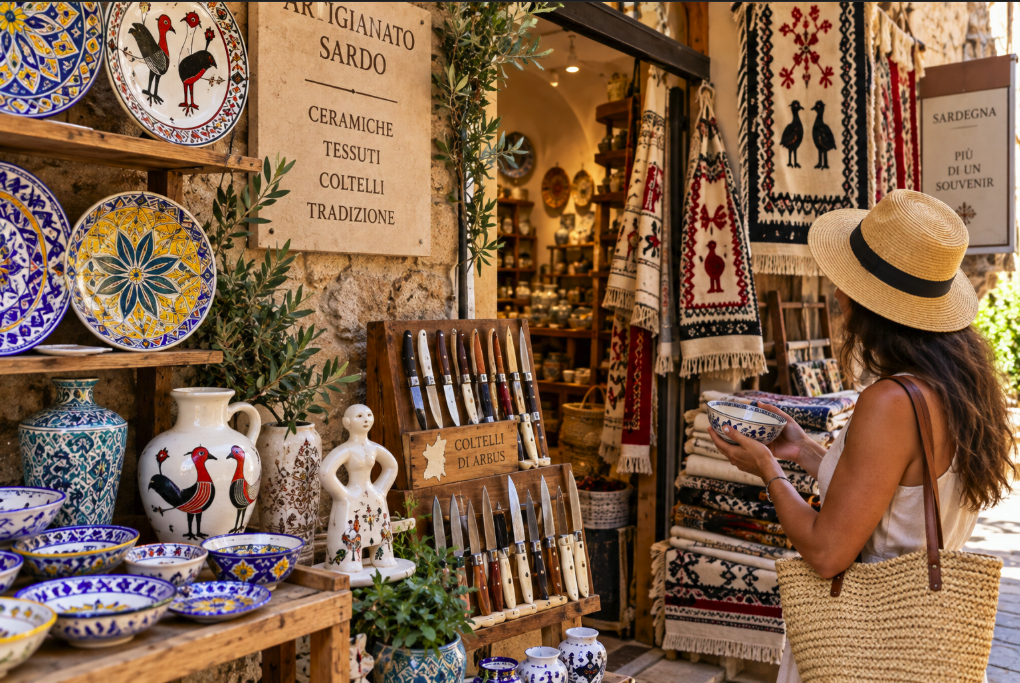
The most interesting souvenirs from Sardinia are often objects that make sense long after the holiday is over: a hand-thrown ceramic bowl, a woven textile or a knife made by a specialist bladesmith. For travelers willing to move beyond generic souvenir shops, the island still has towns where particular crafts remain closely tied to local identity. Oristano is historically associated with ceramics, Samugheo and Nule with weaving, and Arbus with one of Sardinia’s best-known knife-making traditions.
Calling these objects “luxury souvenirs” is useful only if luxury means workmanship rather than a designer label. Prices vary enormously according to maker, dimensions, materials and complexity. The better approach is to buy fewer things, ask who made them and understand the technique before deciding whether an object is worth carrying home.
Oristano: a city with a long ceramic tradition
Oristano is officially recognized in Italy as a city of ceramics, but its connection with pottery is much older than the modern designation. The municipality describes the local tradition of the congiolargius, Oristano’s potters, as one of the city’s historic crafts and in 2025 established an Ecomuseum of Ceramics to strengthen its preservation and promotion.
That makes Oristano a logical place to look for contemporary Sardinian ceramics with a local connection. Rather than searching for a single “official” style, pay attention to how individual workshops reinterpret older forms, glazes, decorative motifs and everyday objects. Sardinian ceramic production is diverse, and a piece made in Oristano does not need to look like a standardized tourist plate to be authentic.
Ask whether the piece was made in the workshop, whether it is intended for food use and how it should be cleaned. For larger pieces, also ask whether the studio can pack and ship internationally. A professionally packed vase arriving separately may be a better investment than attempting to fit it between shoes in a checked suitcase.
Samugheo: Sardinia’s textile stronghold
For rugs and woven textiles, Samugheo is one of the island’s essential stops. SardegnaTurismo describes the town in the province of Oristano as a center for rugs, tapestries and traditional clothing, with textile knowledge handed down over centuries.
Before shopping, visit MURATS, the Regional Museum of Sardinian Textile Art. The museum was founded in 2002 to preserve Sardinia’s textile heritage and holds household textiles, blankets, bags, traditional clothing and rare historical pieces from across the island. The permanent collection helps visitors recognize how much technique sits behind something that can otherwise be dismissed as simply a patterned rug.
As of 2026, MURATS is open Tuesday through Sunday, including holidays. From June through September the published hours are 10 a.m.–1 p.m. and 5–8 p.m. The standard ticket is €6 and includes a guided visit; the museum also has a shop with books and small textile objects.
Samugheo is particularly useful for shoppers because the craft is not preserved only behind museum glass. Textile production remains part of the town’s identity. When comparing pieces, ask about fiber, loom technique, the time required to make the work and whether it was woven locally. Large handmade rugs can represent many hours of skilled labor, so a suspiciously low price deserves questions rather than celebration.
Nule: distinctive flamed-pattern carpets
Nule, in central-northern Sardinia, offers another important weaving tradition. The town is especially known for carpets with a framas patterns — slender, flame-like colored motifs — produced on traditional vertical looms.
According to SardegnaTurismo, the weaving produces a dense textile whose front and back are identical but reversed. Older motifs coexist with designs influenced by twentieth-century Sardinian artist and designer Eugenio Tavolara, showing how the craft has evolved rather than remaining frozen in a folkloric past.
A Nule textile can be a compelling choice for travelers interested in modern interiors because the geometry can work outside an explicitly rustic setting. Smaller runners, wall pieces and cushions are also far easier to transport than a full-size carpet.
Arbus: buying a Sardinian knife from the people who make them
In southwestern Sardinia, Arbus is closely associated with traditional blades. The Museo del Coltello Sardo was founded in 1996 by master bladesmith Paolo Pusceddu beside the family workshop, L’Arburesa. Italy’s Ministry of Culture describes the collection as tracing Sardinian knife-making from ancient examples through contemporary artisan work, including carved and inlaid horn handles.
The adjacent L’Arburesa workshop continues a family bladesmithing tradition and makes knives based on forms associated with Arbus. The museum and workshop are at Via Roma 15 in Arbus. The current official site lists free museum admission and summer opening Monday–Saturday from 9 a.m.–2:30 p.m. and 3–8:30 p.m., with Sunday hours of 10 a.m.–2 p.m. and 4–8 p.m. Winter hours differ, and weekend access can require an appointment.
A handmade Sardinian knife can be a functional object or a collector’s piece, depending on materials and finish. Horn, metalwork, blade shape and decoration can all affect the price. Buying directly from a recognized maker also gives you a chance to understand who produced the piece rather than purchasing a vaguely “Sardinian-style” knife with no provenance.
International travelers need to think about transport rules before buying. Do not place a knife in hand luggage. Airline, airport, customs and destination-country rules can differ, and some knife types may be restricted. U.S. travelers should check current federal, state and local rules applicable to their final destination before purchasing or shipping a blade.
How to recognize a worthwhile Sardinian craft purchase
Origin is more useful than a generic “Made in Sardinia” aesthetic. Ask for the maker’s name, workshop location, materials and technique. An artisan should normally be able to explain the object without relying on a romantic sales pitch.
Imperfection is not automatically proof of handwork, and perfect repetition is not automatically proof of industrial production. What matters is traceability. A reputable shop or workshop should be comfortable explaining whether an object was thrown, painted, woven, forged or assembled locally.
For ceramics, inspect the glaze and ask about intended use. For textiles, examine both sides and ask about fiber composition and loom method. For knives, ask about blade steel, handle material and maintenance. If the object is expensive, request documentation or a detailed receipt that identifies the maker and materials.
Turn shopping into part of the trip
The best craft shopping in Sardinia often requires leaving the resort strip. Samugheo, Nule and Arbus are destinations in their own right, and visiting a museum or workshop before buying changes the experience from retail into cultural context.
Oristano can fit naturally into a western Sardinia itinerary. Samugheo is inland and rewards travelers already exploring central Sardinia. Nule can be incorporated into a route through the Goceano region, while Arbus pairs well with a journey through the southwest and Costa Verde.
None of these stops requires buying an expensive object. A small textile, cup or modest piece from a known maker can carry more connection to Sardinia than a costly decorative item with uncertain origins. The real luxury is knowing where it came from, how it was made and whose hands made it.