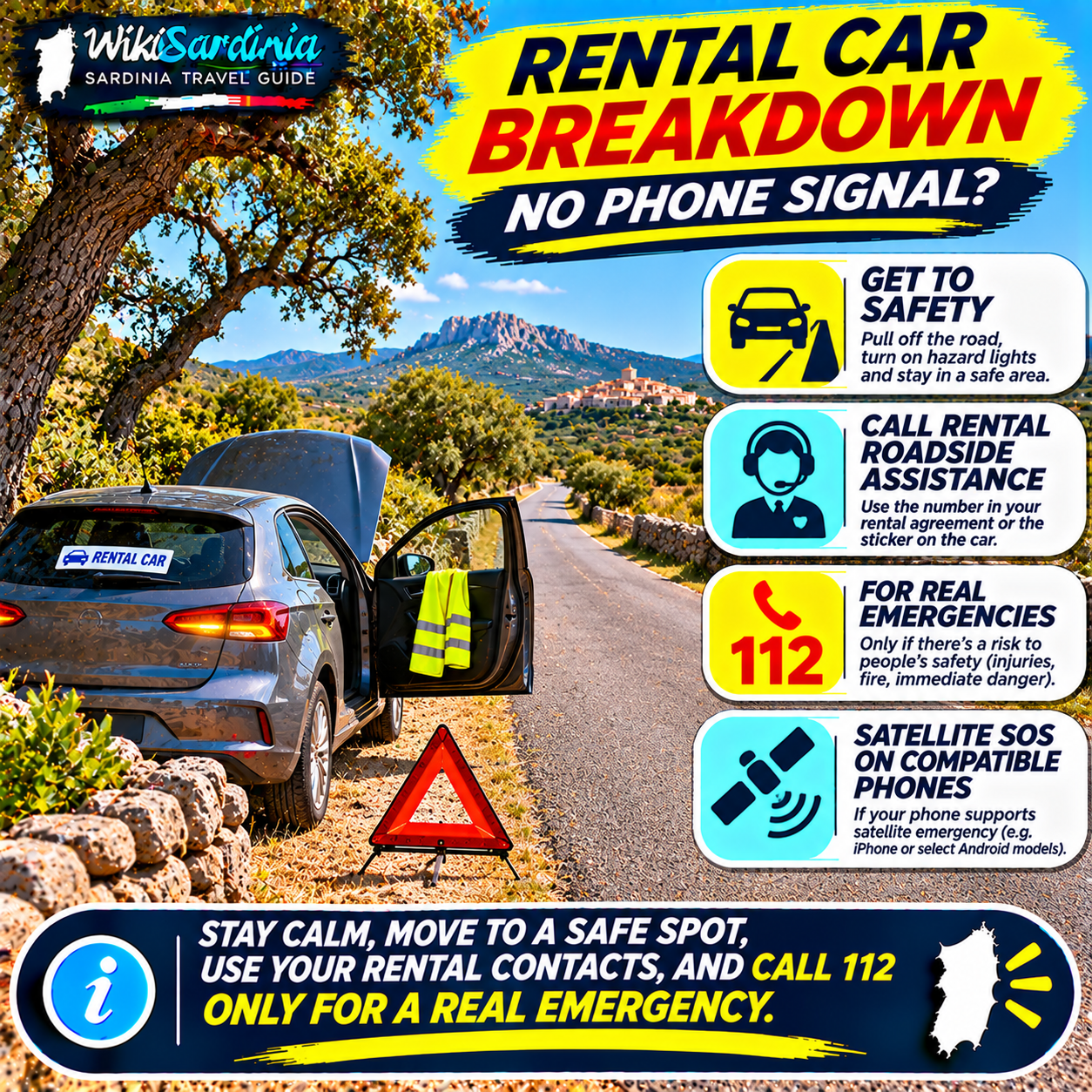
If your rental car breaks down on a rural Sardinian road with no phone reception, first protect yourself and your passengers, then work out how to contact the rental company's authorized roadside-assistance service. Do not try to repair an unfamiliar vehicle on a narrow road or wander into remote countryside without a safe route. If there is an immediate danger to life or road users, dial 112 as soon as any emergency connection is possible. A routine mechanical breakdown is not automatically an emergency.
First: get the car and passengers somewhere safe
If the vehicle can still move safely, steer gently to a lay-by or a wide, stable roadside area away from moving traffic. Do not continue driving if there is smoke, fire, a severe mechanical fault, loss of steering or braking, or another unsafe condition. Turn on the hazard warning lights. On a narrow road, bend or blind corner, your priority is to avoid being struck by approaching vehicles. If you cannot stop off the carriageway, assess the safest place for passengers rather than automatically remaining inside the vehicle or stepping into traffic.
Should I put on a reflective vest and set out the warning triangle?
Italian road-safety rules require high-visibility clothing in specified situations when leaving a stopped vehicle outside built-up areas, particularly in darkness or poor visibility. Keep the vest in the passenger compartment so you can put it on before stepping out. A warning triangle is required in applicable breakdown situations and, under the general road-code guidance, is placed at least 50 metres behind the vehicle so approaching drivers can see it from at least 100 metres. Never walk into traffic or around a blind bend to position a triangle if doing so is unsafe. The Automobile Club d'Italia (ACI) explains these precautions. Conditions on highways differ from quiet rural lanes; always put personal safety first.
What if there is absolutely no mobile signal?
First try placing a normal emergency call to 112 only if the situation is genuinely dangerous. A mobile phone can sometimes connect an emergency call using another available network even when your own provider shows no service. But if no compatible cellular network is reachable, a normal voice call cannot connect. Do not assume the words “No Service” guarantee an emergency call will fail, or that 112 works without any radio coverage at all. The official emergency-service guidance explains cross-network emergency access.
Can satellite SOS help?
Some compatible phones offer satellite emergency communication where supported. Apple confirms that Emergency SOS via satellite is available in Italy on supported iPhone models, subject to device, software, location and connection conditions. The phone generally needs a usable view of the sky, and satellite contact can take time. This feature is for genuine emergencies, not a standard way to request a tow for a harmless breakdown. Other manufacturers may offer their own satellite features, but availability varies; check your exact phone and service before travel.
Who should I call for a rental-car breakdown?
Contact the rental company's roadside-assistance number first once you have reception or access to a phone. It is usually printed in the rental agreement, on a vehicle information card or in the rental app. Give the contract number, registration plate, location and symptoms. The company can authorize a recovery truck, garage, replacement vehicle or other response according to your contract. Do not independently book an expensive tow unless the company authorizes it or an immediate safety emergency requires action: otherwise you may be liable for costs the rental company would not approve.
What if I cannot reach the rental company?
If you are in a safe location and the breakdown is not dangerous, consider whether another motorist, nearby inhabited property or business can help you place a call. Do not enter private property uninvited, hitchhike with strangers or walk a long distance on a road without a safe pedestrian route. If another person can drive to coverage safely, have them relay your exact position and rental details. Keep at least one responsible person with the vehicle if it is safe and appropriate, and avoid splitting up your group in hazardous conditions.
Should I stay with the car or walk to find reception?
There is no universal answer. On a narrow road with moving traffic, staying in or beside the vehicle can be dangerous; move to a protected location away from the carriageway if possible. In remote countryside, setting off on foot in extreme heat, darkness or unfamiliar terrain may be even riskier. If you are safe where you are, remaining near the vehicle may make it easier for recovery crews to locate you. Walk only when you have a clearly safe, short route to a known place with help, and tell companions what you are doing. Never leave children or vulnerable passengers alone.
How do I describe my location without mobile data?
Use the last known town, road number (such as an SP or SS road), kilometer marker, junction, nearby farm or landmark, and direction of travel. GPS coordinates may still be visible in offline maps because satellite positioning does not inherently require mobile data, although the app must have appropriate map data and a GPS fix. Save or write down the coordinates before leaving the vehicle if possible. A photograph of a road marker can also help when you regain connectivity. Avoid giving a vague description such as “somewhere near the mountains.”
Is ACI roadside assistance available?
ACI Global advertises roadside assistance at 803 116, operating 24 hours a day, every day of the year. Its official website also lists +39 02 66 165 116 for calls from abroad. However, a rental car's assistance entitlement and payment responsibility depend on its rental agreement. An independently arranged ACI intervention may not be covered. Contact the rental provider's authorized service when possible. See ACI Global roadside assistance. Verify which number works with your foreign mobile provider before departure.
When should I call 112?
Call 112 if the breakdown creates an immediate danger: a vehicle obstructing a blind bend with a serious collision risk, fire or smoke, an injured passenger, someone trapped, or a person suffering serious illness or heatstroke. Explain the danger, your location and whether anyone is hurt. The official Italian tourism portal identifies 112 as the free emergency number. Do not use emergency dispatch merely because you want a replacement car or a faster tow.
What if the car is blocking a one-lane rural road?
Activate hazard lights, move passengers out of traffic if safe, and assess whether the obstruction presents an immediate collision risk. Avoid trying to push a vehicle around a bend or downhill without control. If the obstruction is creating an imminent threat and you can connect, call 112 to report the road hazard. Otherwise notify the rental company's assistance provider and give precise road and location information. Do not stand in the carriageway waving down traffic.
What if the breakdown happens at night?
Darkness increases the risk of being struck and makes a vehicle harder to locate. Use hazard lights while the battery permits, wear reflective clothing before exiting and move away from traffic to a safe location. Use a flashlight carefully without blinding approaching drivers. Avoid walking along an unlit road unless there is a safe pedestrian route and a known nearby destination. If the road situation is immediately dangerous, request emergency help.
What if the weather is extremely hot?
Carry drinking water before starting remote drives, especially in July and August. If the car's engine is overheating, stop safely and switch it off according to the vehicle's instructions. Do not open a hot radiator cap or touch hot coolant components. Seek shade in a safe place away from traffic, monitor children and older passengers, and avoid unnecessary walking in the heat. Confusion, collapse or other severe heat-illness signs require urgent medical help via 112 when a connection is available.
Can I change a tire myself?
Only if it is safe, the vehicle is equipped for it, you know the procedure and the rental agreement allows it. Many rental cars have a tire repair kit rather than a spare wheel, and some punctures cannot be repaired roadside. On a narrow shoulder, blind bend or unstable surface, attempting a wheel change is dangerous. Ask the rental company's assistance provider what to do before using a repair kit or arranging an external service.
Will I have to pay for towing or a replacement car?
It depends on the rental agreement, optional coverage, fault type and whether the driver caused damage or used the car outside permitted roads. Roadside assistance may be included for mechanical failure but not necessarily for a flat tire, lost keys, incorrect fuel, off-road damage or recovery from an unauthorized track. A replacement vehicle may be subject to availability and conditions. Ask for written confirmation of any charge and keep all receipts and messages. There is no reliable universal Sardinia-wide towing price.
What if I am driving on an unpaved road to a remote beach?
Check your rental agreement before entering unpaved roads. Some contracts restrict off-road or certain unsealed-road use, and assistance or damage coverage may be limited. Do not attempt to reach an isolated beach by following an uncertain navigation shortcut. If the vehicle becomes stuck, do not spin the wheels or try a dangerous recovery; explain the exact surface and location to the rental company. Be truthful about the circumstances, since incorrect information can complicate assistance and insurance claims.
What should I prepare before leaving town?
- Save the rental company's 24-hour assistance number and contract number offline.
- Check that the car has a reflective vest and warning triangle and learn where they are stored.
- Download offline maps and record your planned route.
- Carry water, a charged phone, power bank and suitable footwear.
- Check whether your phone supports emergency satellite communication in Italy.
- Understand your rental contract's roadside assistance, towing and replacement-car terms.
- Tell someone your destination and expected arrival when driving on isolated roads.
Useful Italian phrases
“La mia auto a noleggio è in panne.” — My rental car has broken down. “Non c'è campo sul telefono.” — There is no phone signal. “Mi serve un carro attrezzi.” — I need a tow truck. “Siamo sulla strada provinciale [numero].” — We are on provincial road [number]. “L'auto blocca la strada.” — The car is blocking the road. “C'è un pericolo immediato.” — There is an immediate danger. “Può chiamare l'assistenza del noleggio per favore?” — Could you call the rental company's assistance, please?
The WikiSardinia takeaway
On a remote Sardinian road, safety comes before finding a phone signal. Secure the scene, avoid traffic, keep your passengers safe and use the rental company's authorized assistance when you can communicate. Try 112 for a real emergency, remembering that it may connect through another available network but cannot make a normal call without any cellular coverage. Compatible satellite emergency services offer an additional backup for genuine emergencies. Prepare your contacts and offline maps before leaving town.