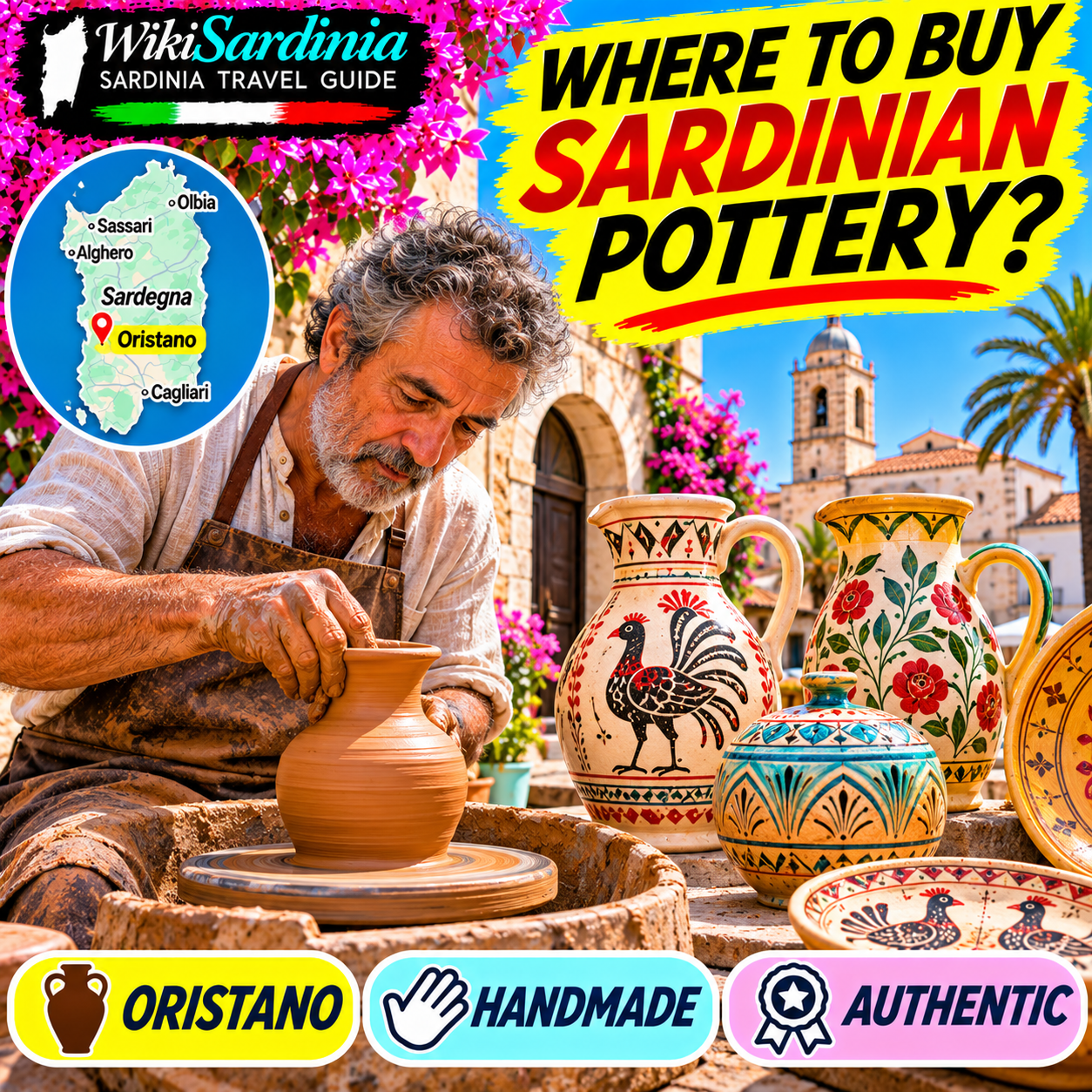
Oristano is one of the best places to buy authentic handmade Sardinian ceramics directly from the artisans who make them. Its pottery tradition includes wheel-thrown terracotta jugs, richly decorated ceremonial vessels, glazed bowls and engraved designs. Nearby Assemini is another officially recognized center of Sardinian ceramic craftsmanship. Grottaglie, by contrast, is a famous pottery town in Puglia on the Italian mainland: its tradition is different from Oristano's, although visitors may enjoy comparing both.
Why is Oristano famous for pottery?
Oristano's ceramics are linked to generations of figoli, the local potters who worked clay into functional and decorative vessels. The municipality celebrates this heritage through Il Tornio di via Figoli, an event devoted to ceramic artists and their evolving techniques. Italy's Ministry of Enterprises and Made in Italy officially lists Oristano and Assemini among the recognized towns of established ceramic tradition. That recognition concerns the territory; it does not automatically certify every item sold in a shop. Comune di Oristano — ceramic heritage; MIMIT — recognized ceramic towns.
What should you look for in traditional Oristano ceramics?
Classic forms include sa brocca, a traditional jug; brocca pintada, a decorated pitcher; and the elaborate brocca fiorita, a festive ornamental vessel. You may also see small pouring jugs, dishes, stylized animals and works inspired by the island's ancient symbols. Traditional techniques include throwing on the potter's wheel, applying slip or glaze, incising or scratching designs into the surface and adding sculptural details. Not every modern Sardinian ceramic uses the same patterns, and an artist may deliberately reinterpret older forms.
Where can you buy handmade pottery in Oristano?
Margherita Pilloni — Via Francesco Crispi 29/A
Margherita Pilloni is a documented Oristano ceramic artist whose work combines traditional local shapes with contemporary experiments in texture and glaze. The Sardegna Artigianato artisan directory describes her wheel-thrown vessels, including the brocca fiorita. Her own website lists a workshop at Via Francesco Crispi 29/A, Oristano, with visits by appointment only. Visitors can explore the artist's online collection and contact her about a workshop visit, availability or custom work. Margherita Pilloni — official workshop website.
Cooperativa Maestri d'Arte (CMA) — Oristano
The Cooperativa Maestri d'Arte was formed by graduates of Oristano's art school and has worked to preserve the traditions of the figoli. Its catalogue includes ring-shaped amphorae, brocche pintade, small jugs, pouring vessels and animal forms, often with engraved decoration. The Mogoro artistic crafts fair directory lists the cooperative at Via Cagliari, corner of Via del Porto, Oristano, telephone +39 0783 358103. A local tourism guide also lists Via Cagliari 139, so confirm the current visitor entrance and opening hours directly before setting out. Mogoro crafts fair — CMA profile.
Valentina Pisu — Via Vittorio Veneto 55/B
Valentina Pisu is included in Sardegna Artigianato's directory of local ceramic artists. Her listed techniques include hand-forming, slab work, molding, glazing and firing. The directory lists Via Vittorio Veneto 55/B, Oristano and contact number +39 328 947 5516. Oristano's tourism guide has also mentioned restoration affecting her premises, so telephone first to confirm where visitors can see or buy current work. Sardegna Artigianato — Valentina Pisu.
Can you find traditional ceramics outside Oristano?
Yes. Assemini, near Cagliari, is another officially recognized Sardinian pottery center. One documented example is Doriana Usai, whose workshop makes handmade ceramics inspired by local forms and motifs, including stylized birds and traditional decorative techniques. Her website lists a shop at Via Carmine 214, Assemini; an artisan directory gives Via Carmine 216, so confirm the entrance before visiting. Doriana Usai — official website. Other Sardinian towns have their own ceramic traditions, but a souvenir labelled “Sardinian style” is not necessarily produced on the island.
Is Grottaglie-style pottery Sardinian?
No. Grottaglie is in Puglia, not Sardinia. Both Grottaglie and Oristano are recognized Italian ceramic towns, but their traditions developed in different places. Grottaglie is associated with its own Apulian pottery heritage, while Oristano is particularly known for its figoli, decorated terracotta vessels and distinctive local forms. If you like the vibrant look of Grottaglie pottery, ask Sardinian artisans about contemporary glazed pieces, but do not describe an imported Grottaglie object as locally made in Oristano. Regione Puglia — ceramic heritage.
How do you tell whether a ceramic is genuinely handmade?
Start by asking who made it, where the workshop is and whether it was thrown, hand-built, molded or decorated by hand. Look for a maker's signature, workshop label or documentation, but remember that signatures alone are not absolute proof of origin. Minor variations between pieces may reflect handwork, while highly uniform products can still contain hand-finished elements. Ask whether the item is a one-off piece or part of a repeatable artisan series. A reputable seller should be able to describe the process and provide a receipt identifying the maker.
Are all handmade ceramics suitable for food?
No. Decorative vases, ceremonial jugs and wall plates may not be food-safe even when they resemble everyday dishes. If buying a bowl, cup or serving platter, ask explicitly whether it is certified or intended for food contact. Ask about dishwasher, microwave and oven suitability separately; handmade glazes and finishes may require hand washing. Do not use a decorative antique or unidentified glaze for drinking water or food merely because its shape resembles a functional vessel.
How much does handmade Sardinian pottery cost?
There is no reliable single price range covering all Oristano ceramics. A small decorative object, an everyday bowl, a large wheel-thrown jug and a complex brocca fiorita require very different amounts of labor. Prices depend on size, decoration, firing technique, artist and whether the piece is unique. Ask for a written price, especially for commissioned work. No current standardized price list was verified across the named workshops, so avoid assuming a fixed cost from generic souvenir-shop listings.
Can you visit a working pottery studio?
Some artisans welcome visitors by appointment, and certain events provide opportunities to meet ceramic makers. Margherita Pilloni explicitly states that studio visits are by appointment. Oristano's Il Tornio di via Figoli has been held around cultural and seasonal events, but the dates vary; check the municipality's current calendar rather than assuming a workshop is open daily. If you want a live demonstration or class, ask whether one is offered before traveling.
Can you buy Sardinian pottery online and ship it to the USA?
Some artisans sell through their own websites or arrange orders directly, but international shipping is not guaranteed. Before paying, confirm whether the artist ships to your US address, the total price, protective packaging, insurance, customs charges and what happens if the piece breaks. Large jugs and sculptural vessels can be expensive to ship safely. Keep receipts and descriptions for customs declarations, and ask the workshop to use purpose-built protective packaging.
What should US tourists ask before buying?
Useful Italian phrases include “È fatto a mano in Sardegna?” (Is it handmade in Sardinia?), “Chi è il ceramista?” (Who is the potter?), “Posso visitare il laboratorio?” (Can I visit the workshop?), “È adatto al contatto con gli alimenti?” (Is it food-safe?), “Potete spedirlo negli Stati Uniti?” (Can you ship it to the United States?) and “Come va pulito?” (How should it be cleaned?). Ask for the artist's name and the proper care instructions in writing when buying an expensive piece.
Frequently asked questions
Is Oristano known for handmade pottery?
Yes. Oristano is officially recognized as a town of established ceramic tradition, with a longstanding local pottery heritage.
Where can I buy authentic Oristano ceramics?
Start with documented artisans such as Margherita Pilloni, Cooperativa Maestri d'Arte and Valentina Pisu. Confirm visiting arrangements and stock directly.
What is a brocca fiorita?
It is a richly decorated traditional Oristano ceremonial jug, often featuring sculptural additions.
Is Grottaglie pottery made in Sardinia?
No. Grottaglie is in Puglia and has its own distinct ceramic tradition.
Is Assemini another Sardinian pottery center?
Yes. Assemini is also officially recognized for its established ceramic tradition.
Can I use a traditional ceramic jug for drinking water?
Only if the maker confirms it is intended and suitable for food or beverage contact.
Can I commission a custom ceramic piece?
Some workshops offer commissions. Ask about design, lead time, price and delivery before placing an order.
Can the artist ship ceramics to America?
Possibly, but shipping services vary. Confirm packing, insurance, customs and delivery arrangements with the seller.
The takeaway
For authentic Sardinian pottery, buy directly from a named ceramic artist or documented workshop in Oristano or Assemini. Oristano's brocca pintada, brocca fiorita and engraved terracotta connect a purchase to a living craft tradition. Grottaglie pottery is equally worth appreciating, but belongs to Puglia. Verify the maker, the intended use and international shipping before investing in a piece to take home.
Verified sources: MIMIT — recognized ceramic towns; Comune di Oristano — ceramic tradition; Oristano Turismo — ceramic workshops; Margherita Pilloni — workshop; Mogoro crafts fair — CMA; Sardegna Artigianato — Valentina Pisu; Doriana Usai — workshop.