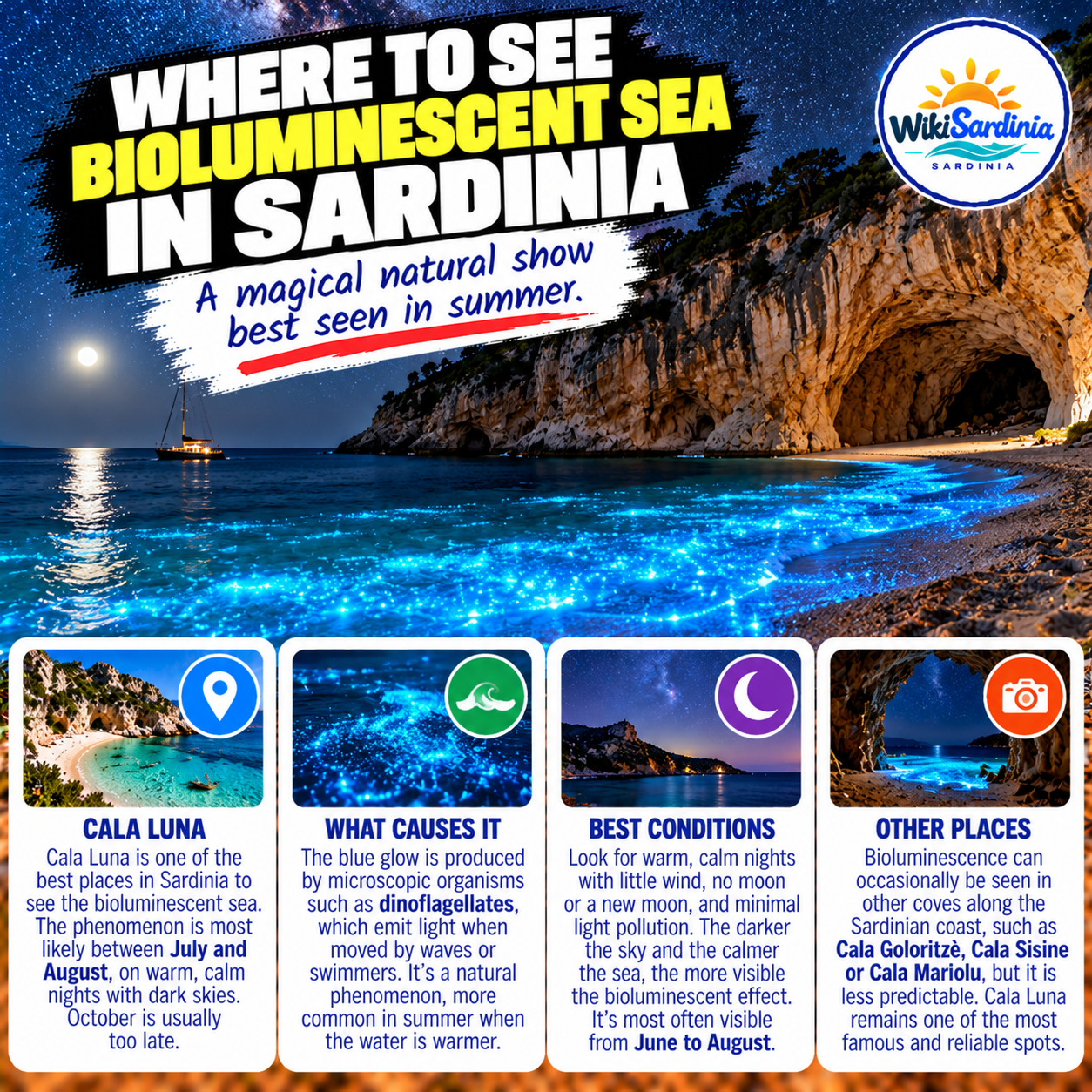
Imagine standing beside the Mediterranean after sunset and watching the water flash electric blue as a wave breaks. This is marine bioluminescence, a real natural phenomenon that can occur when light-producing organisms are present in the sea. But can you reliably see it in Sardinia, and is Cala Luna the best place to go?
The important distinction is between a beautiful place where bioluminescence could occur and a location with verified, predictable displays. Sardinia has many dark, sheltered coves, but there is no reliable evidence that Cala Luna produces a guaranteed annual light show in August—or that October is categorically too late.
What makes seawater glow blue?
Some marine plankton, including certain dinoflagellates, can emit brief flashes of light when disturbed by waves, currents or movement. This light is produced by biochemical reactions inside the organisms. When enough light-producing cells are concentrated near the surface, the effect can look like tiny blue sparks, glowing ripples or luminous foam. Other marine organisms can also be bioluminescent, and not every visible glow has the same biological cause.
Is Cala Luna Sardinia’s best bioluminescent beach?
Cala Luna, on Sardinia’s eastern coast in the Gulf of Orosei, is famous for its limestone cliffs, caves and clear water. Its dramatic setting makes it an appealing subject for night photography, but that does not establish it as a scientifically documented hotspot for glowing plankton. Claims that visitors will see the sea light up there every August should be treated cautiously unless backed by dated, independently verified observations.
Likewise, Cala Mariolu, Cala Sisine and Cala Goloritzè are extraordinary coastal landscapes, but they should not be advertised as dependable bioluminescence-viewing sites without evidence. Their beauty is certain; the appearance of luminous plankton on a particular night is not.
Is August better than October?
Warm months may support conditions favourable to some plankton populations, but there is no fixed Sardinian bioluminescence season established by a reliable local monitoring programme. Water temperature alone cannot predict a bloom: nutrient availability, species composition, currents, weather and many other factors matter. August is a more practical month for many visitors because evenings are warmer and tourist services are more available. October may bring rougher seas, shorter days and fewer coastal transport services, but a glowing-water event is not biologically impossible then.
What conditions make bioluminescence easier to see?
Darkness matters. A moonless or low-moonlight night, limited artificial lighting and a safe view of the water make faint flashes easier to notice. Gentle wave movement can trigger visible light if bioluminescent organisms are present. However, calm water and a new moon cannot create bioluminescence when those organisms are absent. Nor does a photograph of blue water prove that a real bloom occurred: long exposures, editing, artificial lights and even unrelated phenomena can mislead.
How to look for it safely in Sardinia
If you happen to be near an accessible beach after dark, look for brief natural flashes where small waves break. Choose a location with legal public access, safe paths and an easy return route. Do not attempt a night hike to a remote Gulf of Orosei cove or take an unlicensed boat trip in darkness in pursuit of a speculative sighting. Many famous coves have steep trails, limited communications and seasonal access restrictions. Never enter the water at night just to provoke a glow, and do not disturb wildlife or collect plankton.
Can you photograph glowing waves?
If a genuine display occurs, a camera capable of manual exposure and a stable tripod can help. Keep expectations realistic: very faint bioluminescence may not be visible to the camera, while long-exposure images may appear brighter than the scene looked to the naked eye. Describe images accurately and avoid presenting an artistic illustration as documentary evidence.
Where should you go instead?
For travellers whose main goal is to enjoy Sardinia at night, choose a safely accessible stretch of coast with low light pollution and a clear view of the sky. If bioluminescence happens to occur, consider it a rare bonus rather than the purpose of a risky expedition. For a dependable natural spectacle, Sardinia’s starry skies, moonlit cliffs and quiet Mediterranean horizons are memorable even without glowing waves.
The verdict: Cala Luna in August?
Possible in principle, not guaranteed or established as a reliable viewing destination. There is no sound basis for saying that Cala Luna is the best place in Sardinia to see bioluminescent sea, or that the phenomenon happens specifically in August but not October. The scientifically responsible advice is to understand the phenomenon, seek current verified local reports if available, and prioritise safety over viral photographs.
Further reading
For the biology of marine bioluminescence, consult educational resources from NOAA National Ocean Service and the Smithsonian Ocean Portal. For coastal access and visitor information, consult Sardegna Turismo and local authorities.