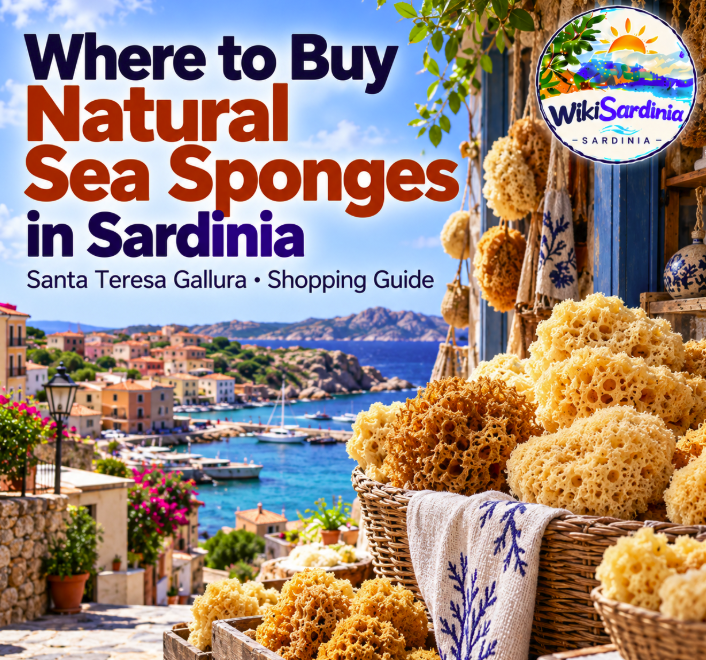
If you are visiting northern Sardinia and want to buy a natural sea sponge, Santa Teresa Gallura is a convenient place to begin your search. This coastal town in Gallura has souvenir shops, gift boutiques and seasonal tourist retail areas where you can ask about marine-inspired bath products. Availability of genuine natural sea sponges is not guaranteed, however, and a sponge sold in Sardinia is not necessarily harvested in Sardinian waters.
Quick answer: start with established shops in central Santa Teresa Gallura and ask specifically for a spugna marina naturale. Check the material, species and country of origin before purchasing. Do not assume that every seaside souvenir shop stocks real marine sponges.
Why shop in Santa Teresa Gallura?
Santa Teresa Gallura is a lively coastal base near the Strait of Bonifacio, with an accessible town center and shops catering to visitors. It makes a practical shopping stop if you are exploring the beaches of northern Gallura, although it is not established here as Sardinia's principal sponge-harvesting or sponge-production center. For a specific product, contact retailers before making a special journey.
Where should you look?
Begin with bath-and-body boutiques, traditional gift shops and established souvenir retailers in the town center. Ask whether they currently carry real marine bath sponges, whether the product is locally sourced or imported, and whether a supplier or origin label is available. Seasonal stalls can be useful for browsing, but they are not proof of origin or sustainable harvesting.
We have not verified a named Santa Teresa retailer currently selling natural marine sponges, so this guide does not present an unconfirmed shop as a guaranteed supplier.
Natural sea sponge, loofah or synthetic sponge?
| Product | What it is | What to ask |
|---|---|---|
| Natural marine sponge | Processed skeletal material from a marine sponge animal | Species, origin and legal sourcing |
| Natural loofah | Fibrous plant material from a gourd | Plant origin and processing |
| Synthetic bath sponge | Manufactured foam or polymer | Material and care instructions |
A marine sponge may have an irregular shape and a network of pores, but appearance alone cannot verify its species or collection history. A seller's documentation is more useful than claims such as 'Mediterranean style' or '100% authentic Sardinian'.
Is the Mediterranean bath sponge protected?
The Mediterranean bath sponge Spongia officinalis is recorded by Italy's environmental institute ISPRA among marine species subject to conservation measures. ISPRA notes that indiscriminate collection and overfishing are major threats, and that the species is listed under relevant Mediterranean and European conservation instruments. That does not mean every commercially sold natural sponge is illegal, but it does mean buyers should be cautious about provenance and applicable harvesting restrictions.
Never remove a living sponge from the sea yourself. Collection rules may vary by species, area and authorization, particularly in marine protected areas. Ask sellers about lawful supply chains rather than treating a beach find as a souvenir.
How to check quality before buying
- Ask for the material: confirm it is a marine sponge, not a synthetic foam or loofah.
- Check the label: look for a country of origin and supplier details.
- Inspect condition: avoid products with obvious deterioration, unusual residues or strong chemical odors.
- Ask about processing: cleaning and preparation methods can affect texture and appearance.
- Compare sizes: shape and dimensions naturally vary, so choose for your intended use.
- Keep the receipt: useful if the product is not as described.
How much does a natural sea sponge cost?
Prices vary by size, species, grade, processing and origin. There is no reliable fixed price for Santa Teresa Gallura without checking current stock. Compare labeled products and be skeptical of unusually specific claims about rare local origin that cannot be supported.
How to care for your sea sponge
Rinse thoroughly after use, squeeze gently without twisting and let it dry in a well-ventilated place. Avoid leaving it constantly wet in an enclosed container. Follow the seller's care instructions and replace it when it deteriorates. A natural marine sponge is not sterile and should not be shared for personal hygiene.
Can you bring one home?
A properly purchased, processed retail bath sponge is different from collecting a living marine organism. Keep proof of purchase and verify customs and wildlife-trade rules if traveling outside the European Union, especially where the species or origin is uncertain. Do not take organisms from protected waters.
FAQ
Are sea sponges sold in Santa Teresa Gallura?
They may be available through tourist, gift or bath-product retailers, but individual shop inventory has not been verified. Call ahead if finding one is the main purpose of your trip.
Are all natural sponges in Sardinia locally harvested?
No. A product sold on the island may come from elsewhere in the Mediterranean or beyond. Ask for documented origin.
Can I collect a sponge while snorkeling?
Do not remove living marine sponges. Species protection and local collection rules can apply, particularly in protected areas.
What should I say in Italian?
Try: “Avete spugne marine naturali? Sapete da dove provengono?” — “Do you have natural sea sponges? Do you know where they come from?”
WikiSardinia's recommendation
Enjoy Santa Teresa Gallura as a coastal shopping stop, but choose traceable sourcing over a romantic 'local sea sponge' story. A clearly labeled, legally sourced product is a better souvenir than an unidentified sponge with no information about its origin.
Further reading
ISPRA — Spongia officinalis, protected marine species atlas. Sardinia Region — 2026 coastal protection ordinance.