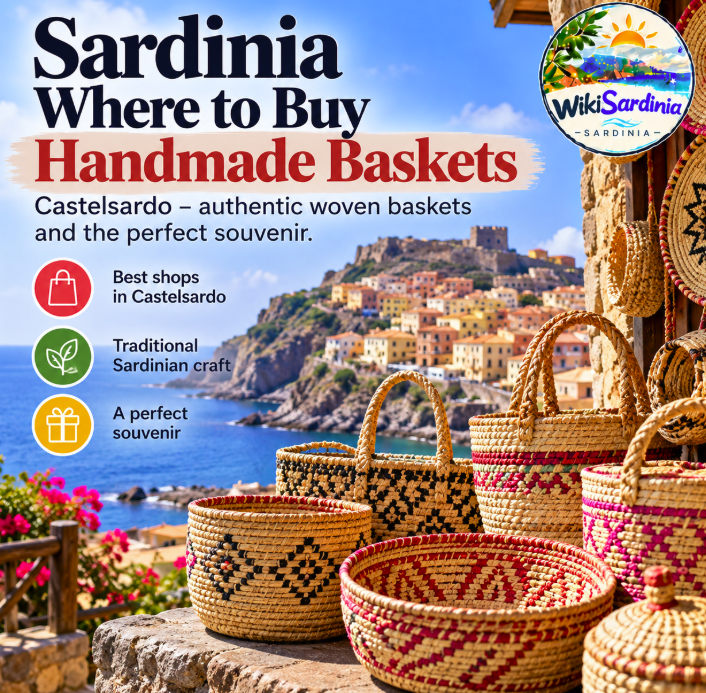
If you want to bring home a piece of Sardinia that reflects the island's living traditions, a handwoven basket from Castelsardo is an excellent place to start. This colorful hilltop town on Sardinia's north coast is celebrated for its weaving heritage, especially the work historically carried out by local women. A basket can be a practical household object, a decorative piece and a reminder of the skill behind Sardinian craftsmanship.
Why Castelsardo is famous for handmade baskets
Castelsardo is one of Sardinia's best-known centers for traditional basket weaving. The craft has been passed between generations, with artisans creating baskets from plant fibers using careful, repetitive handwork. Shapes, motifs and materials can vary according to the maker and intended use. Basketry is not unique to Castelsardo—other Sardinian communities also have important traditions—but the town is a particularly appealing place to explore the craft while visiting its historic center.
Where to buy baskets in Castelsardo
Begin in the historic center around the castle, where small craft shops and displays may offer woven baskets alongside ceramics and other local objects. Browse slowly rather than buying from the first souvenir rack. Ask whether the piece was made locally, who wove it and what materials were used. Opening hours, artisan availability and stock change by season, so this guide does not claim that any specific workshop is open today.
Visit the Museum of Mediterranean Weaving
Castelsardo's Museo dell'Intreccio Mediterraneo, housed in the historic castle, is a valuable starting point for understanding the cultural context of woven objects. Check current admission and opening information before visiting. A museum visit can help you appreciate the difference between a traditionally crafted basket and a generic souvenir.
Look for artisan-led shops and workshops
Whenever possible, favor sellers who can explain the maker, technique and provenance. If you have the opportunity to see a demonstration, observe respectfully and ask permission before photographing artisans at work. The time required to weave a basket is part of its value.
How to tell if a Sardinian basket is handmade
- Ask about the maker: a seller should ideally be able to identify the artisan or workshop.
- Inspect the weave: careful handwork may show subtle natural variation, although neatness alone does not prove origin.
- Check the materials: ask which plant fibers were used and how to care for them.
- Understand the price: larger or more intricate handmade pieces generally require more work, but price alone is not proof of authenticity.
- Request a receipt: useful for purchases and possible customs questions when traveling.
Which basket should you choose?
For an easy-to-pack souvenir, look for a small shallow tray, a decorative bowl or a compact basket that fits safely inside your luggage. Larger baskets can make striking home accents but are more difficult to transport. Choose a shape you will actually use: for keys, bread, fruit or simply as a display piece, depending on the maker's care instructions.
How much do handmade baskets cost?
There is no single reliable price for a Castelsardo basket. Cost depends on size, weaving complexity, materials, maker and sales setting. Rather than assuming that a low price is a bargain, compare craftsmanship and ask questions. This article does not publish unverified current shop prices.
Can you take a woven basket home to the United States?
Many visitors hope to bring Sardinian crafts back to the US. Because baskets can contain natural plant materials, US import and agricultural inspection rules may apply. Declare relevant items when required, retain receipts and check current US Customs and Border Protection and USDA guidance before traveling. Do not assume that every untreated plant-fiber object is automatically permitted.
Other Sardinian basket-weaving traditions
Castelsardo is not the only destination for basketry. Sinnai and Ollolai, for example, are also associated with distinctive local weaving traditions. If you are traveling across the island, exploring different regional styles can deepen your appreciation of the craft.
Tips for a respectful shopping visit
Buy directly from makers where possible, avoid bargaining aggressively over time-intensive handwork and ask before filming demonstrations. Supporting authentic local craft helps keep traditional knowledge visible and economically viable. A basket with a story is often more meaningful than a mass-produced souvenir.
The WikiSardinia takeaway
For travelers wondering where to buy handmade baskets in Sardinia, Castelsardo's old town is a natural first stop. Combine browsing artisan shops with a visit to the weaving museum, ask about provenance and choose a piece that celebrates the skill of Sardinian makers.