Among Sardinia's most recognisable craft traditions is the pattadese, a folding knife associated with the mountain town of Pattada in northern Sardinia. Its slender blade and carefully shaped handle have become symbols of local craftsmanship. Visitors sometimes ask for a Sardinian knife with a ram-horn handle—or a mouflon horn handle. Where does the tradition come from, and what should travellers understand before buying one?
Pattada: a centre of Sardinian knife craftsmanship
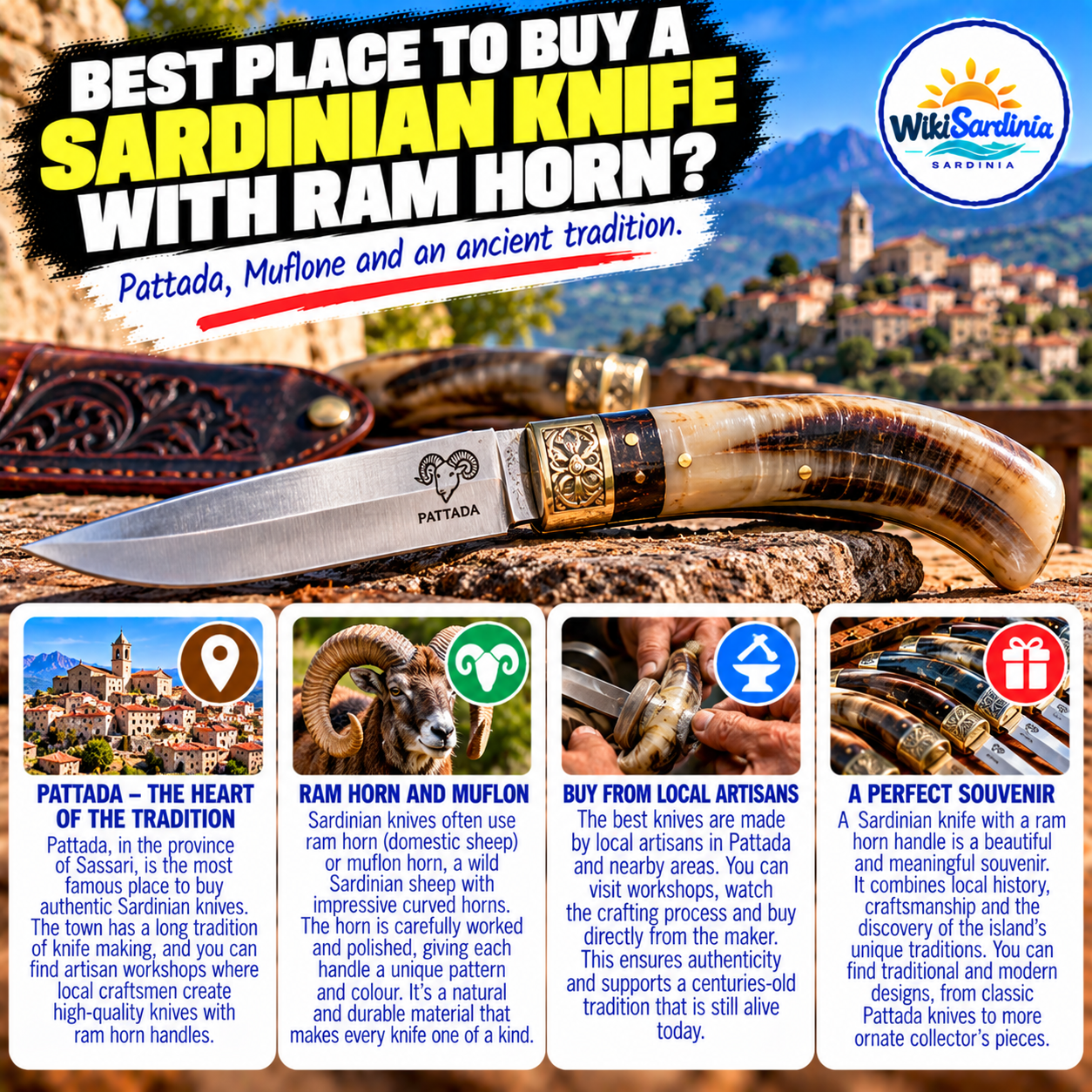
Pattada, in the province of Sassari, is especially well known for its cutlery workshops. Local makers have developed a distinctive folding-knife tradition in which the proportions of the blade, the shape of the handle and the quality of finishing all matter. The best-known design is often called the resolza pattadesa or pattadese. The word resolza is associated with traditional Sardinian folding knives, though forms and terminology vary across the island.
Pattada is an important place to learn about this craft, but it is not the only Sardinian community with a knife-making heritage. Other towns have their own forms, materials and traditions.
What makes a pattadese distinctive?
The classic pattadese is a folding pocket knife with a streamlined, pointed blade and a handle that may be made from horn or other materials. Many traditional examples use a simple friction-folding mechanism rather than a modern locking system. Designs vary between workshops and individual artisans, so there is no single universal specification that defines every authentic example.
The craftsmanship lies in the precise fit of the components, the shaping and polishing of the handle and the overall balance of the finished object. Decorative details can be restrained or elaborate, depending on the maker and intended use.
Ram horn or mouflon horn: what is the difference?
These materials are not interchangeable terms. Ram horn comes from a domestic male sheep, while mouflon horn comes from a wild sheep species or population. Both can have attractive natural patterns, but their origin and legal status may differ. The Sardinian mouflon is part of the island's protected wildlife heritage, and visitors should never assume that horn described as “mouflon” is freely or legally sourced.
For any horn-handled craft item, ask the seller to identify the material accurately and provide information about its lawful provenance. An attractive pattern alone cannot establish whether a handle is made from domestic ram horn, another horn material or a synthetic substitute.
Why are horn handles valued?
Horn has long appealed to artisans because it can be shaped and polished into smooth, distinctive handles. Natural variations in colour and grain make individual pieces visually different. A carefully made horn handle may display creamy, brown, grey or dark bands, but the appearance depends on the material and finishing process. Horn is an organic material that can respond to heat, humidity and neglect, so proper care is important.
Where can you learn about the tradition?
Pattada is the natural starting point for exploring the local history of the pattadese. Its workshops and craft culture are closely associated with the knife's identity. Visitors interested in purchasing an authentic handmade object should favour reputable, established makers and ask about craftsmanship, materials, provenance and applicable regulations rather than relying solely on a souvenir label.
Not every object sold as “Sardinian” is necessarily made on the island. Similarly, a stamped place name or decorative motif is not, by itself, proof of where a knife was produced.
Is the pattadese an ancient Nuragic knife?
It is tempting to describe every Sardinian tradition as thousands of years old, but that would be misleading here. Sardinia has a long history of metalworking, including in the Bronze Age, yet the modern folding pattadese should not be presented as an unchanged Nuragic design. Its present form belongs to a much later artisanal tradition shaped by evolving tools, materials and local practices.
Can tourists carry a Sardinian knife?
A traditional knife is a bladed object, not an ordinary travel trinket. Italian law restricts carrying knives in public without a justified reason, and the circumstances matter. Buying a knife does not automatically entitle someone to carry it in a pocket while sightseeing. Airlines also prohibit knives in cabin baggage, and rules for checked baggage, shipping and importation depend on the carrier and destination. Before travelling, check the current rules with the relevant authorities and transport provider. Do not rely on myths about a supposedly legal blade length that automatically permits public carrying.
How should a horn-handled craft object be cared for?
Keep natural horn away from prolonged moisture, extreme heat and harsh cleaning chemicals. Dry the object carefully after cleaning, and follow the maker's instructions for the particular material and finish. If the item is intended as a collectible, safe storage and appropriate handling are as important as appearance.
What makes Pattada worth visiting beyond the knives?
Pattada sits in the wooded highlands of northern Sardinia, an area with a strong pastoral identity and a distinctive inland landscape. Exploring the town offers a different perspective on the island from its famous beaches. The local knife-making tradition is part of a broader cultural world of craft skills, family workshops and regional identity.
The answer
If you are interested in the history of a Sardinian folding knife with a horn handle, Pattada is one of the most meaningful places to begin. The town is strongly associated with the pattadese and its makers. Remember, however, that domestic ram horn and wild mouflon horn are different materials, and provenance, wildlife protections and rules on transporting or carrying blades must be taken seriously. The most valuable souvenir is one whose craftsmanship and origin you can understand and document.