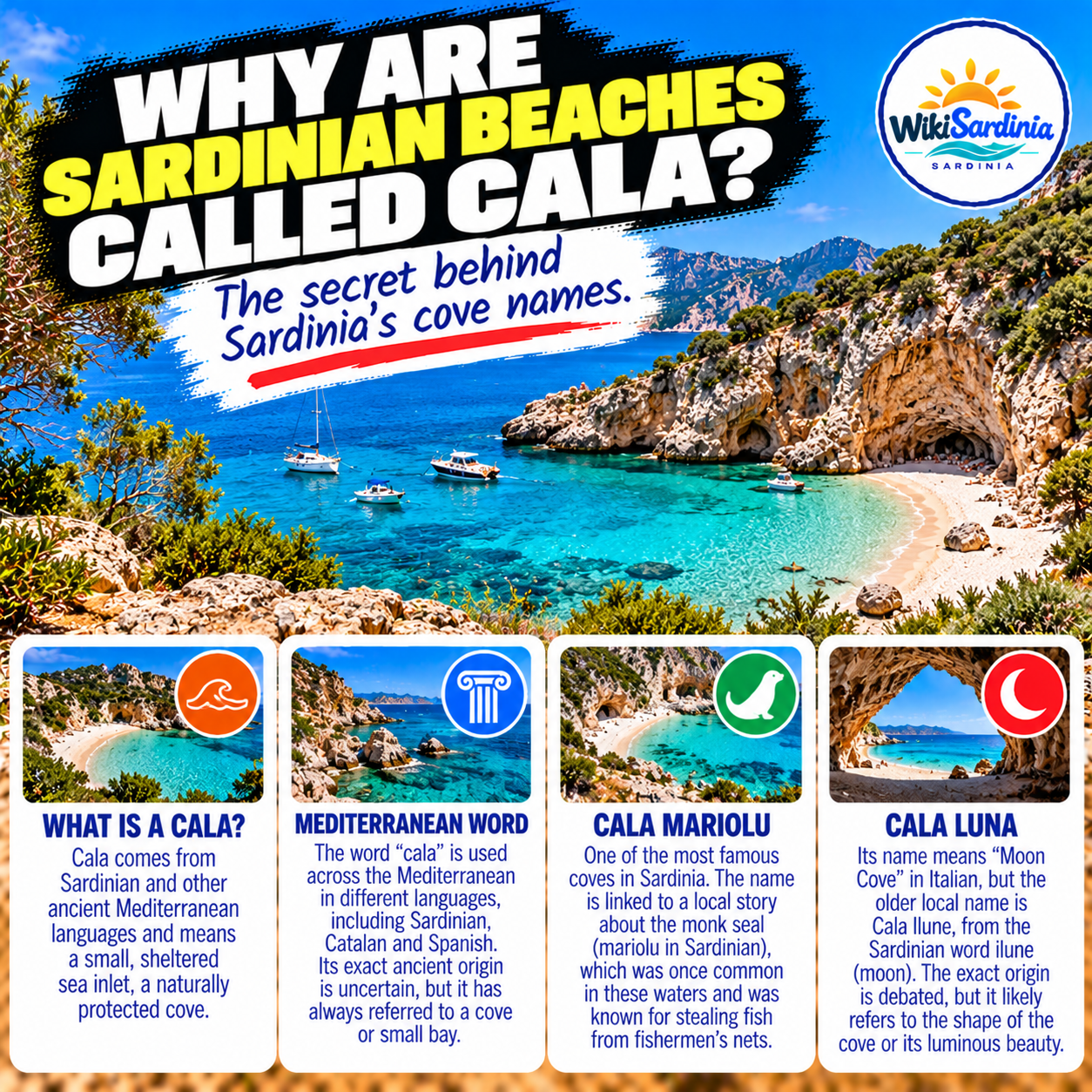
Look at a map of Sardinia and one word appears again and again along its spectacular coastline: Cala. Cala Luna, Cala Mariolu, Cala Goloritzè, Cala Sisine and dozens more. To an English-speaking traveller, the repetition may seem mysterious. The explanation begins with geography, but it also leads into centuries of Mediterranean languages, sailors and local stories.
What does “cala” mean?
A cala is a relatively small inlet or cove where the sea cuts into the coastline, often framed by rocky headlands. Some are sheltered natural landing places; others contain tiny beaches reached by boat or along footpaths. The word describes the shape of the coast, not necessarily a sandy beach. This is why a place can be called Cala even if it has pebbles, cliffs or very little space to sunbathe.
Is “cala” an ancient Sardinian word?
Not quite in the simple sense sometimes claimed online. Treccani traces the Italian geographical noun cala to Spanish cala and describes its deeper origin as probably Mediterranean. The De Mauro dictionary also gives a Spanish source but calls the ultimate origin uncertain. Sardinian place-name studies discuss the word in local coastal toponyms and its connections with Italian and Spanish forms. The safest explanation is that it belongs to a shared Mediterranean maritime vocabulary, used in Sardinia over a long period; we cannot prove that every local occurrence descends directly from a single ancient Sardinian word.
Why are there so many calas in Sardinia?
Much of Sardinia’s coast is made of rocky promontories, steep limestone cliffs and small inlets. In places such as the Gulf of Orosei, deep ravines and narrow valleys reach the sea between dramatic cliffs, creating secluded beaches and landing spots. Before modern roads, coastal names helped fishermen, sailors and local communities distinguish one inlet from the next. A descriptive word followed by a distinguishing name was a practical way to identify places along the shore.
Cala Mariolu: the story of the “thief”
Cala Mariolu, near Baunei, is one of Sardinia’s best-known coves. According to a traditional explanation repeated by the official Sardegna Turismo website, fishermen called a monk seal a mariolu — a thief — because it took fish from their nets or catches. The nickname became associated with the cove. It is a charming piece of maritime folklore, although it should be treated as a traditional account rather than a fully documented naming event. The beach also has a local name associated with its tiny pale pebbles, Ispuligidenie or related spellings, often explained as “snow fleas.”
Cala Luna: is it really named after the moon?
At first glance, Cala Luna seems to mean “Moon Cove.” But the history of the name is more complicated. Historical maps record forms such as Cala Ilune, and regional environmental research cautions that the familiar Italian form may be a later adaptation. Suggestions linking the name to the colour of the rocks or the moon are not settled etymologies. The cove itself is famous for its broad beach and large caves at the foot of limestone cliffs, whatever the precise origin of its name.
Cala Goloritzè and other unforgettable names
Cala Goloritzè is renowned for its white pebbles, turquoise water, natural rock arch and towering limestone pinnacle. Nearby Cala Sisine and Cala Biriola are equally striking examples of the coast’s geography. Their second names come from different local histories, landscapes or linguistic traditions, and not every proposed meaning can be confirmed. That variety is part of the fascination: the word cala tells you what sort of place you are approaching, while the rest of the name may preserve a much older story.
Does every cala have a beach?
No. Some are rocky recesses or small harbours, and others are beaches surrounded by cliffs. Access varies enormously. Several coves in the Gulf of Orosei are reachable only by boat or challenging hiking routes, and protected sites may have visitor rules or reservation systems. Always check current local access arrangements, sea conditions and trail difficulty before setting out.
What other Sardinian coastal words should travellers know?
You will also see spiaggia, the Italian word for beach, and Sardinian terms such as is, sa or su in place names, reflecting local language varieties and grammatical articles. Place names across the island combine Sardinian, Italian, Catalan, Spanish and older linguistic layers. A map of Sardinia is therefore also a small history lesson.
The answer
So why are so many Sardinian beaches called Cala something? Because cala means a small coastal inlet or cove, a useful description for Sardinia’s rugged shores. The term belongs to a wider Mediterranean vocabulary rather than a securely proven single “ancient Sardinian” origin. The name after Cala is where the real local stories begin — from fishermen and monk seals to landscapes, older dialects and names that still puzzle historians.