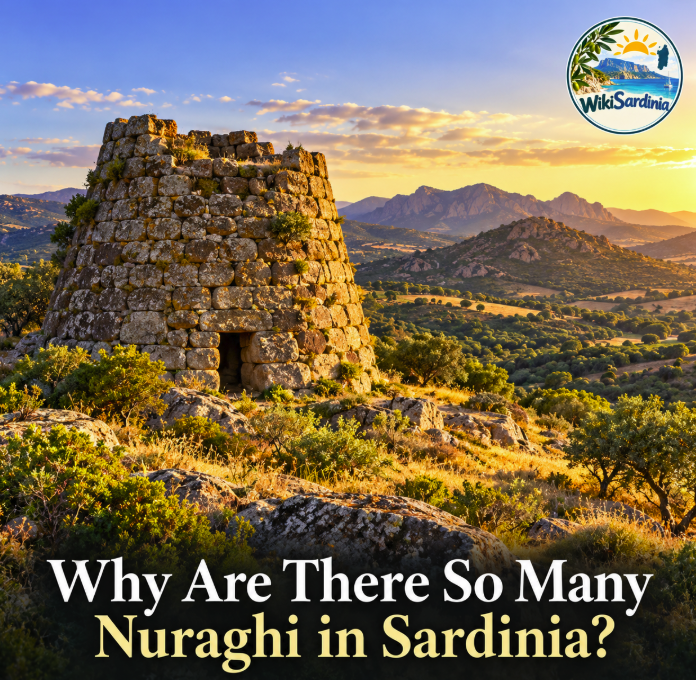
Nuraghi seem to appear everywhere when you travel through Sardinia: a stone tower above a field, a ruined complex near a village, another silhouette beyond the road. Their abundance reflects a building tradition spread across the island during the Bronze Age, rather than one isolated capital or a single monument copied for decoration.
The familiar figure of 7,000 describes the scale of that surviving heritage. It is a useful starting point, but the more interesting question is what these structures tell us about the communities that built them, the land they occupied and the changing roles of their settlements.
What does the figure of 7,000 actually mean?
The National Archaeological Museum of Cagliari states that more than 7,000 nuraghi have been recorded, including single towers, complex structures and their predecessors, known as protonuraghi or corridor nuraghi.
That qualification matters. The figure does not mean 7,000 complete towers of identical shape, all standing as they originally did. It covers different architectural forms and degrees of survival. A visitor may recognise an imposing tower immediately while overlooking a lower or more fragmentary structure.
Think of the number as evidence of an extensive archaeological landscape. It should not become a promise that every listed monument is excavated, open to visitors or straightforward to enter. Nor does the total, by itself, tell us how many buildings were occupied simultaneously.
Many communities, many places to oversee
UNESCO’s account of Su Nuraxi at Barumini describes nuraghi as distinctive Bronze Age stone towers with corbel-vaulted chambers. It considers their initial construction associated with individual families or clans, and explains how additional structures developed around isolated towers as society became more complex, for social and defensive reasons.
This helps explain why a traveller encounters monuments across the countryside rather than only at one famous site. The interpretation concerns communities organising their surroundings through substantial buildings. It does not require imagining a single island-wide command that ordered thousands of identical watchtowers.
The Region of Sardinia’s Virtual Archaeology account says most scholars regard nuraghi as multipurpose buildings associated with a tribal society and the control of territory and its resources. Defence belongs in that discussion, but “every tower was simply a military fort” is too narrow a description.
For a visitor, this shifts attention from the building alone to its setting. Look at the land around it, the relationship with nearby settlement remains and the position from which the structure can be seen. These observations make useful questions for a guide; they do not prove a specific function without archaeological evidence.
The towers were part of a wider world
Nuragic archaeology includes much more than nuraghi. SardegnaCultura’s overview also identifies giants’ tombs, sacred wells and springs, and megaron-type temples. These categories should remain distinct: a tower, a burial monument and a water sanctuary are not interchangeable names for the same structure.
That wider context explains why a visit becomes more rewarding when it includes settlement remains or a museum. A dramatic tower supplies the first impression; objects and associated buildings help you ask how people lived, worked and organised relationships beyond its walls.
Su Nuraxi is especially useful as an example of a complex with a surrounding settlement. Its World Heritage status applies to that inscribed property. The presence of another nuraghe elsewhere on the island does not automatically make that monument part of the same UNESCO inscription.
There is also no need to force every building into one final explanation. The sites differ, and their histories extend beyond a single moment of construction. Treat a local interpretation as an explanation of that monument’s evidence, rather than a rule that instantly resolves the whole island.
How to turn a roadside curiosity into a visit
Choose one managed archaeological site and give it time, instead of trying to count towers from the car. Check its official access arrangements before departure. If possible, ask a guide to distinguish the surviving masonry from later additions or restoration, and to explain which interpretations are well supported and which remain debated.
Useful questions include: “What makes this a single-tower or complex nuraghe?”, “Which settlement remains belong to the same period?” and “What evidence suggests how this particular place was used?” They lead to more precise answers than asking whether all nuraghi were castles or temples.
Across Sardinia, the repeated presence of these monuments records the breadth of a prehistoric building tradition. Their differences are part of the story: thousands of structures invite thousands of local investigations, rather than one explanation that makes every tower identical.