You have just arrived in Sardinia, driven to a supermarket to stock your holiday apartment, and found a row of shopping carts linked together by short metal chains. You pull on one. Nothing happens. Then you notice a little slot marked €1. Do Italian supermarkets really charge you to use a shopping cart?
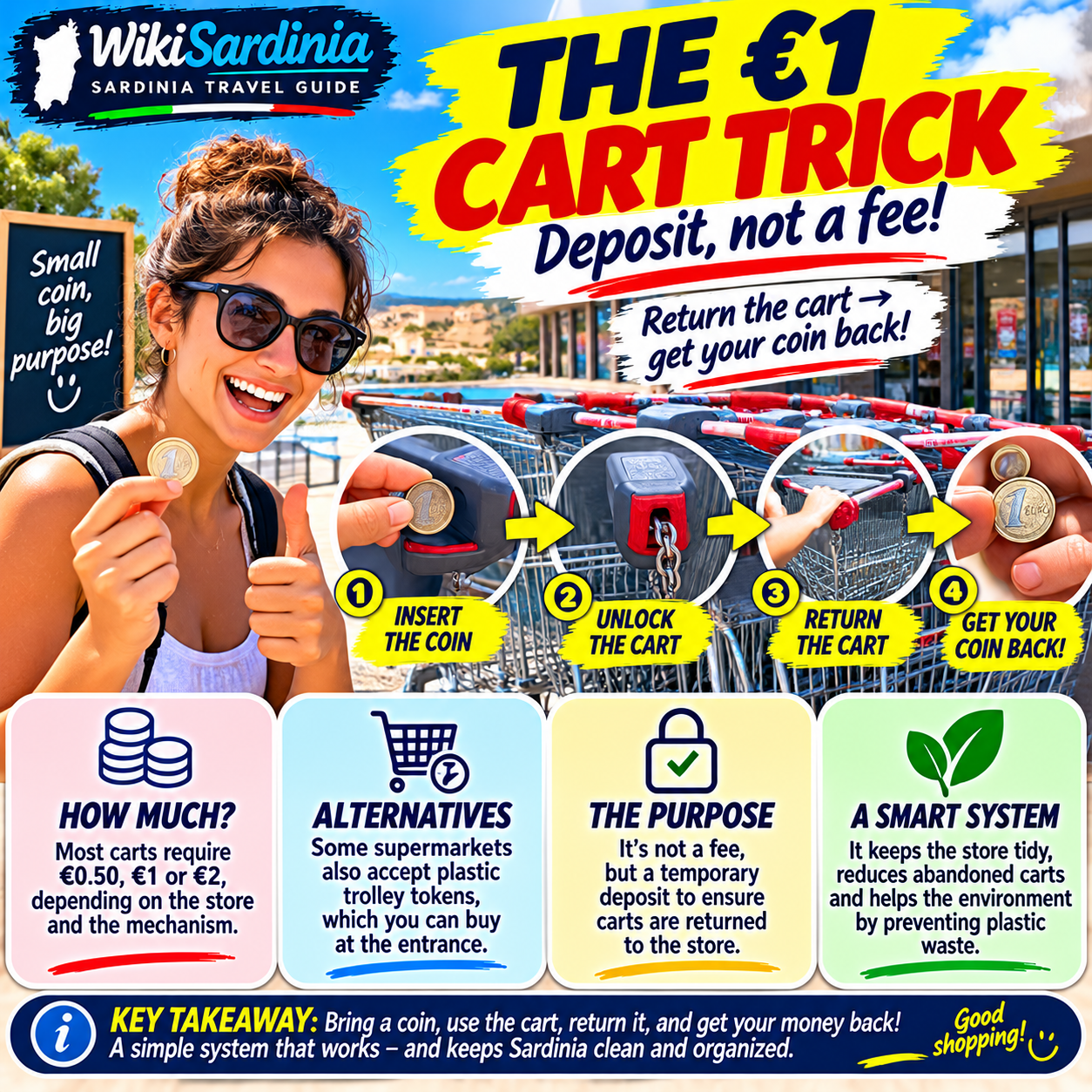
No. The coin is usually a refundable deposit, not a shopping fee. The system encourages customers to return their carts to the designated rack after shopping, keeping supermarket entrances and car parks tidy. It is common in Italy and other European countries, although the exact system varies by supermarket and branch.
Why do Italian supermarkets use a coin deposit?
The main purpose is surprisingly simple: encouraging people to put carts back where they belong. A small deposit creates an immediate incentive to return a trolley rather than leave it beside a parked car, on a pavement or in the middle of a parking bay.
Returned carts are easier for the next customer to find and mean staff spend less time collecting abandoned trolleys. A manager at a Conad store interviewed by Il Tirreno explicitly linked the coin-lock system to reducing the need for employees to retrieve carts. The practice is not unique to Italy; comparable deposit systems are widespread in European supermarkets.
It may also discourage casual misuse, but a one-euro coin is clearly not the full value of a supermarket trolley. The system works primarily as a nudge toward orderly returns, not as a serious theft-proof security device.
How does the shopping cart coin system work?
Most coin-lock carts have a small mechanism attached to the handle and a short chain connecting the cart to the next one. To use one:
- Check the coin slot. It usually shows which coin denomination or trolley token is accepted.
- Insert the coin. Push it fully into the slot or sliding holder until the lock releases.
- Disconnect the chain. The cart is now free to use while you shop.
- Return the cart. After loading your groceries, take the empty trolley back to a compatible cart rack.
- Reconnect the chain. Insert the chain connector from the adjacent cart into the lock on your trolley. The mechanism releases your coin so you can take it back.
The coin is temporarily held in the lock while you shop. It is not collected by the cashier and does not appear as a charge on your grocery receipt.
How much money do you need?
A €1 coin is a very common choice, but some Italian trolley locks accept €0.50 or €2 coins, and some accept special reusable tokens. The required denomination depends on the hardware at that particular supermarket.
If you are staying in Sardinia for a week or two, keeping a €1 coin in your wallet or car is an easy travel habit. Do not assume every machine will accept every denomination: check the symbol or instructions on the lock.
Do Conad and Eurospin always require a coin?
No single rule applies to every Conad, Eurospin or other Italian supermarket branch. Many larger stores use traditional coin-lock trolleys, but others provide carts without deposits, use different release systems or offer smaller baskets that require no coin.
Conad itself has documented trials of a smart trolley check-in system that released carts without a coin or token, illustrating that the mechanism is a store-level operational choice rather than a nationwide law.
Whether you are shopping in Alghero, Cagliari, Olbia or an inland village, look at the trolley area when you arrive rather than relying on the supermarket brand alone.
What if you don't have a coin?
Don't worry. First, check whether the store provides hand baskets or wheeled shopping baskets near the entrance; these often do not need a deposit. If you need a full-size cart, ask a member of staff or the customer-service desk whether they can exchange a small amount of cash for the right coin or provide a compatible token.
Some stores have reusable plastic or metal gettoni—trolley tokens—that work in place of coins. Availability is not guaranteed, so it is better to ask than to force the lock with an improvised object.
If you only have a debit card, ask whether the cashier can help. A card payment at checkout does not normally unlock a purely mechanical coin-lock trolley.
Can you use a foreign coin?
Do not count on it. Coin-lock mechanisms are designed for particular sizes and shapes, and a foreign coin that looks similar may not fit or may jam the device. Use the euro denomination displayed on the cart or an approved trolley token.
For visitors arriving from the United States, the United Kingdom or another country outside the euro area, getting a few euro coins before your first supermarket visit can be helpful.
Is the coin deposit compulsory by Italian law?
No general Italian law requires every supermarket to use coin-lock shopping carts. It is a practical operating system chosen by individual retailers and stores. That is why you may find a coin-operated cart at one branch and an unlocked cart at another.
The same applies within Sardinia: there is no separate Sardinian tourist trolley tax or special regional deposit.
What if you forget to return the trolley?
With a standard coin-lock system, your coin remains trapped in the handle until the cart is properly reconnected to another compatible trolley or the rack mechanism. If you leave the cart in the car park, you may lose the deposit.
That is the point of the system: the small inconvenience of losing a coin encourages most shoppers to bring the trolley back. If the lock malfunctions after you return it, ask staff for assistance instead of trying to break or pry open the mechanism.
Is the deposit the same as paying for shopping bags?
No. Shopping bags are a separate matter. Many Italian supermarkets charge for reusable bags or permitted single-use bags at checkout, so bring your own shopping bags when possible. The trolley deposit, by contrast, is normally returned to you after you reconnect the cart.
When shopping for a holiday apartment, it is worth keeping both a reusable bag and a trolley coin handy.
Other supermarket habits that surprise visitors
The trolley coin is only one of several small differences tourists may notice in Italian grocery stores. Some shops ask customers to wear disposable gloves when selecting loose fruit and vegetables. In others, shoppers weigh produce themselves and print a price label before checkout, while some stores weigh it at the till. Procedures vary by branch.
At the deli counter, you may order cheese or cured meats by the etto, which means 100 grams. And if you are visiting a smaller town, check opening hours: some shops may close for a midday break or have shorter Sunday hours.
None of these details should put you off shopping locally. Sardinian supermarkets are a practical place to buy water, snacks, fruit and ingredients for a self-catering holiday, and a little preparation makes the experience easier.
Useful Italian phrases
- Serve una moneta per il carrello? — Do I need a coin for the trolley?
- Quale moneta serve? — Which coin do I need?
- Avete un gettone per il carrello? — Do you have a trolley token?
- Potete cambiarmi un euro? — Can you give me change for one euro?
- Dove si riportano i carrelli? — Where do I return the trolleys?
- Il carrello non restituisce la moneta. — The trolley isn't returning my coin.
Frequently asked questions
Do I lose the €1 when I take a supermarket trolley?
No. With the usual deposit system, you get the coin back when you return the cart and reconnect its chain.
Can I use a €2 or 50-cent coin instead?
Sometimes. It depends on the trolley lock. Check the denomination shown on the device.
Do all Conad supermarkets have coin-operated carts?
No. The arrangement can vary between branches and store formats.
Do Eurospin supermarkets charge for carts?
A coin-lock trolley is normally a refundable deposit system, not a charge. The exact cart arrangement varies by location.
Can I unlock a cart with a credit card?
Not with a standard mechanical coin lock. Ask staff about tokens or use a basket if you have no change.
Can I use a plastic trolley token?
Many locks accept compatible tokens, but not all. Use only the type approved for that mechanism.
Why not just leave carts unlocked?
Some supermarkets do. Others prefer the deposit system because it encourages customers to return trolleys and reduces carts left around the parking area.
Is this a Sardinian custom?
No. Coin-operated shopping carts are common across Italy and elsewhere in Europe.
The bottom line
That little €1 coin is not a hidden supermarket fee. It is a simple, refundable deposit designed to keep shopping carts where they belong. Bring a euro coin, unlock your trolley, enjoy your grocery shopping and return the cart to get your money back. It's one of those everyday Italian habits that feels completely normal once you've done it once.