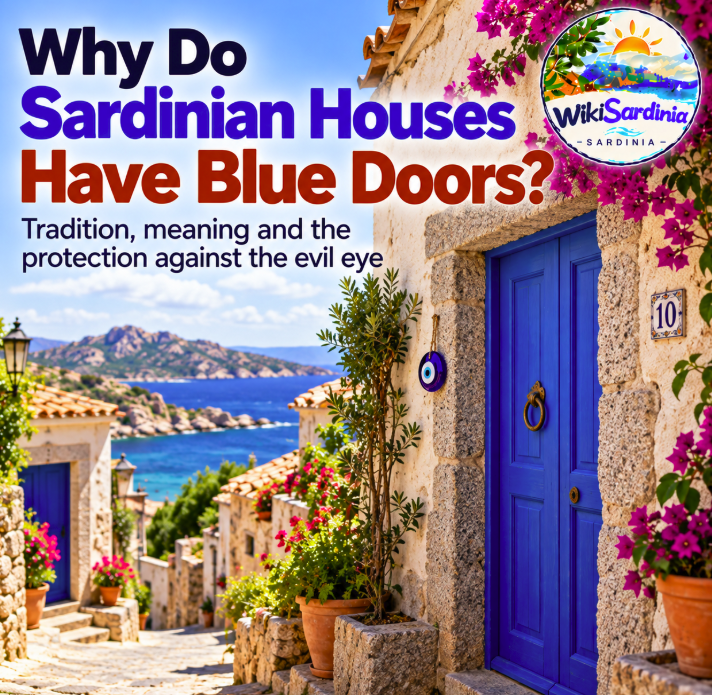
Walk through a Sardinian village and you may spot a beautiful blue door set into a stone or whitewashed wall. Against warm Mediterranean light, the color is striking—and it invites a question: why do some Sardinian houses have blue doors?
One popular explanation links blue to protection from the malocchio, or evil eye, a belief found in Sardinian and wider Mediterranean folklore. But there is an important distinction: the idea that all Sardinian blue doors were painted to ward off the evil eye is not an established island-wide historical fact. Doors can also be blue because of personal taste, coastal aesthetics, local building traditions or later renovations.
Blue doors and the evil eye: where the story comes from
The malocchio refers to the belief that an envious or harmful gaze can bring misfortune. Versions of this belief appear across Italy and the Mediterranean, where families have traditionally used prayers, gestures, charms and protective symbols to counter it. In this broader cultural setting, blue is sometimes associated with protection, especially through blue eye-shaped amulets.
That association makes the blue-door explanation appealing. However, the familiar blue glass eye charm is especially recognizable in parts of the eastern Mediterranean; its appearance in a modern photograph of a Sardinian doorway should not be treated as proof of an ancient, uniquely Sardinian architectural custom.
Is painting a door blue a traditional Sardinian protection ritual?
There is no reason to assume every blue-painted Sardinian entrance has a protective meaning. Without a local historical source, a resident's account or documented village custom, it is more accurate to say that blue doors can be interpreted through Mediterranean protective symbolism rather than to claim that blue paint universally kept evil spirits away in Sardinia.
If you are curious about a particular doorway, ask its owner or consult local heritage material. A family's explanation may be much more specific—and interesting—than a general legend.
Other reasons a Sardinian door might be blue
- Coastal colors: blue recalls the sea and sky and pairs naturally with pale plaster, stone and terracotta roofs.
- Personal preference: a homeowner may simply love the color.
- Decorative contrast: vivid paint makes an entrance stand out against neutral masonry.
- Restoration choices: a recently painted door may reflect contemporary design rather than a centuries-old tradition.
- Local practices: building styles vary between Sardinian regions and villages; one town's appearance should not be generalized to the entire island.
How Sardinian architecture varies across the island
Sardinia is not defined by a single house style. Inland villages may feature stone façades and traditional timber elements, while coastal settlements often show different plaster finishes, shutters and decorative colors. Materials, climate, construction periods and local history all shape what you see.
This variety matters when interpreting a blue doorway. A single attractive photo cannot establish a historical rule for Sardinian architecture.
What exactly is the malocchio in Sardinian culture?
Belief in the evil eye has long existed in Sardinian popular culture, alongside a range of prayers and protective practices. Customs differ by family and community, and they should be described respectfully as folklore and lived cultural traditions—not as scientifically demonstrated forces.
Some protective objects and rituals have specific local histories. A blue door, by contrast, needs its own evidence before it can be identified as one of them.
Where can you photograph colorful doors in Sardinia?
Keep an eye out while exploring historic streets in places such as Alghero, Bosa and Santa Teresa Gallura, where different building periods and decorative tastes create interesting doorways and façades. This is a suggestion for enjoying village architecture, not a claim that any of these towns has a documented blue-door ritual. You may find blue, green, brown, red or natural-wood entrances side by side.
When photographing residential streets, respect private property and avoid blocking doorways or photographing people inside their homes.
How to ask a local about the meaning
Try a friendly question in Italian: “C'è una storia dietro il colore blu di questa porta?” — “Is there a story behind the blue color of this door?”
If someone mentions the evil eye, ask whether that meaning comes from their family, a village tradition or a story they heard. The answer can help separate personal heritage from broader Mediterranean symbolism.
FAQ
Do all Sardinian houses have blue doors?
No. Door colors vary widely across the island.
Does a blue door protect against the evil eye?
Blue can carry protective associations in Mediterranean folklore, but a universal Sardinian custom of painting doors blue specifically against the evil eye has not been established here.
Is the blue eye amulet originally Sardinian?
Eye-shaped blue amulets are associated with several Mediterranean and neighboring traditions; do not assume they are uniquely Sardinian.
Are blue doors a sign of an old house?
No. Paint color alone cannot establish a building's age or the date of its decoration.
What is the Italian word for the evil eye?
Malocchio. It is a traditional belief associated with envy, bad luck and protective practices.
WikiSardinia's take
A blue door is a lovely detail to notice while traveling through Sardinia. The malocchio offers a fascinating cultural lens, but the most rewarding approach is to stay curious: enjoy the folklore without turning every blue doorway into an unsupported historical claim. Sometimes the best explanation comes from the person who painted it.