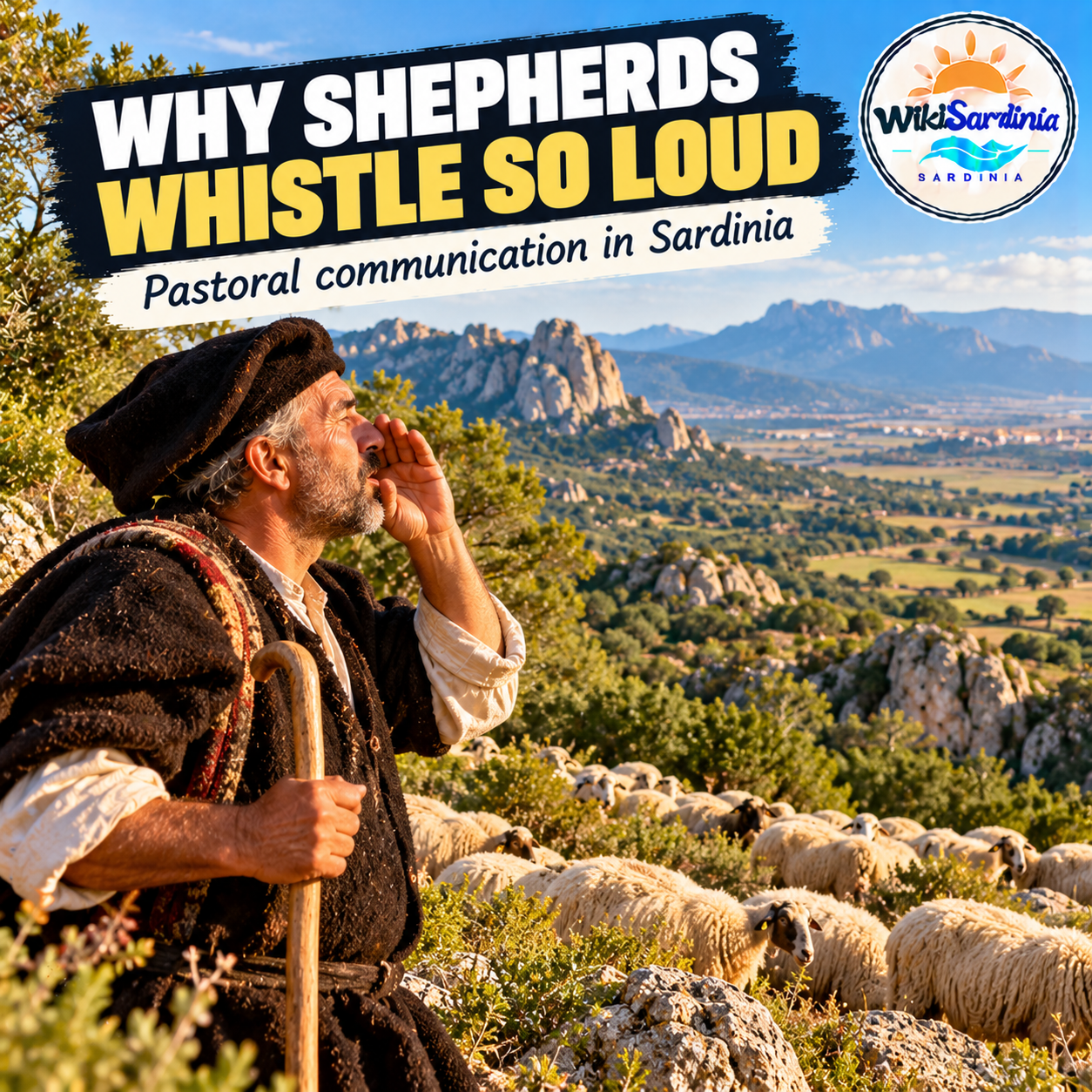
In Sardinia’s open countryside, a shepherd’s whistle can seem astonishingly loud. The sound may carry across a valley or pasture, helping the shepherd get an animal’s attention without having to walk right up to the flock. But there is no reliable rule that every shepherd’s whistle can be heard exactly one kilometre away: distance depends on the landscape, wind, background noise and the pitch and strength of the call.
Whistling is part of a wider pastoral language
Traditional shepherding in Sardinia involves more than ordinary speech. Calls, whistles, shouts, clicks and other vocal sounds have been used to guide, stop or summon livestock. Research documented by Sardinian agricultural scholar Giuseppe Pulina and colleagues describes distinct vocal signals used with different animals, including sheep, cattle, horses, donkeys and pigs. Much of this knowledge was learned by listening to older relatives and experienced shepherds.
These sounds are not necessarily a single standard “whistle language”. Their form and use can vary between shepherds, communities and the animals being handled.
Why make the sound so powerful?
On a large pasture, animals may be spread out and separated by rocks, shrubs or uneven ground. A sharp, clear call can attract attention over the ordinary sounds of the countryside. It may be used to encourage the flock to move, bring animals closer, signal a change of direction or reinforce a familiar command.
A loud call is useful because the shepherd and the animals do not always have a direct line of sight. The aim is not simply to make noise, but to produce a recognisable signal that the animals have learned to associate with a particular action.
Can a whistle really travel one kilometre?
Sometimes a strong whistle may be audible over a long distance in quiet, open terrain, but one kilometre is not a guaranteed range. A rocky valley can reflect or block sound; dense vegetation, wind and other noise can reduce how far it carries. The same whistle may be clear across an open slope and difficult to hear just a short distance away in different conditions.
It is more accurate to say that shepherd calls are designed to be heard at a useful distance in the local landscape than to attach a fixed measurement to every whistle.
How shepherds learn the calls
Historically, pastoral skills were often passed from one generation to the next. Young shepherds learned by accompanying older family members, listening to their calls and watching how the animals responded. The sound itself, its timing and the situation all mattered. A familiar call could become part of the daily routine of moving and managing the flock.
Researchers and artists have also recorded this disappearing sound heritage. The La Nuova Sardegna report on shepherds communicating with animals discusses the vocal signals used in traditional livestock management, while the Oralità Pastorale sound archive explores calls, whistles, rhythms and silences used with sheep and goats.
A sound that belongs to Sardinia’s countryside
The loud whistle is one small part of a much richer pastoral culture, alongside bells, spoken commands, animal calls and the distinctive singing traditions of central Sardinia. UNESCO recognises canto a tenore, a form of Sardinian pastoral polyphonic singing, as intangible cultural heritage. It is a different practice from shepherding calls, but both reflect the close relationship between sound, community and rural life.
So when you hear a whistle echoing across a Sardinian hillside, it may be practical communication shaped by generations of experience. It can travel surprisingly far in the right conditions, but its real importance is not a distance record: it is the knowledge carried in a sound that helps a shepherd work with the flock.