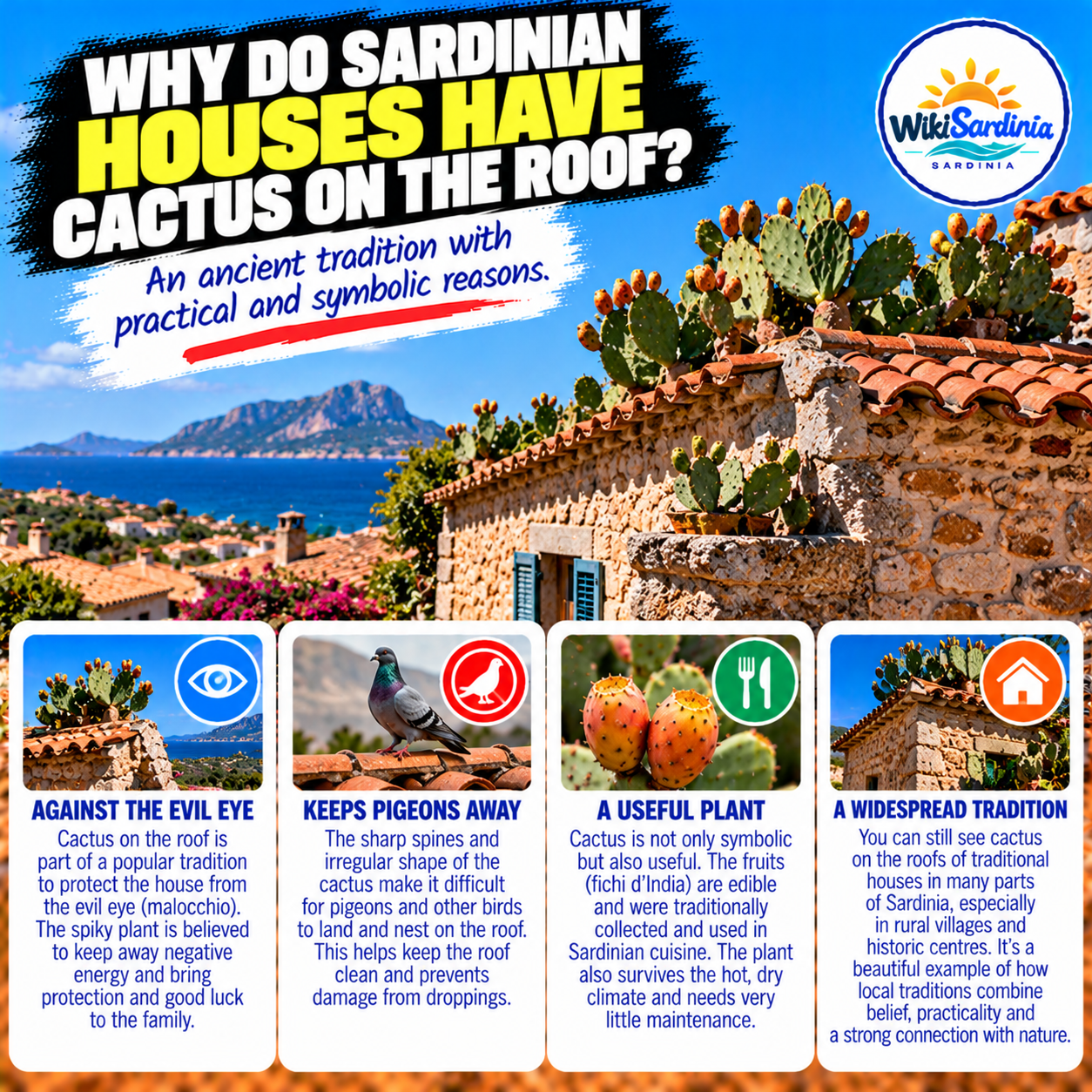
Walk through a traditional Sardinian village and you may notice prickly pear cacti growing beside old stone houses, above boundary walls or occasionally near a rooftop. Their broad green pads and bright orange fruits look almost like part of the architecture. But why are they there? Is it true that Sardinians put cacti on roofs to protect their homes from the evil eye—and to keep pigeons away?
The answer mixes Mediterranean folklore with the practical qualities of a remarkably resilient plant. It also requires one important distinction: prickly pear cacti are widespread in Sardinia, but they are not a universal feature of Sardinian rooftops, and not every cactus growing above a house was deliberately planted there.
The plant behind the story: prickly pear
The plant most visitors recognise is Opuntia ficus-indica, commonly called prickly pear or, in Italian, fico d'India. Despite its familiar place in Sardinian scenery, it is not originally a Mediterranean species. Prickly pears come from the Americas and spread through the Mediterranean after transatlantic contact. They adapted well to Sardinia's hot, dry summers and became a familiar presence around rural properties, roadsides and field boundaries.
The fleshy green structures are flattened stems, called pads or cladodes, rather than leaves. They store water and allow the plant to survive extended dry periods. Its fruits can be eaten after careful handling and preparation, but the tiny hair-like spines, known as glochids, can be extremely irritating.
Was a cactus believed to protect against the evil eye?
In many Mediterranean communities, plants with thorns or spines have been associated with protection, boundaries and the symbolic repelling of misfortune. Sardinian popular traditions also include beliefs concerning the malocchio, or evil eye. Against that cultural background, the idea of a spiny plant acting as a protective presence is plausible as a folk interpretation.
However, a claim that Sardinian families universally placed a prickly pear on the roof as a formal anti-malocchio ritual would go beyond the evidence. Beliefs differ by village, household and generation, and oral traditions do not always have a clear written record. A cactus near a doorway or roof may have had symbolic meaning to one family and a purely practical purpose to another.
Did cacti keep pigeons off the roof?
The second popular explanation is that a cactus discourages pigeons and other birds from landing or nesting. A dense, spiny plant could make a particular ledge less convenient for birds. But that does not establish a documented, widespread Sardinian method of pigeon control. Birds can also perch on or around prickly pear plants, and the presence of cactus on a building does not prove it was planted to deter them.
There is also a practical downside to putting a large plant on a roof. Roots, accumulated soil, trapped moisture and increasing weight may damage old masonry or roof coverings. A cactus growing on a historic building should not automatically be treated as an intentional architectural feature.
Why prickly pears were useful around houses
Whatever their symbolic associations, prickly pears offered genuine benefits to rural households. They tolerated drought, needed relatively little care once established and produced edible fruit. Dense rows of prickly pear could serve as living barriers along property boundaries or help mark the edge of cultivated land. Their tough pads and formidable spines made them particularly suitable for places where an ordinary hedge might struggle in summer heat.
The fruit, known as fichi d'India, became part of local food culture. It is sweet and refreshing when ripe, although harvesting and peeling require care. The plant's usefulness helps explain why it became so common in the Sardinian landscape, even without any supernatural explanation.
Why do cacti sometimes grow on walls or roofs?
Prickly pears can establish themselves in unexpected places. A detached pad can root under favourable conditions, and seeds dispersed by animals may germinate in pockets of soil. Old stone walls, neglected terraces and crevices can collect enough material to support small plants. In some settings people deliberately planted them near a building; in others, they may simply have spread naturally.
That distinction matters when looking at photographs of a cactus apparently growing out of a rooftop. Without knowing the building's history, it is impossible to say whether the plant was placed there as a charm, used as a barrier or arrived by chance.
Is the custom ancient?
Not in the sense of reaching back to Nuragic or Roman Sardinia. Because the prickly pear is native to the Americas, its presence in Sardinia belongs to the post-Columbian history of Mediterranean agriculture and gardens. Sardinian beliefs about protection and the evil eye may have older roots, but that does not mean this particular cactus was part of an ancient Nuragic roof ritual.
Where can visitors see prickly pears in Sardinia?
Prickly pears are visible in many parts of the island, especially in sunny, dry landscapes, along rural roads and near traditional stone walls. They can be striking in late summer and early autumn when the fruit ripens. Visitors should admire them without touching the pads or picking fruit from private land. Even apparently smooth fruit can carry nearly invisible spines.
What is the real story behind cactus on Sardinian roofs?
The most accurate answer is that prickly pears became part of Sardinia's rural landscape because they are hardy, useful plants. Their spines also fit naturally into Mediterranean ideas about protection, so some people may connect them with keeping away the evil eye. The claim that roof cacti were systematically planted to repel pigeons is less securely documented.
Like many Sardinian traditions, the interesting story lies between what people believe, what they remember and what the physical evidence can actually tell us. The next time you see a cactus rising above an old stone wall, you may be looking at a useful plant, a family tradition—or simply nature reclaiming a corner of the building.