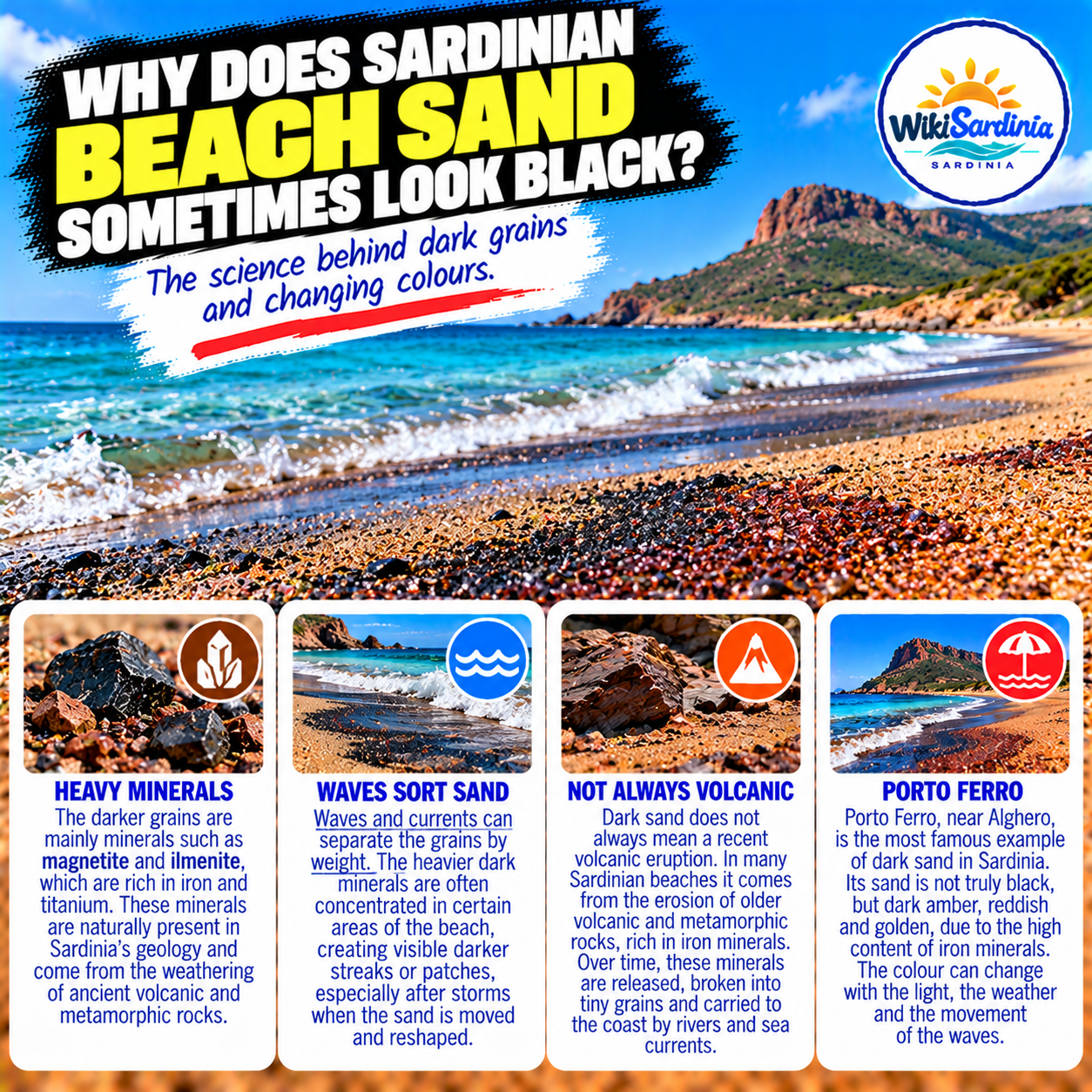
Sardinia is famous for white sand and turquoise water, but occasionally a stretch of beach looks almost black. You might notice dark stripes beside the surf, charcoal-coloured patches after rough weather or grains that sparkle against lighter sand. What causes this unusual effect? The answer lies in the minerals within the sand—and in the remarkable way waves sort them.
Why can beach sand look black?
Sand is made from tiny fragments of rocks, minerals and sometimes shells. Its colour depends on the materials that supply those grains. Dark beach sand can contain minerals such as magnetite, an iron oxide, and ilmenite, an iron-titanium oxide. Both are typically darker and denser than common light-coloured quartz grains. Other dark rock fragments can also contribute to the overall appearance.
These minerals do not have to come from a volcano erupting beside the beach. They may have been released by the slow weathering of much older volcanic, metamorphic or other rocks and carried to the coast by streams, erosion and marine transport.
How do waves create black stripes in the sand?
The most surprising part of the story is that the sea can sort sand by grain size and density. When waves wash over a beach, they move some lighter particles more easily than heavier ones. Under suitable conditions, dense dark minerals become concentrated in thin layers or patches while lighter grains are redistributed. This process can produce striking dark streaks, especially around the swash zone.
Researchers studying beaches in different parts of the world have documented heavy-mineral layers enriched in magnetite and ilmenite. The exact pattern depends on local geology, currents, waves, storms and the shape of the beach. A dark patch that is visible one day may be covered or dispersed after the next change in sea conditions.
Does black sand mean the beach is volcanic?
Not necessarily. Some famous black-sand beaches, such as those in volcanic parts of Hawaii, form directly from dark volcanic rock or fragments of lava. But a dark mineral-rich beach elsewhere can have a very different history. A concentration of magnetite or ilmenite is not evidence that a nearby volcano recently erupted.
Sardinia has a complex geological past, including ancient volcanic activity, but that does not mean every dark grain on its coast is fresh volcanic material. Identifying the exact origin of sand at a particular beach requires geological and mineralogical evidence.
What about Porto Ferro near Alghero?
Porto Ferro, on Sardinia's northwestern coast near Alghero, is sometimes brought into conversations about unusually coloured sand. It is an excellent example of how varied Sardinian beaches can look, but it is important to describe it correctly: Porto Ferro is not officially characterised as a black-sand beach.
The Sardinia regional tourism authority describes its sand as dark amber, sometimes reddish and sometimes golden, mixed with shell fragments. The long bay is framed by reddish rock formations, dunes and Mediterranean vegetation. These warm tones are part of the beach's identity and should not be confused with the deep black volcanic beaches found elsewhere in the world.
Dark-looking grains or patches in a photograph do not by themselves establish the mineral composition of Porto Ferro. A claim that its sand is black specifically because of a high concentration of magnetite would need local laboratory evidence.
Why does wet sand often look darker?
Not every dark area contains special minerals. Ordinary sand often looks darker when it is wet because water changes how light is reflected and scattered among the grains. A patch that looks almost black immediately after a wave can become much lighter as it dries. Shadows, cloud cover and camera exposure can make the contrast even more dramatic.
To understand what you are seeing, notice whether the darkness is confined to wet sand or whether there are distinct dark grains and thin layers visible even when the surface dries.
Can dark sand appear after storms?
Yes. Strong waves can erode, transport and redeposit beach sediment, sometimes exposing layers that were previously buried. Storms may reveal darker mineral-rich streaks or move them to a different part of the shoreline. However, not every storm creates such patterns, and the results depend on the beach's actual sediment supply.
Is black sand dangerous?
The presence of naturally dark mineral grains does not automatically make a beach unsafe. Dark sand can, however, absorb sunlight and become hot underfoot. As with any beach, visitors should pay attention to local water quality notices, currents and weather. If an unusual black deposit looks oily, sticky or has a chemical smell, do not assume it is natural mineral sand; avoid touching it and report the concern to the relevant authorities.
Can you take a handful home?
No souvenir is worth damaging a fragile beach ecosystem. Sardinia restricts the unauthorised removal of sand, pebbles and shells from its coastline. Admire unusual grains where you find them, take photographs and leave the material in place.
The answer: geology and moving waves
So why does Sardinian beach sand sometimes look black? Dense, dark minerals can become concentrated by waves and currents, while wet sand and lighting can also make ordinary grains appear much darker. The effect is not always volcanic and does not necessarily last. Porto Ferro is worth visiting for its remarkable amber, red and gold tones, but it should not be presented as a confirmed black-sand beach.
Next time you notice a dark stripe along the shore, you may be looking at a small demonstration of geology in motion: the sea rearranging countless grains, one wave at a time.