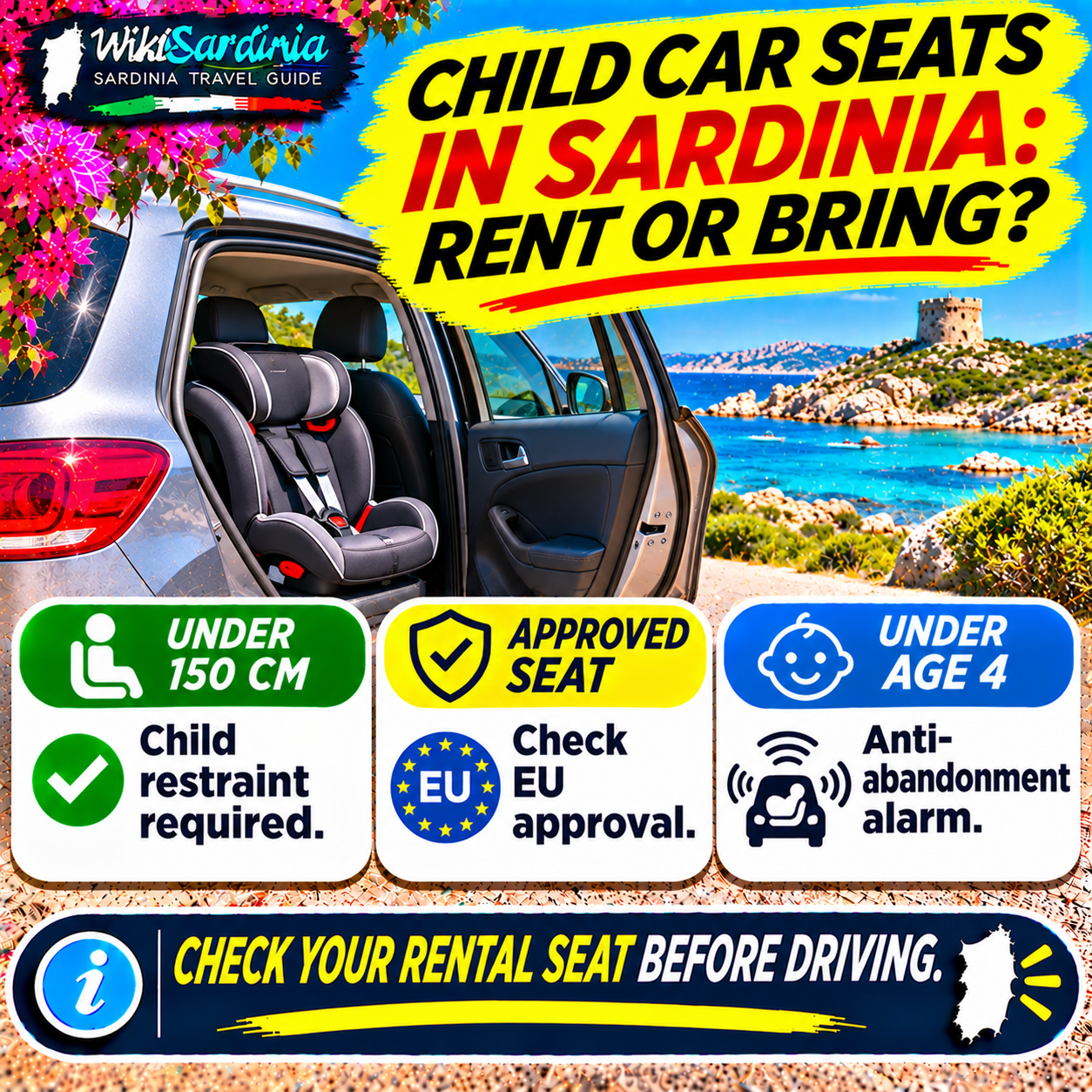
Yes. In Italy, children shorter than 150 cm (approximately 4 ft 11 in) must use an approved child restraint appropriate to their size, including in rental cars in Sardinia. For American families, the important question is not simply whether to pack a familiar seat: a US-only FMVSS 213 label does not automatically establish compliance with the European approval rules applicable to cars on Italian roads. Renting a correctly approved seat from your rental company is often the simplest option for a short trip, while bringing your own can make sense if it carries the appropriate European approval and fits the rental vehicle.
What does Italian law actually require?
Article 172 of the Italian Highway Code requires children under 1.50 metres tall to travel in a suitable approved child restraint. The legal threshold is based on height, not a universal birthday such as age 8 or 12. A child who is 149 cm tall still needs an appropriate restraint, even if older than the age at which a booster is no longer required in the family's US state. A child at or above the height threshold must use the normal seat belt correctly. The restraint must be suitable for the child's size and approved under the applicable UNECE or equivalent European rules. See the official text of Article 172 and the Italian Ministry of Health's child car safety guidance.
Do babies need a rear-facing seat?
Babies and younger toddlers need a restraint designed for their height and weight. Under the current UN R129 system, children must travel rear-facing until at least 15 months, and keeping a child rear-facing for longer, within the seat manufacturer's approved limits, is generally a sound safety choice. Do not move a child into a forward-facing seat merely because the rental desk labels it a “toddler seat.” Ask for the exact seat model, approved height range and installation instructions.
Can I put a rear-facing child seat in the front passenger seat?
Italian law prohibits using a rear-facing child restraint in front of an active frontal passenger airbag. It can be used there only if the airbag is properly deactivated, including where the vehicle provides an approved automatic deactivation system. A correctly installed rear seat is usually the more practical option for families. Never assume the airbag is disabled without checking the car's instructions and indicator.
Are US child seats legal to use in Italy?
Do not assume so. Most US-market car seats are certified to Federal Motor Vehicle Safety Standard 213 (FMVSS 213), while Italian road rules require approved restraints under the relevant European/UNECE framework or equivalent EU directives. A US FMVSS label alone is not evidence of UNECE R129 or ECE R44 approval. Some products are marketed in different versions for the US and Europe; the same brand name does not mean the same certification. Before bringing a seat, inspect the actual approval label on your specific model and ask the manufacturer for written confirmation of Italian road-use compliance. For visitors who cannot verify that approval, renting an EU-approved seat or obtaining one locally is the safer legal option. The Automobile Club d'Italia's guide for visiting motorists specifically advises checking the European approval label.
What labels should I look for?
Look for the official European approval marking and the restraint's permitted height or weight range. UN R129 (i-Size) is the modern European standard and uses height-based classifications, while older seats approved under ECE R44/04 may still be encountered in use. The rules governing the sale of newly manufactured seats are not identical to the rules governing continued use of existing approved seats. Do not infer that every older R44/04 seat is automatically illegal merely because new retail sales have transitioned toward R129. Check the seat's condition, instructions, certification and current applicable rules.
Is an anti-abandonment alarm mandatory for children under four?
Yes, on the Italian-registered rental cars normally used by visitors. Article 172(1-bis) requires an approved anti-abandonment alert system when carrying a child under four in an Italian-registered vehicle, and also covers certain foreign-registered vehicles driven by residents in Italy. The device may be integrated into the seat or supplied separately. It is intended to alert caregivers if a child is left in the vehicle; it does not replace adult supervision. The Ministry of Infrastructure and Transport explains that the alarm must activate automatically and meet specified functional requirements. When booking a seat for a child under four, explicitly request the anti-abandonment device and confirm how it operates. Do not assume an ordinary American car seat includes an Italian-compliant alarm.
Does the rental company provide the anti-abandonment device?
Some do. For example, Hertz's published Italian child-seat terms state that an external anti-abandonment device is supplied for children under four and included in its child-seat rental price. Other providers may have different arrangements. Ask whether the device is included with your exact reservation, whether it needs an app or batteries and whether the agent can demonstrate that it is functioning before you leave.
Should I rent a child seat in Sardinia or bring my own?
For a short holiday, renting a confirmed EU-approved seat is often easiest because you avoid transporting a bulky item and can request a seat suited to the rental vehicle. However, availability, cleanliness, age, condition and correct fit must be checked on arrival. Bringing your own is attractive if you already have a correctly approved European seat, know how to install it and can transport it safely. If the seat you use at home is US-only, its familiarity is not enough to establish Italian legal compliance.
How much does renting a child seat cost?
Prices vary by company, station and rental length. As one documented example, Hertz's Italian rental terms list a child-seat fee of €19.52 per day including tax, capped at €97.60 per rental, plus a separately stated equipment deposit of €158.60. The quoted Hertz product and price may not apply to every booking, and other companies may charge differently. For a seven-day holiday, check whether the provider has a maximum weekly charge rather than simply multiplying the daily rate. Ask for the final total, equipment deposit and cancellation conditions before booking.
Are child seats guaranteed when I reserve one?
Do not assume every supplier guarantees the exact type or model. National Car Rental notes that equipment availability and guarantees can vary by country and location. Reserve as early as possible, particularly for summer arrivals at Olbia, Alghero or Cagliari, and request written confirmation of the correct size and type. If you need two or more seats, confirm each one individually. If the rental desk cannot supply a suitable approved seat, do not drive with an improperly restrained child; ask for an alternative vehicle or a suitable replacement seat before leaving.
Which type of seat should I reserve?
Tell the supplier each child's height, weight and age, rather than just “baby,” “toddler” or “booster.” An infant carrier, a rear-facing toddler seat, a forward-facing harness seat and a booster are different products. A backless booster is not an appropriate substitute for a harnessed infant or toddler seat. Check the manufacturer's approved size range and the fit of the vehicle belt or ISOFIX attachment points. If the supplier cannot confirm suitability, ask for the model information before paying.
Can I install the rented seat myself?
Yes, but proper installation is essential. Rental providers commonly leave installation responsibility with the renter; National explicitly says the renter is responsible for correct installation and fastening. Ask for the instruction manual and, where available, a demonstration. Check that the seat is securely attached using the permitted ISOFIX anchors or vehicle seat belt, that the child harness is adjusted correctly and that the restraint is not damaged or missing components. Never improvise with unapproved accessories or attach both systems unless the manufacturer instructs you to do so.
Will my US seat fit an Italian rental car?
Not necessarily. Many Italian rental cars are compact, with narrower rear seats than larger US vehicles. ISOFIX is the European counterpart to the lower-anchor system commonly called LATCH, but attachment details, top tethers, support legs and seat-belt installation methods vary by restraint and vehicle. A seat can be physically compatible without being legally approved for road use in Italy. Check both the restraint's approval and the manufacturer's compatibility instructions before traveling.
Can I bring a car seat on the plane from the US?
Often yes, subject to airline rules and the seat's approval for aircraft use. EASA advises travelers to check whether the seat is approved for aircraft use, fits the aircraft seat and can be secured correctly. The airline decides whether it can be used on a particular flight; checked baggage policies and fees also vary. ITA Airways lists several accepted aircraft restraint certifications, including US FMVSS 213, under its conditions. Airline acceptance is not the same as Italian road-use approval. A seat may be allowed on an aircraft but lack the European certification needed for a rental car.
What if my car seat is damaged during the flight?
Inspect it carefully before installing it in the rental vehicle. Check for cracked plastic, damaged harnesses, missing parts or signs of mishandling. Follow the manufacturer's instructions on when a seat must be replaced. If you cannot establish that it remains safe and compliant, do not use it; ask the airline about the damage claim and arrange a suitable approved replacement. Transporting the seat in protective packaging may reduce handling damage but does not guarantee it.
Can my child use a booster instead of a full car seat?
Only when the child's size and the booster manufacturer's approval permit it. The 150 cm Italian threshold determines when a child restraint is required, but it does not tell you which restraint is suitable. Some older children may use an approved high-back or backless booster, while younger children need a more supportive harnessed seat. Check that the shoulder belt lies across the shoulder and chest, not the neck, and the lap belt sits low over the pelvis. Do not choose a booster solely to save baggage space.
Are taxis exempt from the car-seat rule?
Italian Article 172 contains a limited exception for licensed taxis and chauffeur-driven hire vehicles: a child up to 150 cm may travel without a child restraint if seated in the rear and accompanied by a passenger aged at least 16. This is a legal exception, not a safety recommendation, and it does not apply to an ordinary self-drive rental car. A correctly fitted child seat remains strongly preferable, especially for infants and long journeys. If you are booking an airport transfer, request a suitable seat in advance and confirm its availability.
What happens if we drive without the required seat?
The driver or responsible accompanying adult can face penalties under Article 172, and the lack of a suitable restraint puts the child at serious risk even at low speeds. Penalties and enforcement consequences depend on the applicable legal provisions and circumstances. Do not rely on a short drive from the airport, a sleepy child or an empty rural road as an exception. Ensure the seat is installed before moving the car.
What should I check before leaving Olbia, Alghero or Cagliari airport?
- Confirm the reserved child seat matches the child's height, weight and developmental stage.
- Inspect the European approval label and manufacturer's instructions.
- Check for visible damage, missing straps, buckles, inserts or ISOFIX components.
- Install the seat correctly in the actual rental vehicle and test that it is secure.
- For a child under four in an Italian-registered car, confirm the anti-abandonment alarm is present and working.
- Check rear-facing orientation, airbag status and harness adjustment.
- Keep the rental provider's contact details in case the equipment is defective.
- Do not depart until every child is properly restrained.
Questions to email the rental company before booking
“We are renting a car in Sardinia with a child aged [age], [height] cm tall and weighing [weight] kg. Can you confirm that you will provide an EU-approved child seat suitable for this child, the total rental price, the equipment deposit and an anti-abandonment alarm if required? Please also confirm the seat's installation method and whether the exact category is available at our pickup branch.” Request a written response tied to your booking reference.
Useful Italian phrases
“Vorrei prenotare un seggiolino per bambini.” — I'd like to reserve a child car seat. “È omologato secondo la normativa europea?” — Is it approved under European rules? “Mio figlio è alto 110 centimetri.” — My child is 110 cm tall. “È incluso il dispositivo antiabbandono?” — Is the anti-abandonment alarm included? “Potete mostrarmi come si installa?” — Can you show me how to install it? “Questo seggiolino è danneggiato.” — This car seat is damaged.
Official sources
Automobile Club d'Italia — Article 172 of the Highway Code; Italian Ministry of Health — child restraints and anti-abandonment alarms; Ministry of Infrastructure and Transport — anti-abandonment devices; ACI — English guide for visiting motorists; EASA — child seats on aircraft; Hertz Italy — child seat rental terms.
The WikiSardinia takeaway
Children under 150 cm need a suitable approved restraint in Italian rental cars, and children under four also require an anti-abandonment device in the Italian-registered vehicles normally rented in Sardinia. For many US visitors, pre-booking an EU-approved seat from the rental company is the simplest way to avoid uncertainty about a US-only seat's road-use certification. If you bring your own, verify the exact European approval label, fit and airline rules in advance. Check the seat and alarm at pickup, and never drive away without a correctly installed restraint.