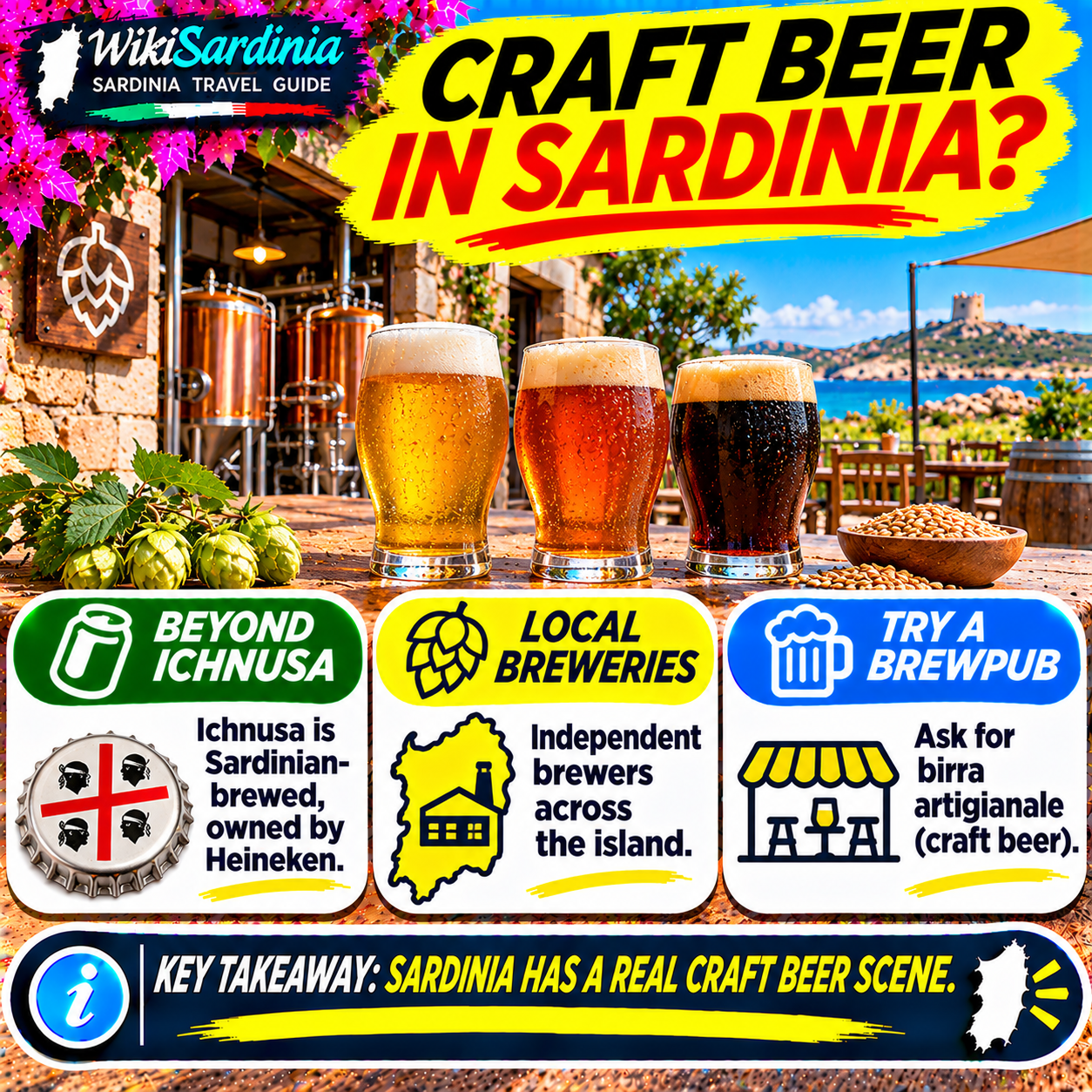
Yes—Sardinia has a well-established craft beer scene alongside its famous Ichnusa lager. Independent breweries and brewpubs operate in and around Cagliari, Sassari, Sant'Antioco, Tertenia and smaller towns. Visitors can find everything from approachable pale ales to hop-forward IPAs, dark beers and inventive brews incorporating grape must or local ingredients. You do not have to limit yourself to Ichnusa, although small-batch beer is not stocked in every beach kiosk or village bar.
Is Ichnusa a Sardinian craft beer?
Ichnusa is authentically brewed in Sardinia, but it is not an independent craft microbrewery. Its story began in 1912, and the brand is produced at the Assemini brewery near Cagliari. Heineken acquired Birra Ichnusa in 1986 and still operates the brewery. Ichnusa's widespread presence on the island is part of Sardinian everyday drinking culture, but ownership and industrial-scale production distinguish it from independently produced craft beer. Its familiar Non Filtrata version should not be confused with a small independent brewery merely because it is unfiltered. Sources: Ichnusa official website and Heineken Italia's company history.
How established is the Sardinian craft beer scene?
It is more than a passing trend. Regional research has documented local microbreweries for years, including Barley, Lara and Rubiu. Slow Food's Birre d'Italia 2027 guide recognizes Sardinian producers including Barley, Il Birrificio di Cagliari, Mezzavia, P3 Brewing and Rubiu, alongside independent beer venues. This is evidence of a developed scene, not proof that every brewery offers public tours or that craft beer is available in every village. A university thesis citing historical industry figures reports growth from 13 activities in 2012 to around 47 in an earlier reference period; that is not a verified count of breweries operating in 2026. Sources: Sardegna Ricerche brewery project and Birre d'Italia 2027 selections.
Which Sardinian craft breweries should travelers know?
Barley — Maracalagonis, near Cagliari
Barley is a longstanding independent brewery in southern Sardinia and one of the best-known names in the island's craft scene. It is especially associated with experimental beer styles and Italian Grape Ale, including beers using grape must. Its brewery is in Maracalagonis, outside Cagliari. A production site is not automatically a walk-in tasting room: check visitor arrangements and opening hours before travelling.
Il Birrificio di Cagliari — Cagliari
This urban brewpub is a practical choice for visitors who want to drink locally brewed beer with food rather than arrange a formal brewery tour. It has a brewing operation and restaurant setting in the city. The venue is among Sardinian names highlighted by Slow Food's guide. Verify the current tap list and restaurant service directly.
P3 Brewing Company — Sassari
P3 is known for modern, often hop-forward beers and is based in Sassari. Local reporting has documented its award-winning brewing and focus on IPAs. The brewery also has an associated taproom and food service. If you are staying around Alghero, Sassari is a useful city in which to explore northern Sardinian craft beer, but check whether the taproom is open before making the journey. Source: La Nuova Sardegna profile of P3.
Rubiu — Sant'Antioco
Rubiu combines a craft brewery with a brewpub in Sant'Antioco, southwestern Sardinia. It is an appealing stop for visitors exploring the Sulcis area, where local beer can accompany pizza and other food. It is included among Slow Food's recognized Sardinian breweries. Check whether the beer you want is currently on tap and whether a table reservation is needed.
Lara — Tertenia, Ogliastra
Birrificio Lara is associated with the Tertenia area in eastern Sardinia and offers a rural, food-and-beer experience. It appears in Sardegna Ricerche's historical brewery project. The venue's current opening and tasting arrangements should be confirmed before travelling, particularly outside the main tourist season.
Mezzavia — Selargius
Mezzavia is another recognized Sardinian craft producer, based in Selargius near Cagliari. It appears among Slow Food's 2027 guide selections. If your goal is to buy bottles or cans rather than drink at a brewpub, ask about the brewery's shop or local stockists. Do not assume production-site hours are the same as taproom hours.
Where can I drink craft beer in Sardinia without visiting a brewery?
Look for a birreria artigianale, brewpub, specialist birroteca or a bar advertising birre artigianali sarde. Cagliari and Sassari offer a particularly useful concentration of options, while smaller towns may have a brewpub or bottle shop. Slow Food's guide highlights venues including Gattarancio and Brew Bay House in Cagliari, Birroteca Hamelin in Sassari and Rubiu in Sant'Antioco. Menus and tap lists change, so ask what is actually available that day.
What kinds of beer do Sardinian breweries make?
Expect familiar international styles such as pale ale, IPA, stout, porter, amber ale and lager, plus experimental beers reflecting local ingredients or wine-making traditions. Some brewers use grape must or explore the Italian Grape Ale category, which makes Sardinia's wine culture particularly relevant to beer. Not every beer marketed as “Sardinian” contains exclusively Sardinian barley, hops or other ingredients: origin of production and origin of raw materials are different claims.
Is Sardinian craft beer stronger than Ichnusa?
Sometimes, but not necessarily. A craft brewery can make a light, low-alcohol session beer or a strong specialty beer. Ichnusa's mainstream lager is generally more standardized, while independent breweries often offer a wider range of styles and alcohol strengths. Read the ABV or grado alcolico on the label or tap menu. A beer's color, bitterness or craft status does not reliably tell you its alcohol content.
Is craft beer expensive in Sardinia?
It often costs more than a mass-market lager, but there is no dependable island-wide price. Cost varies by serving size, venue, production method and whether the beer is bottled, canned or on draft. A small tasting glass is not directly comparable to a 400–500 ml pint. Ask for the size and price before ordering; check whether a tasting flight is offered rather than assuming one is available.
Can I visit a brewery or book a tasting?
Some brewpubs serve customers directly, while production breweries may offer only a shop, scheduled tours or occasional events. Contact the brewery before visiting to confirm whether tours are offered, whether English explanations are available, how much a tasting costs, and whether food or non-alcoholic options are provided. Do not enter production areas without permission. No live tasting slots or opening-hour guarantees are implied by the examples in this article.
Are craft beers easy to find in supermarkets?
Larger supermarkets and specialist shops may stock Sardinian craft bottles or cans, but selection varies. In a small village store or beach kiosk, Ichnusa may be far easier to find. Look for the producer's name and the place where the beer was brewed rather than assuming any label with the Sardinian flag is locally made by an independent brewery. If a particular beer matters, ask the producer for its current stockists.
What food pairs well with Sardinian craft beer?
A crisp pale ale can work with seafood or fried appetizers; an IPA can complement rich grilled dishes; a malt-forward amber or darker beer may pair well with roast meats, aged pecorino or a hearty pizza. Local experimentation is part of the fun, and there are no rigid pairing rules. Some Sardinian craft beers deliberately bridge beer and wine through grape must, making them interesting alongside traditional wine-region foods.
Is craft beer gluten-free?
Do not assume so. Most beers made with barley or wheat contain gluten unless they are specifically produced and labelled to meet the relevant gluten-free standard. “Unfiltered,” “natural,” “local” and “craft” do not mean gluten-free. If you have celiac disease, check the product's certified labelling and discuss cross-contact with the venue. Similarly, ask about alcohol-free beer rather than assuming every craft brewery produces one.
Can you drink craft beer on the beach?
Rules depend on the municipality, beach and any temporary local ordinances. Some places restrict glass containers, alcohol consumption or both. Do not assume a beer sold in a nearby bar may be taken onto the sand in a glass bottle. Check posted rules and local notices, dispose of packaging responsibly and never drive after drinking.
Useful Italian phrases
“Avete birre artigianali sarde?” — Do you have Sardinian craft beers? “Quali birre sono alla spina?” — Which beers are on draft? “Questa birra è prodotta in Sardegna?” — Is this beer brewed in Sardinia? “È un birrificio indipendente?” — Is it an independent brewery? “Fate degustazioni o visite al birrificio?” — Do you offer tastings or brewery visits? “Quanti gradi ha?” — What is its alcohol strength? “Avete una birra senza glutine?” — Do you have gluten-free beer?
Sources and verification
Ichnusa — official website; Heineken Italia — acquisition history; Heineken Italia — Assemini brewery; Sardegna Ricerche — Sardinian microbrewery project; Slow Food Birre d'Italia 2027 selections; La Nuova Sardegna — P3 Brewing profile. These sources document producers and the development of the craft scene; current tap lists, prices, tours and opening hours require direct confirmation.
The WikiSardinia takeaway
Ichnusa is the familiar beer of Sardinia, but it is far from the island's only beer story. Independent brewers such as Barley, P3, Rubiu, Lara and Mezzavia show that Sardinia has a genuine craft scene. Try a brewpub in Cagliari, Sassari or Sant'Antioco, ask for birra artigianale sarda, and check whether the beer is brewed by an independent producer. You can enjoy Sardinian wine traditions and a local craft pint on the same trip—just arrange safe transport when tasting.