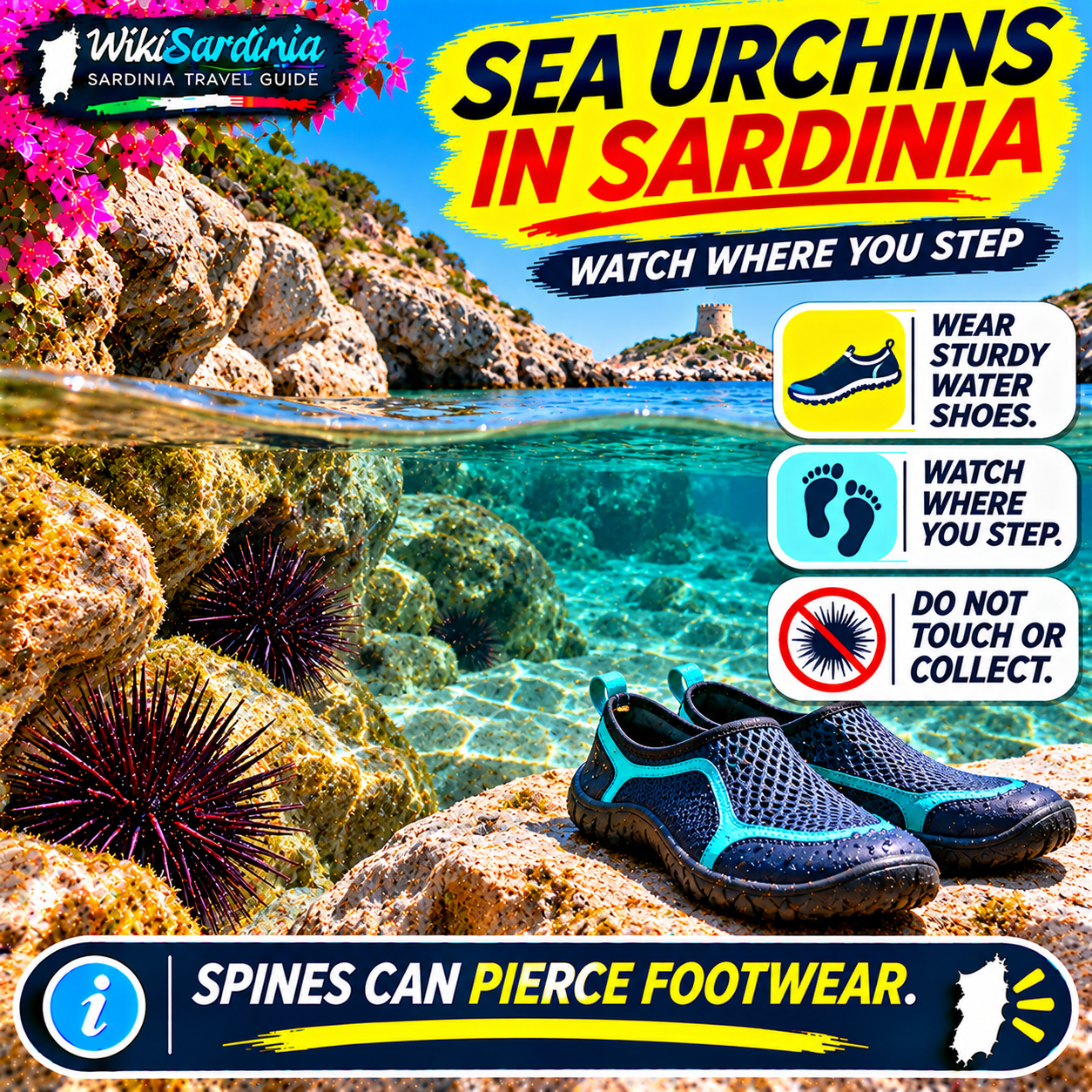
Sea urchins can be found in Sardinia's rocky coves, especially on submerged rocks, in crevices and among hard surfaces in shallow water. They are not equally abundant everywhere, and recent monitoring has raised concerns about declining populations of the edible purple sea urchin. The practical beach habit is simple: look before putting your feet down, enter rocky water carefully and wear well-fitting water shoes with sturdy soles. Shoes reduce risk but cannot guarantee protection against sharp spines.
Where might I encounter sea urchins in Sardinia?
Check shaded cracks, rocky ledges, submerged boulders and uneven seabeds rather than expecting them across every sandy beach. Sea urchins are marine animals that attach to hard substrates. They can be difficult to spot in deeper water or among dark rocks. A clear-looking cove is not automatically free of them. Their distribution varies by site and season, so no particular beach should be described as permanently safe or infested.
Are sea urchins common throughout Sardinia?
They are characteristic of Mediterranean rocky habitats, but “common” does not mean abundant at every cove. Research across Sardinian coastal sites has examined major differences in local densities and the effects of harvesting and protection. Recent 2025–2026 regional monitoring has also reported substantial pressure on populations of the edible species Paracentrotus lividus. A tourist should remain careful in suitable habitat even where few urchins are visible.
How do local swimmers protect their feet?
A practical approach used by many experienced beachgoers is to choose scarpette da scoglio—snug water shoes with a reasonably thick, grippy sole—for rocky entries. The shoes also help against sharp stones and slippery surfaces. Thin fabric beach socks or ordinary flip-flops offer less dependable protection. However, even substantial footwear can be pierced by a sea urchin spine, so avoid deliberately stepping onto rocks where urchins are visible. The Queensland Health sea-urchin injury guidance specifically warns that spines can penetrate rubber-soled shoes and wetsuits.
What kind of water shoes should I choose?
Look for a secure heel, a sole that protects against sharp surfaces, and traction on wet rock. Try them on before your trip; shoes that slip off in the water are not useful. A flexible but thin sole may be comfortable for swimming yet inadequate on jagged rocks. There is no certified “urchin-proof” shoe that guarantees no punctures, so treat footwear as one part of a safer entry strategy, not permission to walk over marine animals.
How should I enter a rocky cove safely?
- Pause at the shoreline and look for a clear route into the water.
- Use a stable entry point and avoid waves washing over slippery rocks.
- Look down before placing each foot; avoid crevices and dark clusters you cannot identify.
- Once the water is deep enough, float or swim rather than walking unnecessarily across the seabed.
- Keep your hands off rocks and animals when snorkeling; do not push into cracks for balance.
The Divers Alert Network recommends particular care when entering or exiting rocky water and avoiding contact with marine life.
What if I am snorkeling?
Maintain enough distance from the seabed and rocky walls to avoid brushing them with your hands, feet or fins. Fins are not puncture-proof footwear, and an uncontrolled kick can harm marine life. In shallow water, stay horizontal and keep good buoyancy control. Avoid standing on rocks or touching sea urchins for a photograph.
Are sea urchins dangerous or venomous?
The principal problem for Sardinian swimmers is usually a painful puncture wound from sharp, brittle spines. Some sea urchin species have venomous structures, but most injuries are mechanical. A spine can break off in the skin, causing pain, inflammation and sometimes infection or problems near joints. Serious systemic reactions are uncommon, but any breathing difficulty, collapse or other severe symptoms require emergency assistance.
What should I do immediately if I step on one?
- Leave the water safely and avoid putting weight on the injured foot if walking is painful.
- Rinse and gently clean the wound without aggressive scrubbing.
- Soak the affected area in comfortably hot, non-scalding water—never hotter than about 45°C (113°F)—to ease pain. Medical guidance describes 30–90 minutes, with repeated soaking if needed.
- Remove only clearly superficial, easily grasped spines if you can do so without digging or breaking them.
- Do not attempt to cut into the skin or extract deep fragments yourself.
- Arrange a medical evaluation, particularly if spines remain, pain persists or the injury is near a joint.
This is consistent with Divers Alert Network first-aid guidance. Be especially cautious with hot water for children or people who have reduced temperature sensation.
Should I use vinegar, lemon juice or another home remedy?
Some medical references discuss vinegar as a possible aid for small superficial spine fragments, but it is not a reliable substitute for proper wound care or medical assessment. Do not pour irritants into deep puncture wounds, dig with a needle, cut the skin or rely on folklore that every spine will dissolve. A clinician can assess whether fragments are retained and whether treatment is needed.
When should I seek medical help?
Medical review is advisable after a puncture, particularly if a spine remains embedded. Seek prompt assessment for deep wounds, increasing redness or swelling, pus, fever, severe or persistent pain, difficulty walking, or injury close to a joint. Ask whether your tetanus vaccination is up to date. For a life-threatening emergency in Sardinia, call 112. The Merck Manual describes retained spines and inflammation as potential complications.
Are sea urchins safe for children?
Children can enjoy rocky beaches with close supervision, appropriate footwear and a safe entry point, but should be taught not to pick up spiny animals or step on unseen rocks. Choose an accessible, sheltered swimming area for less confident swimmers. Adults should test hot water themselves before using it for first aid; young children can be burned more easily.
Can tourists collect sea urchins or take them home?
No: recreational and sport collection of the edible sea urchin is prohibited in Sardinian waters. Sardegna Ricerche and the regional government emphasized this in an August 2026 public-awareness campaign. Do not detach living animals, carry them home or assume that a small personal quantity is permitted. Marine protected areas can have additional restrictions.
What is happening with Sardinia's sea urchin population in late 2026?
The regional government regulated the 2026 professional fishing season, with an official extension to May 16, 2026. In early November 2026, news reports described a proposed three-year halt to sea urchin fishing because monitoring showed depleted stocks. As of November 6, 2026, the proposed three-year measure had not been confirmed as in force; its effective date depended on a further step. This is distinct from the already-established prohibition on recreational collection. See ANSA's November 2 report. Check current regional rules before relying on future-season information.
Are sandy beaches free of sea urchins?
Broad sandy areas without nearby rock generally present less of the typical rocky-habitat risk, but many Sardinian beaches have rocky edges, submerged stones or mixed seabeds. Do not assume an entire beach is urchin-free because its main shoreline is sandy. Other hazards—sharp shells, broken glass, slippery rock and waves—also justify careful footing.
Useful Italian phrases
“Ci sono ricci di mare qui?” — Are there sea urchins here? “Dove posso entrare in acqua in sicurezza?” — Where can I enter the water safely? “Mi servono delle scarpette da scoglio.” — I need water shoes. “Ho una spina di riccio nel piede.” — I have a sea urchin spine in my foot. “Dove posso trovare assistenza medica?” — Where can I get medical help?
Before visiting a rocky cove: quick checklist
- Bring secure water shoes with sturdy soles.
- Check sea conditions and choose a stable entry point.
- Look carefully before stepping on submerged rocks.
- Swim or float rather than walking across shallow rocky habitat when safe.
- Never touch, remove or collect sea urchins.
- If punctured, clean the wound, use non-scalding hot water for pain relief and seek medical assessment.
The WikiSardinia takeaway
Sea urchins are a real consideration in Sardinia's rocky coves, but they are not uniformly abundant at every beach. Sturdy water shoes, careful footing and avoiding contact are the best practical precautions. If a spine punctures your foot, do not dig it out: treat the wound carefully and seek medical help. Leave sea urchins in the water—recreational collection is prohibited, and their populations are under pressure.