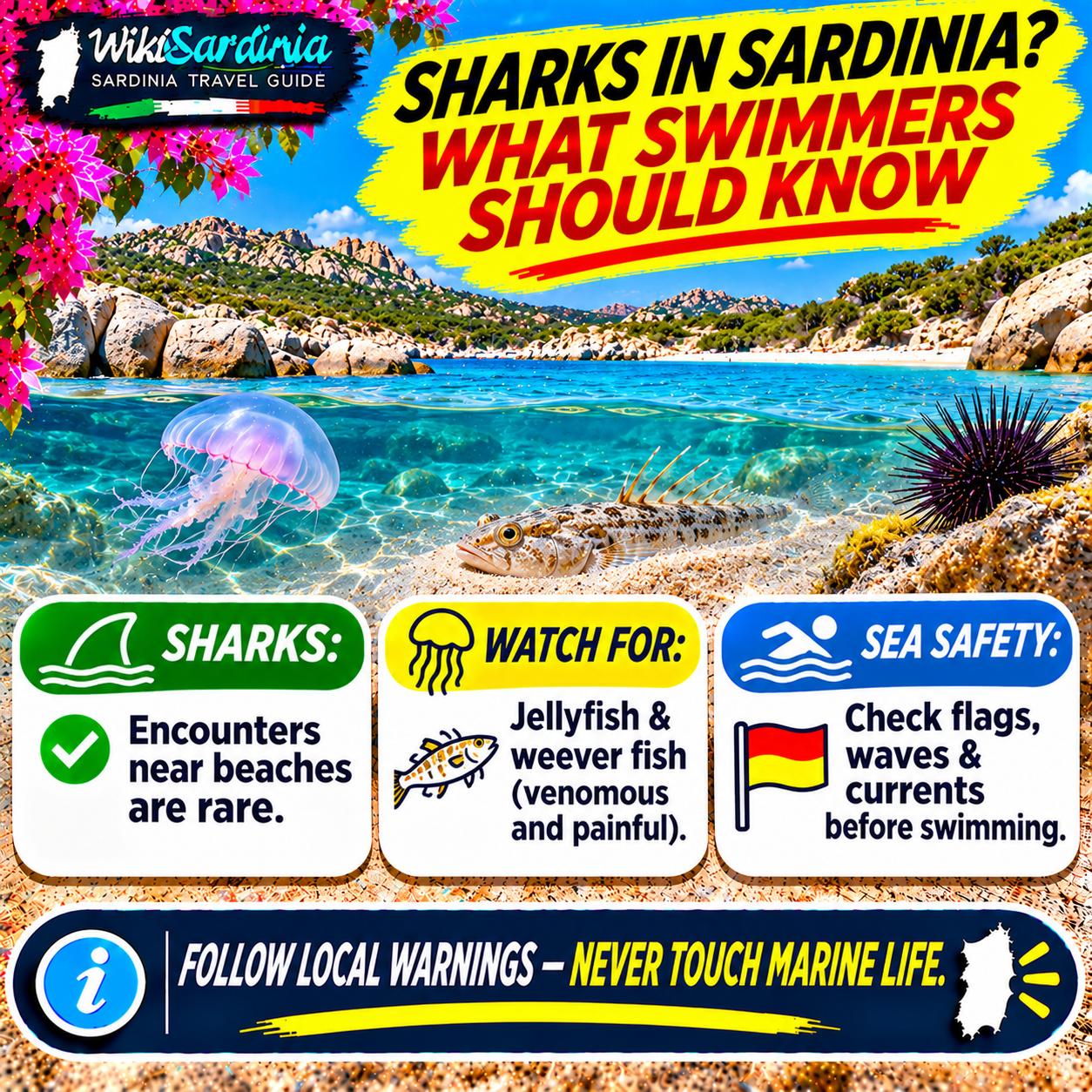
Sharks live in the Mediterranean, including waters around Sardinia, but shark encounters near ordinary swimming beaches are uncommon and there is no verified island-wide shark warning in the official sources reviewed for this guide. Visitors should take local warnings seriously without assuming that a viral sighting means every beach is unsafe. For a typical Sardinian beach day, the marine animals more likely to cause a painful encounter are jellyfish, weever fish hidden in sand, and sea urchins on rocks. Rough seas, currents and unsafe swimming conditions can be more serious risks than wildlife.
Are there sharks in Sardinia?
Yes. Sharks are part of the Mediterranean marine ecosystem, and some species occur in the broader waters surrounding Sardinia. Their presence does not mean they routinely approach swimmers or that popular beaches are under constant threat. Shark sightings may involve animals far offshore, and photographs shared online do not always establish the exact location, species or date. Treat unverified social posts cautiously. No reliable basis was found to describe an active, generalized shark alert for all Sardinian beaches as of November 2026.
Are shark attacks a common risk for tourists?
No. Shark attacks on people are extremely uncommon in the Mediterranean relative to the enormous number of people who swim there. However, “rare” is not “impossible,” and no beach can be guaranteed completely free of marine wildlife. The sensible response is to obey local lifeguard and Coast Guard instructions, avoid approaching or feeding a shark, and calmly leave the water if a credible sighting occurs nearby. Do not attempt to photograph or follow the animal.
How do I check for an official shark warning?
Check beach signs and speak to lifeguards (bagnini) where present. For a reported incident, consult the municipality, the local Capitaneria di Porto or Guardia Costiera, and their official notices. A beach closure or swimming restriction should be verified from an authority rather than inferred from a headline or social media video. The Italian Ministry of Health's swimming-safety guidance emphasizes following posted notices, rescue personnel and bathing restrictions. Its Portale Acque map shows official bathing-water quality and certain swimming prohibitions; it is not a live shark-tracking or jellyfish-warning service.
Which marine animals should swimmers actually watch for?
Four categories deserve practical attention: jellyfish in the water; weever fish that can be buried in sand; sea urchins around rocks; and stinging or sharp-spined animals that should never be handled. Encounters vary by location, season, wind and sea conditions. Seeing one animal does not imply a whole coastline is unsafe. The Ministry of Health's bathing-water information recognizes stinging aquatic organisms as a potential cause of harm to bathers.
Jellyfish: what should I do if I see them?
Jellyfish can be carried into coves and beaches by winds and currents. If you see several near the shoreline, avoid entering the water and ask a lifeguard about current conditions. Do not touch jellyfish, even when washed ashore, because tentacles can remain capable of stinging. If stung, leave the water, rinse gently with seawater rather than freshwater, and avoid rubbing the affected area. Do not apply urine, alcohol or unverified home remedies. Jellyfish species differ, so seek local medical guidance for treatment and avoid assuming vinegar is appropriate for every sting. For severe pain, extensive stings, breathing difficulty, faintness or facial swelling, seek urgent medical help.
Weever fish (tracina): the hidden hazard in sandy shallows
Weever fish are small fish that may bury themselves in sand, leaving venomous spines exposed. Stepping on one can cause sudden, intense pain, swelling and sometimes more serious symptoms. Shuffle or look carefully where you step, especially in shallow sandy water; footwear can reduce some contact but is not guaranteed protection. If stung, get out of the water safely, seek medical advice and immerse the affected area in comfortably hot—not scalding—water if advised and feasible, while arranging assessment. Do not cut the wound, attempt to suck out venom or dig blindly for a spine. Prompt medical assessment is particularly important for severe pain, persistent swelling, infection signs or systemic symptoms.
Sea urchins (ricci di mare): common around rocky coves
Sea urchins live on rocky seabeds and can cause painful punctures when stepped on or grabbed. Avoid putting your hands or feet onto unseen rock shelves and do not stand on marine life. Water shoes with robust soles may help reduce contact, but thin footwear cannot guarantee protection from spines. If punctured, leave the water, gently clean the area and seek medical assessment for deep, retained or difficult-to-remove spines, significant pain or signs of infection. Do not dig deeply into the skin or break spines trying to remove them. Sea urchins are part of the ecosystem; leave them undisturbed.
What about stingrays, scorpionfish and other fish?
Some bottom-dwelling Mediterranean fish have venomous spines, and rays may have defensive barbs. They generally do not seek out people. Avoid handling fish, probing crevices or stepping on animals hidden on the seabed. If a puncture is deep, involves the chest or abdomen, causes substantial bleeding or triggers systemic symptoms, obtain urgent medical care. The same caution applies to unfamiliar marine animals: observe from a distance and never pick them up for a photograph.
Are jellyfish more common at certain times?
There is no reliable single calendar that guarantees jellyfish-free beaches in Sardinia. Their presence changes with winds, currents, species and local conditions. A beach may be clear one morning and have jellyfish later. Ask lifeguards or local operators on the day and check credible local notices. Avoid declaring a whole month or region “safe” based on a few recent sightings.
Are rocky beaches more dangerous than sandy beaches?
They present different hazards. Sandy shallows may conceal weever fish, while rocky coves can have sea urchins, slippery algae and sharp edges. Open sandy beaches may have waves and rip currents that are less obvious from the shore. No surface is automatically risk-free. Choose a beach suitable for your swimming ability and current conditions, not just the color of the water in photographs.
What is more dangerous than sharks on a typical beach day?
Rough seas, currents and overestimating swimming ability. In its July 2026 drowning-prevention guidance, Italy's Ministry of Health warns against swimming with a red flag or in rough water and advises moving sideways out of a rip current rather than fighting it head-on. Do not swim alone far from shore, jump into unknown water or ignore the lifeguard's instructions. Some remote beaches have no lifeguard or warning-flag system, so the absence of a flag is not proof of safe conditions.
What do red, yellow and green beach flags mean?
Under the Ministry of Health's general explanation, green indicates favorable conditions, yellow calls for caution, and red means conditions are unsafe and swimming should not take place. Follow the local beach ordinance and lifeguard instructions: flag practices and staffing vary, and a free beach may not display any flag. The official swimming-safety page explains the color guidance.
What should families with children do?
Keep children under continuous supervision near water, including in shallow areas. Explain that jellyfish, sea urchins and fish should be observed but never touched. Choose sheltered, supervised beaches when possible and ask the lifeguard about local hazards. Bring appropriate footwear for rocky entries, but do not rely on shoes to prevent all punctures. The Ministry of Health's 2026 guidance emphasizes that even brief lapses in supervision can have serious consequences.
Should snorkelers and boat passengers take extra precautions?
Yes. Snorkelers should avoid touching the seabed or marine animals, keep a safe distance from boats, check currents and stay within their abilities. Boat passengers should enter the water only where the operator permits and should not swim near propellers. If you encounter a large animal, keep your distance and return calmly to the boat or shore. Do not use bait or food to attract wildlife. Check marine protected area rules, which may restrict certain activities independently of wildlife hazards.
What if I see a shark close to swimmers?
Stay calm and move toward shore or the boat without splashing or pursuing the animal. Alert the lifeguard and other swimmers, giving a clear location and description without creating panic. Follow any evacuation or closure instructions. If there is an immediate danger or injury, contact emergency services. Avoid sharing an unverified claim as a confirmed shark warning: report what you actually saw and allow authorities to assess it.
When should I seek medical care after a sting or puncture?
Seek emergency help for breathing problems, fainting, severe allergic symptoms, serious bleeding or rapidly worsening illness. For persistent pain, deep punctures, suspected retained spines, worsening swelling or signs of infection, obtain prompt medical assessment. In Italy, call 112 for an emergency. For urgent danger at sea, the Coast Guard emergency number is 1530. A lifeguard may provide initial assistance, but is not a substitute for medical care when symptoms are serious.
Can I check whether the water is officially safe for bathing?
Use the Ministry of Health's Portale Acque to see monitored bathing-water quality and relevant closures, then check the municipality's current notices and the conditions at the beach itself. Water-quality monitoring is about contamination and bathing eligibility, not a promise that there are no jellyfish, sharks, strong currents or rocks.
Useful Italian phrases
“Ci sono meduse oggi?” — Are there jellyfish today? “Ho visto uno squalo vicino alla riva.” — I saw a shark near the shore. “La balneazione è vietata?” — Is swimming prohibited? “Mi ha punto una tracina.” — A weever fish stung me. “Ho una spina di riccio nel piede.” — I have a sea-urchin spine in my foot. “Serve un medico.” — We need a doctor.
Before swimming: a practical checklist
- Check beach flags, lifeguard guidance and official local notices.
- Look for jellyfish in the water and avoid touching marine life.
- Watch your footing on sandy shallows and rocky seabeds.
- Check waves, wind and currents, not just the weather forecast.
- Keep children close and avoid swimming alone far offshore.
- Know where to seek medical help and call 112 for emergencies.
The WikiSardinia takeaway
Sharks are part of Sardinia's marine environment, but shark encounters near swimming beaches are rare and no island-wide shark warning was verified for this guide. Visitors are better served by practical awareness of jellyfish, weever fish, sea urchins and, above all, waves and currents. Respect local warnings, never touch marine animals and seek medical care for significant stings or injuries. Enjoy the sea with informed caution rather than fear.