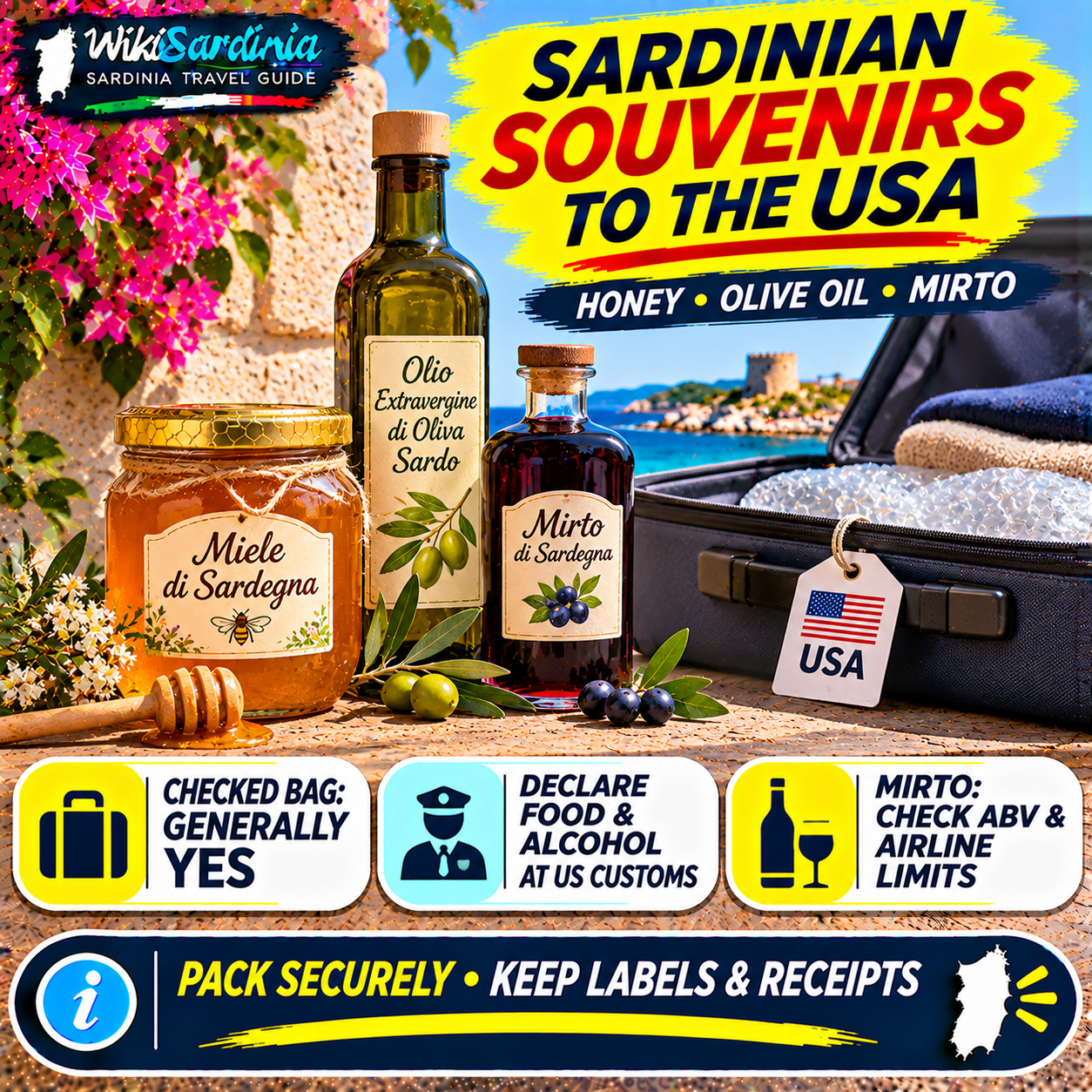
Yes. Travelers returning from Sardinia to the United States can generally pack commercially purchased Sardinian honey, olive oil and Mirto liqueur in checked baggage for personal use. However, airline baggage rules and US customs rules are separate: a bottle may be permitted on an aircraft but still need to be declared and inspected on arrival. Keep original packaging, ingredient labels and receipts, and check the alcohol percentage printed on Mirto before packing.
Quick answer: honey, olive oil and Mirto
| Souvenir | Checked baggage | US entry considerations |
|---|---|---|
| Sardinian honey | Generally permitted; protect jars from breakage | Generally admissible for personal consumption; declare it |
| Olive oil | Generally permitted; seal bottles carefully | Oils are generally admissible; declare the food purchase |
| Mirto liqueur | Generally permitted subject to ABV, packaging and quantity limits | Age 21+, declare it, check duty allowance and destination-state rules |
These are general guidelines, not advance customs clearance. Final admissibility is determined by US authorities at entry, and airlines may impose additional carriage restrictions.
Can I bring Sardinian honey into the United States?
Generally, yes, for personal consumption. The US Department of Agriculture's Animal and Plant Health Inspection Service (APHIS) says travelers can generally bring honey and certain other bee products for personal use. USDA's special regulation of honey and beeswax intended as feed for bees is a different situation from an ordinary jar purchased as food. You must still declare honey to US Customs and Border Protection (CBP). See USDA APHIS guidance on honey.
Can I bring Sardinian extra-virgin olive oil?
Yes, ordinary culinary olive oil is generally admissible for personal use. CBP's international traveler guide identifies oils, honey and many other prepared foods as generally admissible, while cautioning that unsafe or contaminated packaging can be refused. Choose a commercially labeled bottle, ideally sealed, and declare it at US customs. A bottle containing olive branches, leaves, fresh produce or other plant material may raise different agricultural questions, so plain filtered or unfiltered culinary oil is the simpler souvenir.
Can I pack Mirto liqueur in checked baggage?
Usually yes, but check the exact alcohol by volume (ABV) on the bottle. Under the US Federal Aviation Administration's PackSafe alcohol guidance, alcoholic beverages containing more than 24% but no more than 70% ABV are limited to 5 liters total per passenger in unopened retail packaging. Drinks at 24% ABV or below are not subject to that particular FAA hazardous-materials quantity limit, though airline baggage allowances, other applicable rules and US customs requirements still apply. Alcohol above 70% ABV is prohibited in both carry-on and checked baggage. Mirto recipes and brands differ, so do not assume every bottle has the same strength.
Does the 5-liter airline limit mean I can bring five liters into the US duty-free?
No. Aircraft safety limits and customs duty allowances are different. CBP says travelers aged 21 or older can generally bring one liter of alcohol into the US duty-free, subject to applicable conditions. More than one liter may be admissible for personal use but can be subject to duty and federal excise tax, and state laws may be more restrictive. Large quantities can prompt questions about commercial importation. See CBP's alcohol guidance. Never interpret the FAA's 5-liter safety ceiling as a customs exemption.
Can someone under 21 bring Mirto as a gift?
No. CBP states that travelers under 21 cannot import alcoholic beverages, even as gifts. An adult traveler should check applicable rules and carry their own permitted purchases. State-level alcohol regulations can also affect what is allowed at the US destination.
Do I have to declare honey, olive oil and Mirto?
Yes—declare food and agricultural products, and declare alcohol and other purchases as required. CBP instructs incoming travelers to declare food and agricultural items even when they believe the items are allowed. Inspectors may examine the products and make the final admissibility decision. USDA recommends keeping receipts and original packaging to establish origin. Failing to declare agricultural products can lead to seizure and penalties, whereas properly declaring an item protects you from penalties for an honest admissibility mistake. See USDA APHIS traveler instructions and CBP declaration guidance.
What should I say to the customs officer?
Use a clear description, such as: “I have two sealed jars of honey, one bottle of olive oil and one bottle of Mirto liqueur from Italy for personal use. The Mirto contains [percentage] alcohol.” Provide the quantities and purchase values when requested. If you use a customs declaration form, digital process or Global Entry, answer the relevant food and merchandise questions accurately. Do not omit a souvenir simply because it is in checked luggage rather than hand baggage.
How do I protect glass bottles and honey jars in a suitcase?
Choose sturdy, tightly sealed retail packaging. Put each bottle or jar in its own leak-resistant bag, cushion it with clothing or protective sleeves, and position it near the center of a hard-sided suitcase rather than against an outside edge. Avoid packing glass directly beside electronics or important documents. Inspect closures before packing and do not rely on a decorative paper gift bag for protection. Glass can still break during baggage handling, and an airline may not reimburse damage to inadequately packed fragile items.
Can I put these products in carry-on luggage instead?
Honey and olive oil are liquids or liquid-like products for security-screening purposes, so ordinary full-size jars and bottles are generally unsuitable for carry-on baggage through standard airport security checkpoints. Carry-on liquid limits and any duty-free sealed-bag exceptions depend on the departure airport, connections and screening rules. The simplest option for typical souvenir bottles is checked luggage. If you buy items after security, confirm whether a connecting airport will rescreen your carry-on before assuming they can travel all the way home.
What if I have a connecting flight in the United States?
Travelers normally clear US customs at their first US port of entry, unless they have already completed US preclearance abroad. If you connect onward domestically, follow the airport's instructions for reclaiming and rechecking baggage. Any liquids moved into carry-on bags for rescreening may be subject to checkpoint rules. Keep your customs declaration details and receipts accessible. See CBP's first-port-of-entry guidance.
Are homemade honey or Mirto treated differently?
Homemade or unlabeled goods can be harder to identify and assess. Honey for personal consumption is generally permitted, but commercial labeling and receipts make origin easier to establish. For homemade Mirto, airline rules requiring unopened retail packaging for beverages above 24% ABV can make transport problematic. If the alcohol percentage is uncertain or the container is not an unopened retail package, do not assume it is eligible for checked baggage. Choose a commercially bottled product with a clearly stated ABV for the most straightforward trip.
What about infused olive oil, honeycomb and gift baskets?
Ingredient details matter. APHIS generally permits honeycomb for personal consumption, but gift baskets containing fresh fruit, seeds, meat or plant material can face additional restrictions. Olive oil flavored with loose fresh herbs, leaves or other botanical material may require closer scrutiny than plain olive oil. Check the exact ingredients against USDA and CBP guidance and declare everything. Avoid packing fresh plant decorations with the bottles.
Will I have to pay US customs duty?
Possibly. For qualifying returning US residents, the general personal exemption is often $800 in total merchandise value, with exceptions depending on travel circumstances; alcohol has additional specific limits. A one-liter alcohol allowance does not mean that the remaining souvenirs are automatically exempt regardless of value. CBP determines the applicable treatment based on your purchases, residency, destination and current rules. Keep receipts and do not misstate the purchase price. See CBP's personal exemption guidance.
Can I ship Mirto home instead of packing it?
Do not assume it is easier. CBP says mailing alcoholic beverages through the US postal system is prohibited, while commercial courier shipments can involve duties, handling charges and additional legal requirements. Honey and olive oil shipments can also face import, labeling and carrier restrictions. For a small personal souvenir purchase, checked baggage is often simpler, provided the product meets airline and customs rules.
What should I check before buying souvenirs?
- Choose sealed, commercially labeled honey, olive oil and Mirto when possible.
- Read the Mirto bottle's alcohol percentage and compare it with your airline's carriage rules.
- Confirm your airline's checked-baggage weight and any stricter restrictions.
- Keep purchase receipts and the products' original labels.
- Wrap each jar or bottle separately and protect against leaks.
- Declare all food, agricultural products and alcohol at US entry.
- Check the destination state's alcohol rules if bringing more than a small personal amount.
The WikiSardinia takeaway
Sealed Sardinian honey, olive oil and appropriately packaged Mirto are generally practical souvenirs to bring home to the United States in checked luggage. The crucial steps are to check Mirto's ABV and airline quantity rules, distinguish the FAA baggage limit from the US duty-free allowance, protect glass containers and declare the products on arrival. Customs officers make the final decision about entry, so keep labels and receipts and check official guidance again shortly before departure.