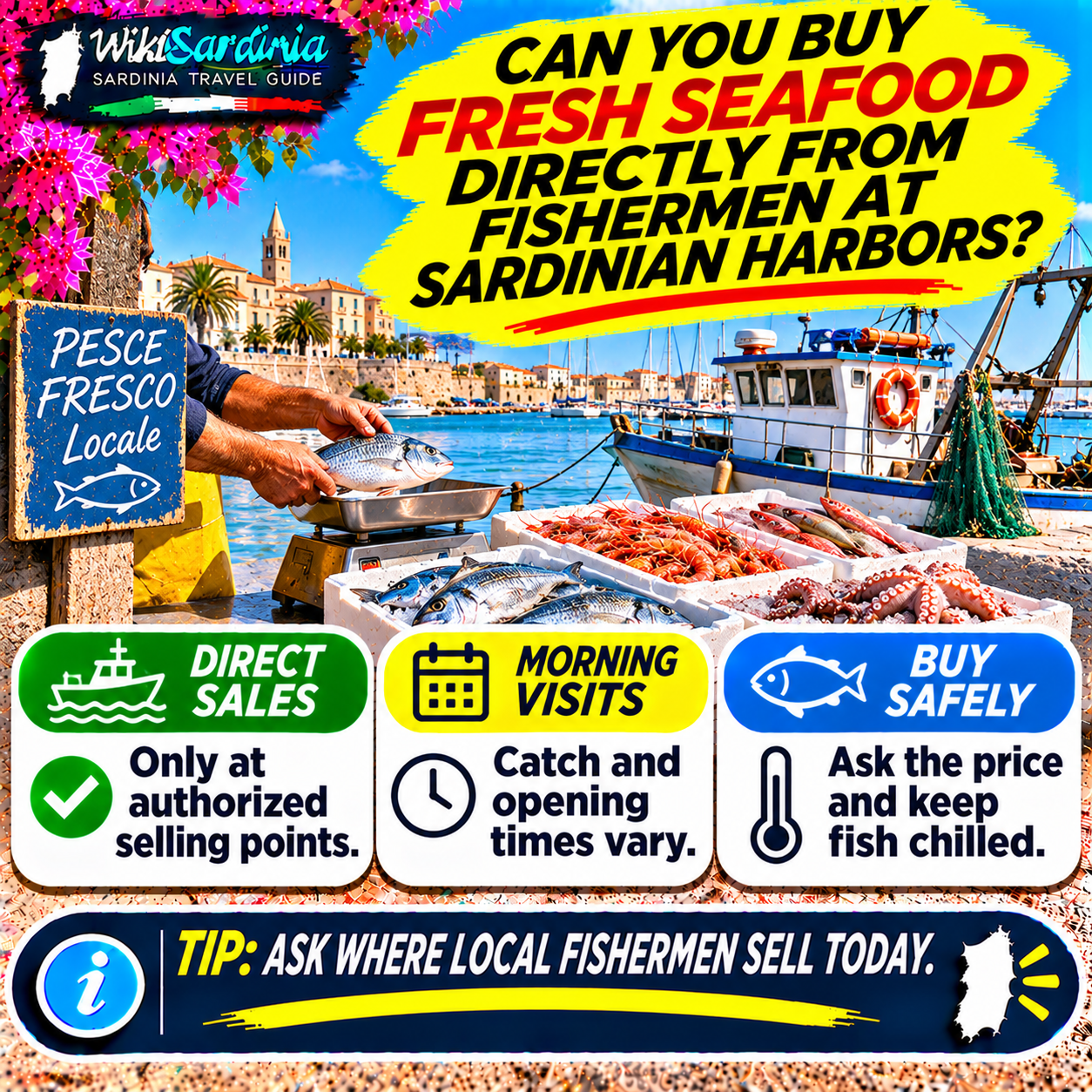
Yes, visitors can sometimes buy freshly landed seafood directly from professional fishermen at authorized selling points in Sardinian harbors. But a fishing boat returning to port is not automatically a public fish shop: sales depend on the operator, local arrangements, food-safety requirements, weather and the day's catch. A good starting point is a designated fishermen's stall or local fish market rather than approaching any working boat on the quay.
Is buying fish directly from fishermen legal in Sardinia?
Direct sale of a fisher's own catch to the final consumer is a recognized activity in Italy, subject to the applicable fishing, hygiene and marketing rules. National guidance on direct seafood sales describes sales from vessels and designated public selling areas under relevant conditions. This does not mean that every harbor, landing area or mooring is an unrestricted retail space. Ask whether a fisherman sells directly to consumers and where the authorized point is located. See the direct-sale guidelines published by Assopesca and the Italian ministry's seafood traceability decree.
Where can I try buying fish directly in Alghero?
Alghero has a documented local catch market near Banchina Rafael Catardi in the port area, where local fishermen have been reported selling their catch directly. A July 2026 local guide identifies this as Mercato del pescato locale and recommends visiting in the morning. The city's other retail options include the central municipal market and neighborhood fishmongers. These are useful starting points, but the source is a local guide, not a live municipal operating notice: confirm that the market is trading on the morning you plan to visit. Alghero local fish-market guide, July 2026.
Can I walk into Cagliari's wholesale fish market?
No, not as an ordinary tourist shopper. The Municipality of Cagliari explicitly states that its wholesale fish market at Viale la Plaia 27 is not open to the public and access is reserved for accredited sector operators. The listed wholesale hours, 2 a.m. to 8 a.m. Tuesday through Saturday, are not public shopping hours. For personal purchases, choose an open retail fish market, fishmonger or a verified direct-sale point instead. Do not assume a harbor's commercial fish auction welcomes walk-in consumers.
What time should I go?
Morning is often the best time to look, because fishermen may sell after landing and retail markets commonly operate in the morning. A local Alghero guide suggests approximately 8–10 a.m. for the widest selection, but this is a practical suggestion rather than a guaranteed schedule. Boats return at different times, and fishing can be interrupted by wind, sea conditions, seasonal closures and other restrictions. Ask the market or local tourist office the day before: “A che ora vendono il pescato locale domani?” (What time will they sell the local catch tomorrow?).
Will fresh fish be available every day?
Not necessarily. Rough weather, fishing restrictions, holidays, seasonal patterns and the size of the local fleet affect what is landed. A market may be open even when a particular species has not been caught that day. “Fresh” does not always mean caught that morning, and “sold in Sardinia” does not necessarily mean caught in Sardinian waters. Ask for the catch area, fishing method and whether the fish was previously frozen when that matters to you.
What seafood might I find?
Depending on location, season and lawful catches, Sardinian fish counters may offer sea bream (orata), sea bass (spigola or branzino), mullet (muggine), red mullet (triglia), squid (calamari), octopus (polpo) and other local species. Some products may come from aquaculture or from outside Sardinia. Availability cannot be guaranteed, and protected species, minimum sizes, seasonal prohibitions and marine-reserve rules must be respected. Never buy a species that appears to be illegally harvested.
Is fish cheaper when bought from fishermen?
It can be, because there may be fewer intermediaries, but direct sale does not guarantee a bargain. Prices depend on species, size, scarcity, demand, freshness and market conditions. There is no reliable standard harbor-dock price per kilogram across Sardinia. Ask “Quanto costa al chilo?” (How much is it per kilogram?) before the fish is weighed. Confirm whether the quoted price is per kilo, per fish or for the whole lot.
How do I know the fish is genuinely local?
Ask where it was caught, by whom and whether it is wild-caught or farmed. Normal seafood marketing rules require consumer information about species, production method and catch or farming area, with certain exceptions for qualifying small direct sales. The Italian ministry's decree sets out a specific exception for small direct sales from fishing vessels to final consumers, but that exception should not be mistaken for permission to sell unsafe or illegally caught seafood. A friendly conversation with the seller is useful, yet a verbal claim alone is not a substitute for proper traceability where required.
How can I tell whether the seafood is fresh?
Choose a clean, properly chilled selling point. Whole fish should generally have firm flesh, intact skin and a mild marine smell rather than a strong sour or ammonia odor. Appearance is only a clue: clear eyes and bright gills are not infallible tests, and different species look different. Seafood must be handled hygienically and kept at suitable temperatures. If it is warm, poorly displayed or smells unpleasant, do not buy it. Ask when it was landed and how it has been stored.
Should I bring cash?
Bring a payment card and a small amount of cash as backup. Some established stalls may accept cards, while payment methods at temporary or small-scale direct-sale points vary. Do not assume contactless works at every harbor. Ask “Posso pagare con la carta?” (Can I pay by card?) before the seller prepares your order. Request the appropriate receipt where applicable.
Can the fisherman clean and fillet the fish?
Sometimes. A seller may offer to gut or clean fish, but services vary and should not be presumed free. Ask “Me lo può pulire?” (Can you clean it for me?) and whether filleting is available. Not every dockside point has the equipment or authorization to prepare fish in the same way as a dedicated fishmonger. If you need a ready-to-cook fillet, a properly equipped retail fish shop may be the more dependable choice.
Can I buy shellfish or sea urchins directly from a boat?
Be particularly careful. Live bivalve mollusks such as mussels and clams have specific sanitary controls and approved distribution requirements. Do not buy shellfish from an informal seller who cannot demonstrate that the product has entered the authorized supply chain. Sea urchin harvesting in Sardinia is subject to strict regional protections and restrictions; do not assume that seeing sea urchins for sale means the sale is legal. For shellfish, choose a recognized retail operator and ask about traceability and handling.
Can I eat freshly bought fish raw?
Do not eat raw fish simply because it was caught that morning. Freshness does not eliminate parasites or other food-safety hazards. Fish intended to be eaten raw or nearly raw generally requires appropriate parasite-control freezing or another compliant process, subject to the applicable rules and exemptions. Home freezing in an ordinary refrigerator freezer is not necessarily equivalent to a professional validated treatment. If you plan sushi, carpaccio or marinated raw fish, purchase from a seller able to advise on suitability and required treatment; when uncertain, cook the fish thoroughly.
How should I carry seafood back to my holiday apartment?
Bring an insulated cooler bag and frozen ice packs, especially in summer. Buy seafood near the end of your shopping trip, keep it cold, avoid direct sun and return promptly to a refrigerator. Do not leave fish in a parked rental car while sightseeing. Store raw seafood separately from ready-to-eat foods and follow safe cooking and storage practices. If your accommodation has no suitable refrigerator or kitchen, eating at a restaurant may be a better choice than buying raw seafood.
Can tourists enter the fishing dock?
Only where public access is permitted. Fishing quays are working environments with ropes, hooks, winches, vehicles and slippery surfaces. Do not cross barriers, climb aboard boats without permission or obstruct unloading. Ask at an official stall, harbor office or tourist information point where customers are allowed to purchase. Photographing workers or their boats at close range is best done after asking permission.
Are there alternatives if no fishermen are selling?
Yes. A municipal retail market, local pescheria (fishmonger) or established food market is often more predictable. In Alghero, the local guide also identifies the central municipal market and a neighborhood market in Pietraia as alternatives. In Cagliari, look for retail fish counters rather than the restricted wholesale market. Check current hours, particularly on Sundays, public holidays and during winter. Ask specifically for pescato locale if you want local catch rather than imported or farmed products.
What should I ask the seller?
“È pescato locale?” — Is it locally caught? “È stato pescato oggi?” — Was it caught today? “Quanto costa al chilo?” — How much per kilogram? “È fresco o decongelato?” — Is it fresh or previously frozen? “Me lo può pulire?” — Can you clean it for me? “Posso pagare con la carta?” — Can I pay by card? “Dove vendono il pesce i pescatori?” — Where do the fishermen sell their fish?
Morning harbor-shopping checklist
- Identify a documented retail or direct-sale point rather than assuming all fishing docks are open to shoppers.
- Check the latest trading day and arrival times with a local source.
- Bring a cooler bag, ice packs and a payment backup.
- Ask about origin, catch date, species, price per kilogram and whether the fish has been frozen.
- Inspect cleanliness and refrigeration; avoid questionable shellfish or protected species.
- Respect working-port access restrictions and keep out of unloading areas.
- Return promptly to suitable refrigeration and cook seafood safely.
Sources and verification
Assopesca — guidelines on direct sale of fish; Italian Ministry — seafood marketing and traceability decree; bluAlghero — local fish markets, July 2026; Municipality of Cagliari — wholesale market access rules; CREA — research on Italian fisheries and dockside direct sales. The Alghero market reference is from a local report, not live confirmation of today's hours; Cagliari's wholesale restriction is from the municipal website.
The WikiSardinia takeaway
Buying fresh fish directly from fishermen can be a memorable Sardinian experience, but go to a verified selling point, not just any boat. Morning visits are a sensible plan, though the catch and trading times change. Alghero's port-area local catch market is a documented lead; Cagliari's wholesale market is not open to the public. Ask where the fish came from, confirm the price, keep it chilled and respect the harbor's working areas.