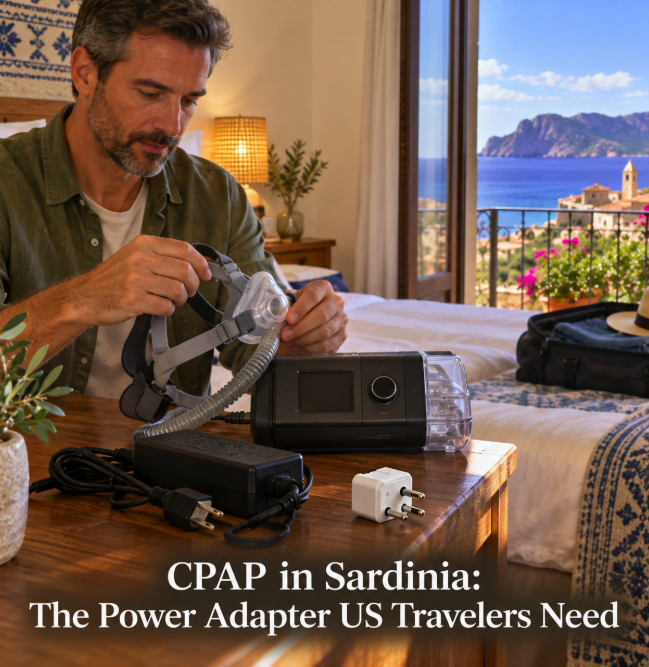
American travelers bringing a CPAP machine to Sardinia usually need a plug adapter, not a voltage converter — provided the machine’s own power supply is rated for Italy’s electricity. Many modern CPAP systems accept 100–240V at 50–60Hz, which covers both the US and Italy. The important step is to read the electrical label on your own machine or power brick before packing.
Italy uses different wall sockets from the United States, so a US Type A or B plug will not normally fit directly. Sardinia follows the same electrical standards as the rest of Italy: there is no special island-specific CPAP adapter.
What plug adapter should you bring?
Italian outlets commonly use round-pin formats. Italy’s official tourism portal describes Type C and Type L sockets, along with multistandard outlets that can also accept Schuko-style plugs. For an American traveler, a compact US-to-Italy/Europe adapter that works with Italian Type L and common European round-pin sockets is the practical choice.
Because hotels, vacation apartments and older buildings do not all have identical outlet plates, a well-made adapter designed specifically for Italy or a reputable European travel adapter offers more flexibility than assuming every room will have the same socket.
A plug adapter only changes the physical shape of the connection. It does not reduce Italian mains voltage to US voltage.
Do you need a voltage converter?
Check the input specification printed on the CPAP power supply. If it says something such as 100–240V, 50–60Hz, it is designed to accept Italy’s mains supply and normally does not need a step-down voltage converter. You still need the appropriate plug adapter for the wall socket.
ResMed provides a clear example. The current AirSense 11 65W power supply is specified for 100–240V and 50–60Hz. ResMed also states that its CPAP systems automatically adjust to power supplies in different parts of the world and advises travelers to use the correct plug adapter.
Do not generalize that specification to every CPAP ever sold. Older machines, specialized respiratory equipment and third-party power supplies can differ. The rating printed on your own equipment is the deciding factor.
If the label says only 120V or otherwise does not include Italy’s voltage range, do not simply connect it to an Italian outlet with a passive adapter. Contact the manufacturer or your medical-equipment supplier about the correct approved power solution.
Why a random voltage converter can be the wrong solution
Travel voltage converters are often marketed for hair dryers and other consumer appliances. A CPAP is medical equipment, and adding an unnecessary or unsuitable converter introduces another component that can fail, overheat or provide poor-quality power.
If your CPAP power brick already accepts 100–240V, the power supply is doing the necessary conversion itself. Adding a separate voltage converter is normally unnecessary. If your machine is not compatible with 230V-class mains, obtain manufacturer-specific advice rather than improvising with a generic converter.
Check the hotel outlet before bedtime
The adapter is only one part of the problem. CPAP users also need an outlet close enough to the bed. In older Sardinian hotels, agriturismi and historic apartments, the nearest usable socket may be behind furniture or across the room.
Ask the accommodation whether there is a bedside electrical outlet when booking, especially if moving furniture or running a cable across a walkway would be difficult. ResMed’s own travel guidance recommends packing an extension cord because an outlet may not be conveniently located near the bed.
If you bring an extension lead or power strip from the US, its electrical rating matters too. Do not assume that an American 120V-only accessory is appropriate for Italian mains just because the CPAP power supply itself is dual-voltage. A simpler approach is often a suitable Italy-rated extension solution obtained from a reputable supplier.
AirSense 11: a useful real-world example
ResMed’s current technical documentation lists the AirSense 11 power supply input at 100–240V, 50–60Hz. That means a US AirSense 11 traveler does not need a transformer merely because Sardinia uses European electricity. The physical US plug still needs to connect safely to the Italian socket through the correct adapter.
The AirSense 11 documentation also says the machine meets FAA requirements for all phases of air travel. That does not automatically mean every airline procedure is identical, so travelers who intend to use CPAP onboard should contact their airline before departure about seat power, batteries and advance notification.
What about a travel CPAP?
Compact machines can reduce luggage, but the same rule applies: inspect the manufacturer’s input specification and use the approved power supply. ResMed’s travel guidance notes that its devices are designed for international power, while its AirMini has separate manufacturer-approved DC power accessories for use from suitable vehicle power sources.
Do not assume that a USB phone charger can power a CPAP simply because the connector or travel adapter looks convenient. CPAP machines have specific voltage and power requirements, and heated humidifiers can substantially increase consumption.
Bring a backup plan for rural stays
Sardinia has normal modern electrical service, but travelers staying in remote countryside accommodation, on boats or at campsites may want to think about backup power. A CPAP-compatible battery can also be useful during outages or when an outlet is unavailable.
Battery choice is model-specific. Capacity, humidifier use, heated tubing and therapy settings all affect runtime. ResMed advises users to discuss portable battery options with their CPAP equipment provider and sells model-specific DC converters for some systems.
If uninterrupted therapy is medically important, arrange the backup solution before leaving the United States rather than hoping to find a compatible battery after arrival.
Flying from the US with a CPAP
Keep the machine protected in its travel case and follow the airline’s current medical-device rules. Manufacturer travel guidance recommends carrying relevant documentation and contacting the airline when necessary, particularly if you intend to operate the machine during the flight.
Pack the mask, hose, power brick and adapter together so a missing cable does not make the machine unusable on the first night. If your CPAP uses removable filters or proprietary accessories, bringing a spare can be sensible on a longer trip because the exact replacement may not be immediately available in a small Sardinian town.
A simple packing checklist
- Your CPAP machine, mask, tubing and original or manufacturer-approved power supply.
- A US-to-Italy/Europe plug adapter suitable for Italian sockets.
- A photo of the power-supply label showing its input voltage and frequency.
- An appropriately rated extension solution if the accommodation cannot guarantee a bedside outlet.
- Spare filters or other essential model-specific consumables for a longer stay.
- A manufacturer-approved battery or DC solution if your itinerary requires backup power.
- Airline or manufacturer documentation if you plan to use the CPAP during a flight.
For most Americans using a modern dual-voltage CPAP, preparing for Sardinia is straightforward: confirm 100–240V, 50–60Hz on the power supply, pack the correct Italian plug adapter and leave the unnecessary voltage transformer at home. The crucial word is “confirm.” Medical devices vary, and the label and manufacturer documentation for your exact machine should always take priority over generic travel advice.