Driving through Sardinia's inland villages can be one of the most memorable parts of a road trip. Stone houses, tight corners and historic streets create beautiful scenery, but they also require more attention than a modern highway. If you encounter a raised speed bump or a narrow bridge that seems barely wide enough for one car, the most important rule is simple: slow down, read the signs and never force your way through.
What are dossi and dissuasori?
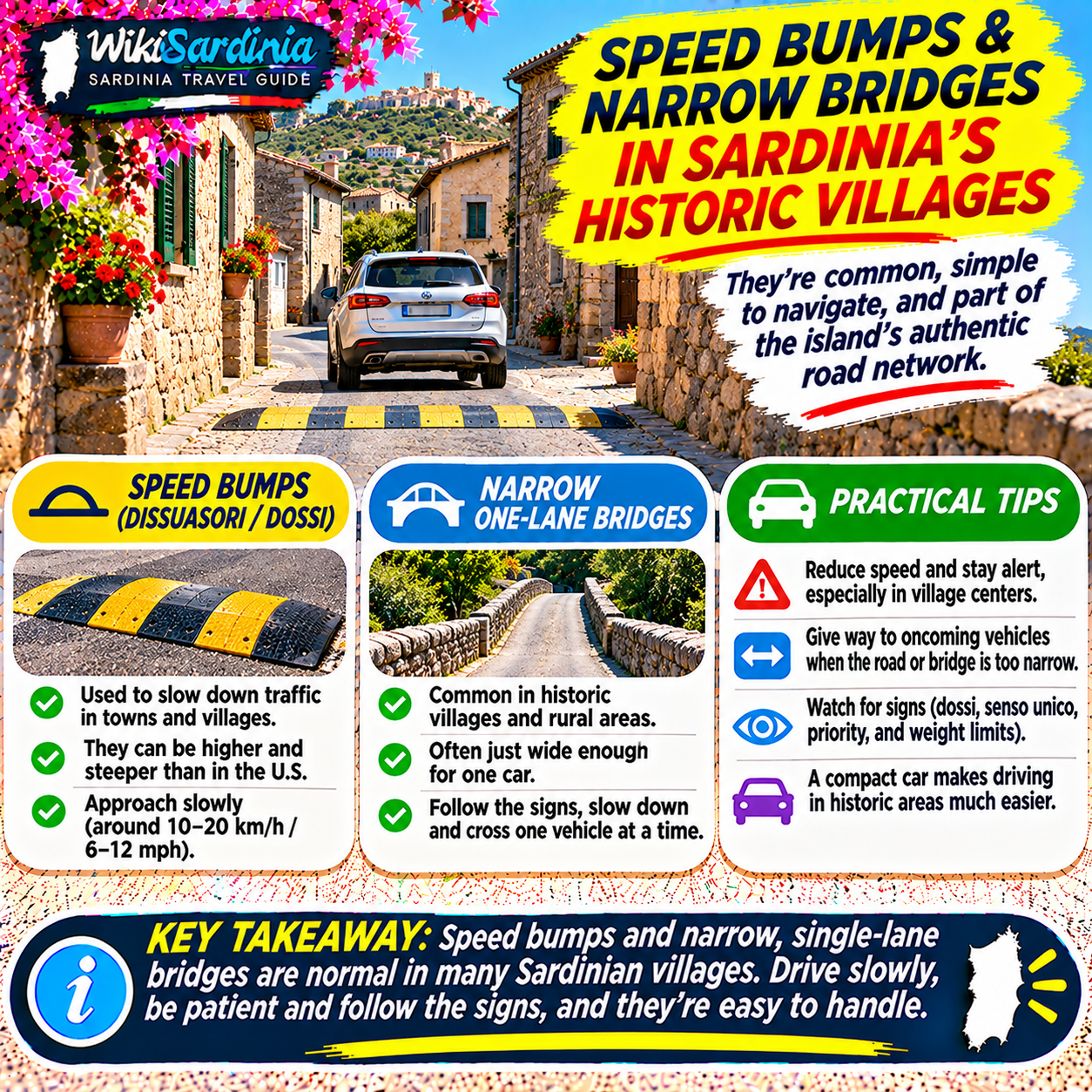
Dosso can refer to a raised section of road or a speed hump, while dissuasore di velocità is a traffic-calming device intended to reduce speed. You may encounter raised humps or other traffic-calming features on streets where drivers need to slow down. They are not all the same height, shape or material. Watch for road markings and signs, particularly on poorly lit streets.
How fast should I drive over a speed bump?
There is no single safe crossing speed for every bump. Follow the posted speed limit and any specific warnings, reduce speed smoothly before the bump, and cross slowly enough to avoid losing control or damaging the vehicle. Be especially careful in a low-clearance rental car. Do not swerve into the opposite lane or onto a sidewalk to avoid a bump, and watch for pedestrians nearby.
What if a bridge is only wide enough for one vehicle?
Approach at a low speed and look for signs identifying who has priority. If the bridge is occupied by an oncoming vehicle, wait at a safe position before the narrow section. Do not enter if you cannot see a clear exit or if doing so would block an oncoming vehicle. Even when you have priority, proceed only when the crossing is clear and safe.
Which Italian sign means I must yield to oncoming traffic?
Look for a circular sign with a red border and two opposing arrows, usually a red upward arrow and a black downward arrow. This indicates that you must give priority to vehicles coming from the opposite direction on the narrow section. The related blue rectangular sign with two opposing arrows, typically a white upward arrow and red downward arrow, indicates that your direction has priority over oncoming traffic. The colors and shapes matter; do not rely on an improvised drawing or a navigation app icon.
Does the first driver to arrive always go first?
No. Traffic signs and the actual situation determine what to do. Where signs assign priority, follow them. If there is no sign, slow down, assess whether the road is clear and cooperate safely with other drivers; do not assume that being first gives you an absolute right to proceed. If an oncoming vehicle is already on the bridge, do not enter and create a confrontation.
What if there is no room for two cars on a village street?
Many old streets were built long before modern cars. If two vehicles meet in a constricted section, one may need to wait or use a safe passing place. Follow posted signs and use the available space cautiously, without driving onto sidewalks, damaging property or reversing blindly. If you must reverse, make sure the route behind you is clear of people, obstacles and other vehicles. On steep roads, particular rules and practical safety considerations can apply; do not improvise a risky maneuver.
What does senso unico mean?
Senso unico means one-way traffic. A narrow street is not necessarily one-way: two-way traffic may still be permitted even when cars cannot pass side by side. Look for official one-way and no-entry signs rather than guessing from the road width. Never enter a street marked with a red circular divieto di accesso sign just because it appears empty.
What about ZTL zones in historic centers?
A Zona a Traffico Limitato, or ZTL, restricts vehicle access under specified conditions. Some historic centers use signs and cameras to enforce these restrictions. A navigation app may suggest a route through a ZTL even when your rental car is not authorized to enter. Read the signs carefully, check active hours and ask your accommodation about legal parking and any applicable guest access arrangements. Do not assume a hotel booking automatically grants permission.
Are narrow bridges and streets safe for rental cars?
They can be navigated safely when the route is suitable for your vehicle and you follow the signs, but not every street or bridge is appropriate for every car. Watch for width, height and weight restrictions, especially with larger SUVs, vans or vehicles carrying roof equipment. If a road looks too narrow or a restriction applies, choose another route rather than testing the clearance.
Should I rent a smaller car for inland Sardinia?
A compact car can make parking and maneuvering easier on narrow village streets, although luggage capacity and passenger needs still matter. Compare the vehicle's width and turning circle with your itinerary. Regardless of size, never assume you can drive directly to the door of accommodation inside a historic center; some properties require parking outside pedestrian or restricted areas.
What if another driver is impatient or honks?
Stay calm and prioritize safety. Do not rush onto a narrow bridge or squeeze past a pedestrian because someone behind you is impatient. If you are uncertain, wait where it is safe and allow other traffic to pass when possible. Avoid stopping in a way that blocks a blind bend, driveway or emergency access.
Useful Italian phrases
“Dosso artificiale” means “Speed bump.” “Dare precedenza ai veicoli provenienti dal senso opposto” means “Yield to oncoming traffic.” “Senso unico” means “One-way street.” “Strettoia” means “Narrowing of the road.” “Limite di larghezza” means “Width limit.” And “Zona a traffico limitato” means “Restricted traffic zone.”
The WikiSardinia takeaway
Speed bumps and narrow crossings in Sardinia are manageable when you drive patiently and follow the actual road signs. Slow before bumps, yield when the signs require it, never enter a one-lane bridge that is not clear, and watch for ZTL and vehicle-size restrictions in historic centers. A little extra caution makes exploring inland villages far more enjoyable.