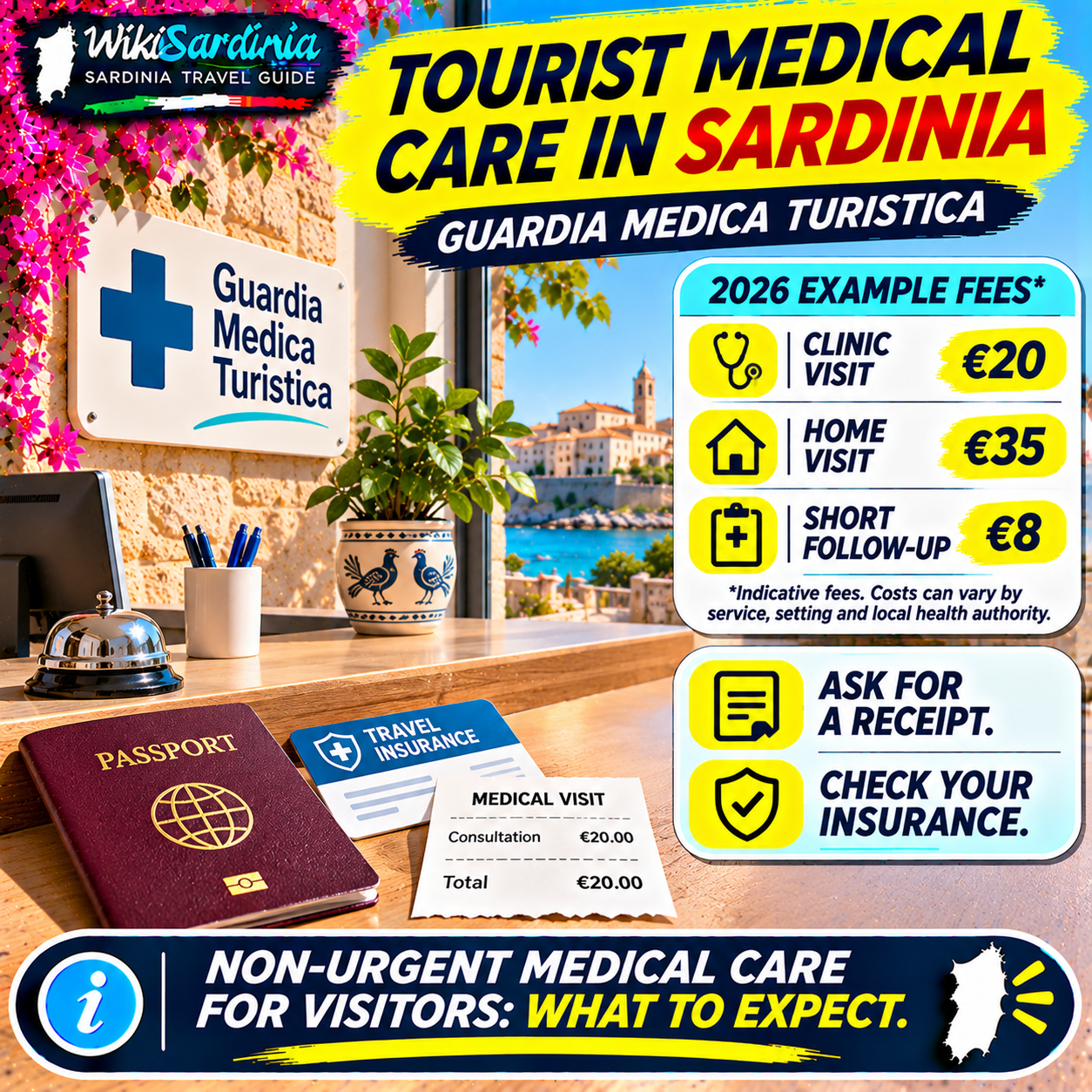
Non-EU tourists visiting Sardinia can generally use the seasonal Guardia Medica Turistica for non-emergency medical problems, but they should expect to pay for the service and request a receipt. The published 2026 tariff at several Sardinian local health authorities is €20 for an outpatient consultation, €35 for a medically appropriate home visit, and €8 for certain brief follow-up services. These are documented service fees, not a promise that every treatment, test or prescription will cost the same amount or that all non-EU visitors have identical entitlements.
What is Guardia Medica Turistica?
Guardia Medica Turistica is a public, usually seasonal primary-care service for visitors who are not resident in the local area. It can assess common non-emergency health concerns, prescribe appropriate medicines, issue certain certificates and refer patients for additional testing or specialist care. It is not a replacement for a hospital emergency department. The official SardegnaTurismo health guide explains the difference between tourist medical posts and ordinary out-of-hours medical services.
How much does a visit cost in 2026?
The ASL Cagliari 2026 announcement and ASL Ogliastra guidance publish the following fees for tourist medical services:
| Service | Published 2026 fee |
|---|---|
| Clinic consultation (visita ambulatoriale) | €20 |
| Home visit when indicated (visita domiciliare) | €35 |
| Brief follow-up or repeat prescription where applicable | €8 |
These amounts are also listed in 2026 information for Santa Teresa Gallura and San Teodoro. The fees may be revised, and different care settings or additional services may have separate charges. Check with the specific ASL or clinic before treatment, particularly if you are reading this guide in a later season.
Do American, British, Canadian and Australian visitors pay?
As a general rule, tourists from outside the European Union who are temporarily in Italy and are not registered with the Italian National Health Service (SSN) should plan to pay the applicable charges. The Italian Ministry of Health states that non-EU visitors staying up to 90 days may receive urgent and elective healthcare subject to the applicable regional tariffs. Nationality alone is not the whole test: entitlement may differ for people with specific international agreements, reciprocal healthcare rights, residence status or other recognized coverage documents. Present any valid entitlement documents rather than assuming the ordinary tourist fee always applies.
Do I pay before or after seeing the doctor?
Payment arrangements can differ by clinic and ASL. Ask at registration when and how the fee is collected and whether card payment is accepted. Do not assume that every tourist medical office has the same payment terminal or cash procedure. Request an official itemized receipt or invoice showing the date, provider and service. ASL Cagliari specifically confirms that a fiscal receipt is issued for its tourist medical consultations. Keep it for insurance reimbursement.
Are prescriptions, medication and tests included?
Not necessarily. The consultation fee pays for the defined medical service, not every medicine, laboratory test, diagnostic examination, specialist visit or hospital treatment that may follow. A doctor may prescribe medicines or recommend further evaluation, and those additional services can have their own payment or entitlement rules. Ask what is included before agreeing to non-urgent additional care, and retain each separate receipt.
Does travel insurance reimburse the visit?
It may, depending on your policy. Some travel insurance plans reimburse eligible outpatient consultations after you submit documents; others require prior contact with an assistance line, apply a deductible, exclude pre-existing conditions or use a direct-billing network. Do not assume automatic reimbursement. Call the insurer when practical, explain that you are using an Italian public tourist medical service, and ask which records they require. Save your policy number, medical report, prescription, receipts and proof of payment. If you pay €20 at the clinic, that does not establish what your insurer will ultimately reimburse.
Does a US health insurance card or Medicare automatically cover the visit?
Do not assume it does. Many US domestic health policies limit overseas coverage, and Original Medicare generally does not cover routine medical care outside the United States except in narrow circumstances. Some Medicare supplement plans or private policies may provide limited foreign-travel emergency benefits. Confirm coverage with your insurer before travel and keep the relevant contact details accessible. A US insurance card is not the same as an Italian SSN card or European Health Insurance Card.
What documents should I bring?
Bring your passport or other valid identification, local accommodation address, telephone number, travel insurance information and any relevant medical records or medication list. If you have documentation of a healthcare entitlement under an international agreement, bring it too. You may be asked for personal and billing information. The clinic can explain which documents it needs for the specific service.
How do I find an open Guardia Medica Turistica?
Check the website of the local ASL (Azienda Socio-Sanitaria Locale), the municipality or the regional tourism service. Tourist medical posts are often seasonal and their schedules vary. For example, ASL Gallura published 2026 seasonal clinics in locations including Olbia, San Teodoro, Palau and Santa Teresa Gallura, with daytime hours around 10 a.m.–5 p.m. at listed sites. These hours are not a year-round island-wide schedule. Check that the exact office is operating on the day you need care.
Can I call 116117 for non-urgent medical help?
Yes, where the regional service is active. ASL Gallura and ASL Ogliastra direct visitors to 116117 for non-urgent medical information and access to appropriate services. This is not the emergency number. If someone has severe breathing difficulty, loss of consciousness, stroke symptoms, major injury or another life-threatening condition, call 112 immediately rather than waiting for a tourist medical appointment.
What if I need care at night or outside the tourist season?
The seasonal tourist clinic may be closed. Ask 116117 about the appropriate continuità assistenziale or out-of-hours service in your area, or consult the local ASL's current information. The ordinary guardia medica and the seasonal tourist service have different schedules and access arrangements. Do not assume a listing that was open in August is operating in November.
Can I request a home visit?
Some tourist medical services can arrange home visits when medically indicated, subject to staffing, geography and availability. The published example fee is €35. This is not an on-demand hotel doctor service or a guaranteed immediate visit. Explain why you cannot safely attend the clinic and ask the operator what arrangements are available. If symptoms are severe, call 112 instead.
Will the doctor speak English?
English proficiency varies by clinician and clinic. Do not assume that every tourist medical office has a fluent English-speaking doctor or interpreter on site. Bring a written description of your symptoms, medication names, allergies and medical conditions. A translation app may help with basic communication, but important clinical details should be confirmed carefully. Ask your insurer whether it offers telephone interpretation or medical assistance in English.
What if the clinic charges more than expected?
Ask which services were billed and request an itemized receipt. The €20, €35 and €8 figures refer to defined 2026 tourist medical services, not every possible treatment. A specialist consultation, test, private doctor or hospital service can have a different price. If a charge seems inconsistent with the published tariff, contact the local ASL's patient information or public relations office (URP) for clarification. Keep documents rather than disputing the amount without knowing the service classification.
What about hospital emergency departments?
A Pronto Soccorso is for emergencies and urgent conditions, not a substitute for routine tourist medical care. The applicable hospital charges and entitlements may differ substantially from the tourist clinic fee, particularly for non-EU visitors without reciprocal coverage. Emergency treatment should never be delayed over uncertainty about payment: call 112 when there is immediate danger, and resolve insurance and billing questions afterward.
How to claim reimbursement after the visit
- Ask for a fiscal receipt or invoice and, when possible, a medical report or consultation summary.
- Keep prescriptions, pharmacy receipts and any separate test invoices.
- Contact your travel insurer promptly and ask for its claim form and deadlines.
- Submit the documents and any required translation or payment evidence.
- Keep copies until the insurer confirms the outcome; reimbursement is subject to the policy.
Useful Italian phrases
“Quanto costa la visita?” — How much is the consultation? “Accettate carte di credito?” — Do you accept credit cards? “Mi serve una ricevuta per l'assicurazione.” — I need a receipt for my insurance. “Ho un'assicurazione di viaggio.” — I have travel insurance. “È possibile una visita domiciliare?” — Is a home visit possible? “Dov'è la guardia medica turistica più vicina?” — Where is the nearest tourist medical clinic?
The WikiSardinia takeaway
Non-EU tourists should generally expect to pay for non-urgent Guardia Medica Turistica services in Sardinia. Several local health authorities confirmed 2026 fees of €20 for a clinic visit, €35 for a home visit and €8 for certain brief services. These are not universal prices for every type of healthcare. Verify the current local tariff, keep a receipt, and ask your travel insurer about reimbursement. For non-urgent guidance call 116117 where available; for a serious emergency call 112.