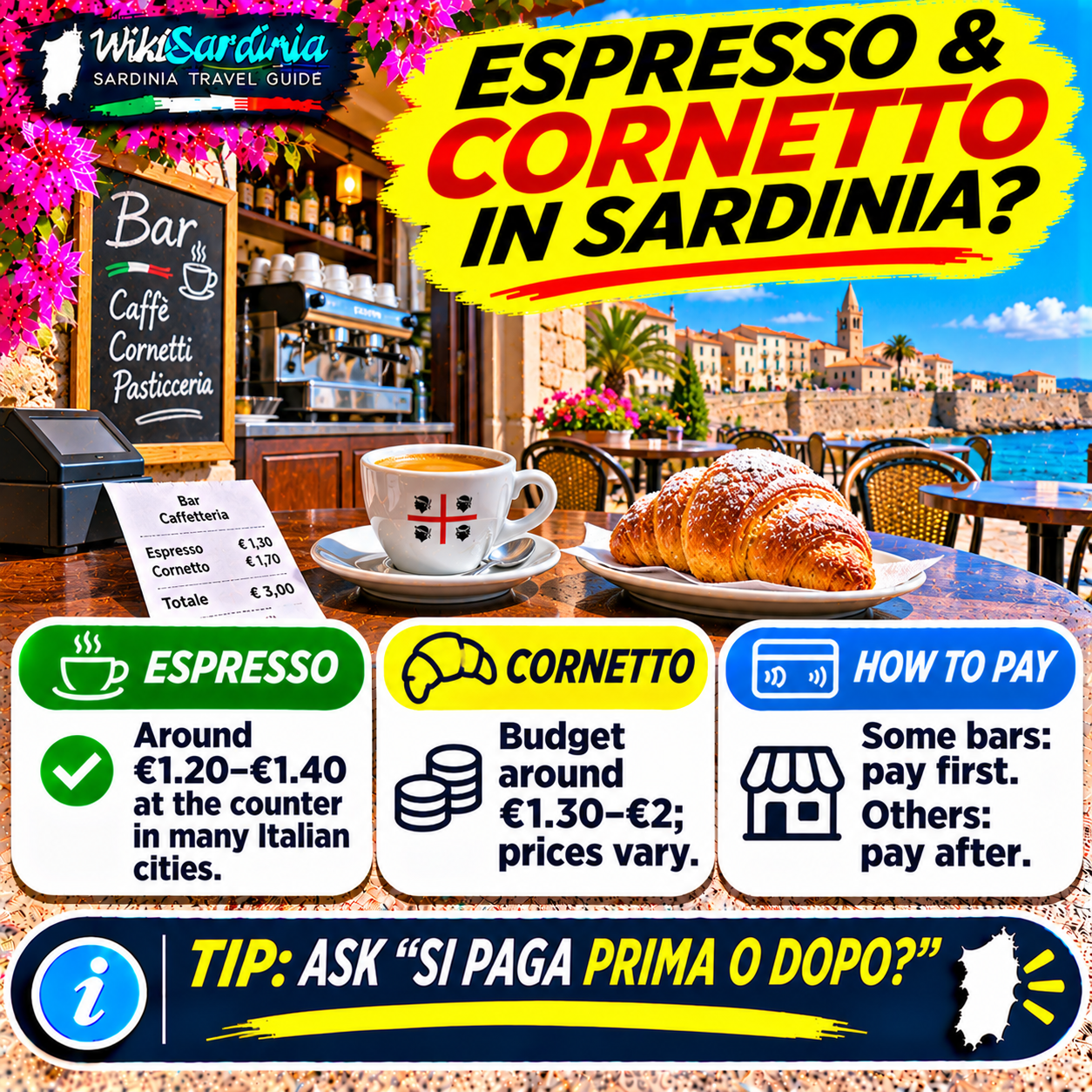
In a typical Italian neighborhood bar, an espresso at the counter costs around €1.20–€1.40 in many cities in 2026, while a plain cornetto can reasonably be budgeted at about €1.30–€2. Prices are not fixed by law and vary by town, venue, filling and whether you stand at the counter or sit at a table. As for payment, some bars expect you to pay first at the cash register, while others let you order and pay afterward. Neither arrangement is a universal Italian rule.
How much does an espresso cost in Sardinia in 2026?
According to Altroconsumo's October 2026 analysis of Ministry of Enterprises and Made in Italy price-monitoring data, an espresso at the bar cost €1.22 in Cagliari in June 2026, while the price in most of the 19 Italian cities examined was €1.20–€1.40. A separate August 2026 study reported by ANSA estimated a national average of €1.29 per espresso. Those figures are useful reference points, not a guaranteed price for every bar in Alghero, Olbia, Bosa or a rural village. Waterfront cafés, hotels and tourist attractions can charge more, especially for table service.
How much does a cornetto cost?
For everyday budgeting, allow roughly €1.30–€2 for a plain cornetto, with filled pastries, artisan bakeries and tourist-facing cafés potentially charging more. This is a practical planning range, not a verified 2026 Sardinia-wide statistical average. Altroconsumo's 2024 breakfast survey found average counter prices of €1.37 for a plain brioche/cornetto and €1.57 for a filled one, showing how the filling affects the price. Those are older national survey figures and should not be presented as current island-specific prices. A cornetto with cream, chocolate, jam or pistachio may cost more than an empty one.
What should I budget for a coffee and pastry breakfast?
At a regular bar, a simple espresso plus cornetto might cost around €2.50–€3.50 at the counter using the illustrative ranges above. This is a budget estimate rather than a quoted menu or measured average. A cappuccino instead of an espresso, a specialty pastry or sitting at a scenic terrace may raise the total. Check the price list before ordering if you want to keep costs predictable.
Do you pay before or after ordering?
Both systems are normal. In a pay-first bar, go to the cassa (cash register), tell the cashier what you want, pay and take the receipt (scontrino) to the barista or pastry counter. In a pay-after bar, order at the counter, enjoy your coffee and pastry, then tell the cashier what you had and pay before leaving. Some bars use numbered receipts, trays or table numbers. The Local's updated guide to Italian bar etiquette confirms that the routine varies by establishment. If you are unsure, watch what the other customers do or ask “Si paga prima o dopo?” (Do I pay before or afterward?).
What happens if I pay first?
Approach the cashier, order “Un caffè e un cornetto, per favore”, pay and keep the receipt. Then hand it to the barista if the bar uses receipts to organize orders. If the pastry selection is displayed at a different counter, you may be asked which filling you prefer. Do not throw away the receipt before you have collected everything. The staff will usually guide you if you are unfamiliar with the setup.
What happens if I pay afterward?
Order and consume at the counter, then go to the cash register and say what you had. In a small neighborhood bar, the barista may remember your order and tell the cashier; in a busy venue, you may need to list the items. Paying afterward does not mean you should leave without checking whether payment is due. If you sit at a table, the waiter may bring the bill or ask you to pay at the register.
Is it cheaper to drink coffee standing at the counter?
Often, yes. Many Italian cafés distinguish al banco (standing at the counter) from al tavolo (table service). The difference can be noticeable in historic centers and tourist areas. Italy's FIPE guidance from March 2026 explains that prices and any additional table-service components must be clearly communicated under the applicable rules. A €1.30 espresso at the counter does not necessarily cost €1.30 when served at a terrace table. Check the table menu rather than assuming the counter price applies everywhere.
Can a bar charge extra just because I sit down?
Table-service prices or supplements may be charged where properly disclosed under the applicable regional rules. They should not be a surprise added without clear price information. FIPE's 2026 explanation emphasizes transparency and advance disclosure of prices and service components. If you want the cheaper counter price, order and consume at the counter rather than carrying a counter-purchased coffee to a table without asking. Some cafés reserve tables for waiter service.
Are bar prices regulated or fixed?
There is no single legally fixed national espresso price. Businesses set their prices and must communicate them appropriately. FIPE identifies the price-display obligation under Article 180 of the implementing regulation of the Italian public-security law and explains that regional rules detail how prices must be shown. A bar in a small inland village can have different prices from a hotel café in Porto Cervo or a waterfront terrace in Alghero. If the price is not obvious, ask before ordering.
Do I need to leave a tip for an espresso?
No mandatory tip is expected for a quick coffee at the counter. You can leave small change as a voluntary gesture if you particularly appreciate the service, but it is not required. At a table, any service charge should be indicated in the price information. Do not confuse a voluntary tip with an obligatory fee.
Can I pay by card for a €1.30 espresso?
Card and contactless payments are widespread in Italy, and merchants generally must accept electronic payments subject to the applicable legal framework. In practice, a particular terminal may be temporarily unavailable, especially in a small or remote business. Having a few euros in cash is a useful backup, but do not assume a minimum purchase is legally required simply because the amount is small. Ask “Posso pagare con la carta?” (Can I pay by card?) if you are unsure.
What does “un caffè” mean in Italy?
In an Italian bar, “un caffè” normally means one espresso, not a large American-style filter coffee. If you prefer a longer drink, ask for “un caffè americano” or “un caffè lungo”, recognizing that these are not identical. “Un macchiato” is an espresso marked with a little milk, while a cappuccino contains espresso and steamed milk. If you ask for “un latte” alone, you may receive a glass of milk; say “caffè latte” for coffee with milk.
What is a cornetto, and is it the same as a croissant?
A cornetto is an Italian crescent-shaped breakfast pastry, often softer and sweeter than a classic French croissant. It can be plain (vuoto), filled with jam (marmellata), custard (crema), chocolate (cioccolato) or other fillings. Some Sardinian cafés may call a similar pastry a brioche. You may also find local sweets such as pardulas or seadas at bakeries and pastry shops, though availability and breakfast customs vary by location.
Can I order a cappuccino after 11 a.m.?
Yes. Italians commonly associate cappuccino with breakfast, but there is no law or universal bar rule against ordering one in the afternoon. The staff will generally make it if the café serves it. The idea that cappuccino is forbidden after a certain hour is a cultural exaggeration, not a restriction visitors need to worry about.
Do I need to sit down to eat my cornetto?
No. Standing at the counter for a quick espresso and pastry is a common Italian breakfast routine. Many locals finish in a few minutes before work. If you want a slower breakfast, choose a table and check whether waiter service and different prices apply. Be mindful not to occupy a small counter space longer than necessary during a busy morning rush.
What if I have food allergies?
Ask before choosing a pastry. Cornetti commonly contain wheat and may contain milk, eggs, nuts or other allergens depending on the recipe and filling. A pastry labelled “vuoto” means unfilled, not necessarily dairy-free, egg-free or allergen-free. Ask “Contiene frutta a guscio, latte o uova?” (Does it contain nuts, milk or eggs?) and request allergen information from the staff. If you have a serious allergy, communicate it clearly and do not rely on appearance alone.
What time do local bars open for breakfast?
Many neighborhood bars open early to serve workers and commuters, while tourist cafés, pastry shops and beach bars can follow different schedules. There is no single opening time for every town in Sardinia. On Sundays, public holidays and during the off-season, hours can change. Check the specific venue's current schedule rather than assuming breakfast will be available at 6 a.m. everywhere.
Can I ask for water with my espresso?
Yes. Some bars offer a small glass of water with espresso, while others do not provide it automatically. You can ask politely “Un bicchiere d'acqua, per favore.” Do not assume bottled water or a larger glass is free; if the price matters, ask first. In Italy, a small glass of water accompanying coffee is a familiar custom but not a universal guaranteed service.
What if I receive a different price than the one on the menu?
Ask whether you were charged for table service, a specialty coffee, a filled pastry or another item. If the price was not disclosed, request clarification politely and refer to the displayed price list. FIPE's 2026 guidance emphasizes clear price information, including additional table-service components. Keep the receipt and resolve the question with the cashier before leaving.
Useful Italian phrases at the bar
“Un caffè e un cornetto, per favore.” — An espresso and a cornetto, please. “Si paga prima o dopo?” — Do I pay first or afterward? “Dov'è la cassa?” — Where is the cash register? “Un cornetto vuoto / alla crema / al cioccolato.” — A plain / custard-filled / chocolate-filled cornetto. “Quanto costa al banco?” — How much is it at the counter? “C'è un supplemento per il tavolo?” — Is there an extra charge for table service? “Posso pagare con la carta?” — Can I pay by card? “Il conto, per favore.” — The bill, please.
A first-time visitor's five-step breakfast routine
- Look at the price list and decide whether you want counter service or a table.
- Check whether customers are paying at the cashier before ordering or afterward.
- Order “un caffè e un cornetto”, specifying the pastry filling if needed.
- Keep the receipt if the bar uses it to prepare orders.
- Pay before leaving and check any table-service charge against the displayed menu.
Sources and price methodology
Altroconsumo — October 2026 espresso price comparison, using June 2026 ministry data; ANSA — August 2026 national espresso average of €1.29; Altroconsumo — 2024 cornetto price survey, for historical context; FIPE — March 2026 guidance on price transparency and table service; The Local — Italian bar payment customs, updated October 2026. The cornetto budget is an estimate, not a 2026 Sardinian average; local menu prices should always take precedence.
The WikiSardinia takeaway
Budget roughly €1.20–€1.40 for an everyday espresso and €1.30–€2 for a cornetto at many ordinary bars, while expecting higher prices in some tourist venues and at tables. An espresso and pastry at the counter may cost approximately €2.50–€3.50, but there is no fixed island-wide price. Whether you pay before or after depends on the bar: watch the local routine or simply ask “Si paga prima o dopo?”. You will fit right in.