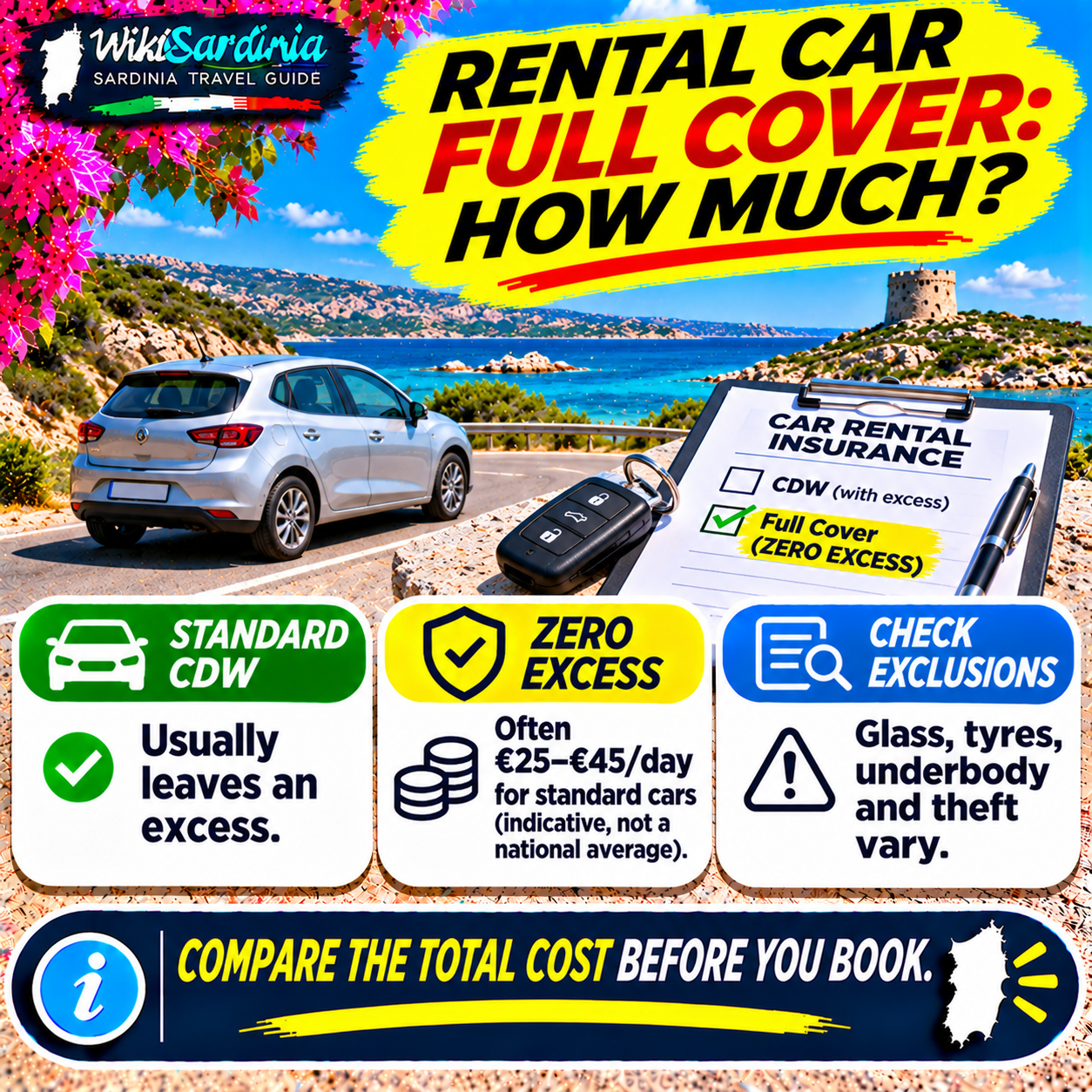
For a standard rental car in Italy, a useful indicative budget for full-coverage, zero-excess protection purchased directly from the rental company is around €25–€45 per day. This is a practical planning range, not a verified nationwide statistical average. The price depends on the supplier, vehicle category, rental location, duration and whether the package covers damage only or also theft, glass, tyres and roadside assistance. Some published premium packages cost substantially more.
How much does full-coverage rental car insurance cost in Italy?
Official Italian rental-company terms provide concrete examples. Avis Italy's published conditions list standard Damage Waiver at approximately €17.64–€26.47 per day when not already included, and Super Damage Waiver (zero damage excess) at approximately €23.01–€35.82 per day under its general terms. Its more extensive protection packages cost more. Budget Italy lists Super Cover Protection, combining damage and theft excess elimination, at approximately €32.05–€52.34 per day. Drivalia's March 2026 published price list prices optional Super Cover at €25–€70 per day before VAT, depending on vehicle group. These are supplier-published ranges, not a comparison of identical coverage.
What is the difference between CDW and full coverage?
Collision Damage Waiver (CDW) usually reduces the amount you owe if the rental car is damaged, but commonly leaves an excess or deductible—the amount you may still have to pay after a covered incident. The basic CDW may already be included in the advertised rental price. Super CDW, Super Cover or zero-excess protection typically reduces that damage excess further, sometimes to zero for covered incidents. However, “full coverage” is a marketing expression, not a guarantee that every type of loss is covered. Theft, glass, tyres, underbody, keys, interior damage, towing and administrative charges may have separate conditions.
Official price examples: what are you actually buying?
| Published product | Indicative daily price | Important distinction |
|---|---|---|
| Avis Damage Waiver, if not included | €17.64–€26.47 | Standard damage waiver; excess generally remains |
| Avis Super Damage Waiver | €23.01–€35.82 in general Italian terms | Reduces damage excess to zero subject to exclusions |
| Budget Super Cover Protection | €32.05–€52.34 | Combines damage and theft excess reduction |
| Drivalia Super Cover | €25–€70 before VAT | Vehicle-dependent damage/theft waiver, with stated exceptions |
The Avis website also publishes some location- or vehicle-specific terms with higher maximum prices than its general Italy document. For example, a Rome Fiumicino page quotes Super CDW up to €43.92 daily. Therefore, the actual quote shown for your booking takes precedence over any general range. All examples were checked against published company documents in November 2026; they are not live offers for a specific Sardinian pickup date.
How much will full coverage add to a one-week rental?
At an indicative €25–€45 per day, seven days of zero-excess protection would add €175–€315 to the rental price. A five-day rental would add €125–€225, while ten days would add €250–€450, assuming the same daily rate throughout. These calculations are illustrative: the supplier may charge a capped number of days, apply airport supplements or offer a bundled rate. For example, Avis and Budget's published Italian terms describe charging for at most 15 days of certain protections on qualifying rentals of up to 30 days. Check the final booking total rather than multiplying a headline daily rate blindly.
Does zero excess mean absolutely no liability?
No. Even a product advertised as zero excess has contractual exclusions and obligations. Avis Italy's conditions exclude or restrict certain losses linked to intentional conduct, serious misuse, interior damage, roof damage from height misjudgment, clutch damage, tyre or rim issues and underbody damage under specified circumstances. Drivalia's Super Cover list includes several of these areas, but its theft rules retain exceptions in specified parts of Italy. Coverage is product-specific: never assume that the words “full protection” have identical meanings across companies.
Are tyres, windscreens and the underbody covered?
Sometimes, but not always. A basic CDW or Super CDW may not cover damage to tyres, wheels, glass, roof or underbody. Some premium packages add these items, and certain providers sell glass-and-tyre protection separately. Drivalia's published Super Cover describes coverage for glass, roof, underbody and wheels under its conditions, whereas Avis offers broader packages with windscreen protection. Ask for the actual list of included components, not merely the product name.
Does full coverage include theft protection?
Not necessarily. CDW is primarily about vehicle damage, while theft protection is a separate waiver or part of a bundled package. Avis Italy states that theft protection is mandatory and already included in the rental rate, but the remaining theft excess can depend on the package. Budget's Super Cover combines damage and theft excess elimination. Check the theft excess separately and read regional exceptions. Do not infer that a zero damage excess also means zero theft excess.
What about roadside assistance and towing?
Basic mechanical-breakdown assistance and optional extended roadside products are not necessarily the same thing. Some premium packages include additional assistance for flat tyres, lost keys, lockouts or other driver-caused incidents, while others charge separately. If you plan to explore remote Sardinian roads, ask what assistance is included, which phone number to call, whether towing is covered and whether service reaches rural areas. Do not assume an insurance product guarantees immediate recovery everywhere.
Is the price different in Sardinia?
It can be. Pickup locations at Olbia, Cagliari and Alghero airports may have different prices, airport surcharges and available vehicle groups. Summer demand can also affect the overall rental quote. The official national price ranges are useful benchmarks but do not establish a fixed Sardinia-wide premium. Compare quotes for the same pickup and return dates, vehicle class, driver age and coverage level.
Is a third-party excess reimbursement policy cheaper?
It may be, but the mechanism is different. With a rental-company zero-excess waiver, the rental supplier reduces your contractual liability for covered damage. With a third-party excess reimbursement policy, the rental company can still charge you under its rental agreement, and you must submit a claim to the outside insurer afterward. Avis explicitly warns that customers using third-party cover remain responsible for paying Avis's applicable charges and seeking reimbursement themselves. Check the third-party policy's limits, exclusions, required documentation, geographic coverage and claim deadlines before comparing its price with a desk-sold waiver.
Does my credit card already cover rental car damage?
Some credit cards provide rental vehicle damage benefits, but coverage differs by issuer, card tier, country and rental length. A card may require you to pay the entire rental with that card and decline certain optional waivers. Italy and some vehicle types may have restrictions, and a credit-card benefit may not cover third-party liability, glass, tyres, theft or administrative fees. American travelers should request the card benefit guide or a coverage confirmation for Italy before booking. Do not cancel the rental company's protection based on a generic internet claim about your card brand.
Does buying full coverage eliminate the security deposit?
Not always. Some suppliers reduce the hold when you buy a premium package, but they may still require a deposit for fuel, tolls, fines or other charges. The accepted card type can also remain unchanged. Ask the pickup branch for the exact deposit amount after your chosen protection package and whether the physical payment card is still required. This matters especially for travelers using debit cards.
Should I buy full coverage when driving in Sardinia?
It depends on your financial tolerance, experience, route and the basic excess. Narrow historic streets, tight parking spaces and unfamiliar rural roads may make some travelers prefer the predictability of a zero-excess package. Others may be comfortable keeping the standard CDW and a larger potential excess, particularly if they have verified credit-card coverage. Compare the premium against the deductible you would otherwise face, and check whether the extra package actually covers the types of damage you worry about.
How do I compare two rental quotes fairly?
- Compare the same vehicle group, dates, pickup location and mileage terms.
- Identify what CDW and theft protection are already included in the base price.
- Write down the damage and theft excess before and after the optional package.
- Check coverage for tyres, wheels, glass, roof, underbody, keys and roadside assistance.
- Compare the final price including VAT, airport supplements and optional cover.
- Check the deposit hold and accepted card requirements.
- Read exclusions, incident-reporting deadlines and conditions for unauthorized drivers or prohibited roads.
What should I do if the rental desk pressures me to buy insurance?
Ask the agent to explain which protection is already included, which optional product is being offered, its daily and total price, the resulting excess and any exclusions. If you decline, confirm the original deposit and liability terms in writing. If you accept, check the rental agreement before signing. Do not rely on verbal assurances that “everything is covered,” especially if glass, tyres or underbody damage matter to you.
What if the rental car is damaged?
Follow the rental company's incident instructions immediately. Take photos of the vehicle, location and damage, record other parties' details when relevant, and contact emergency services if anyone is injured. The company may require a police report for certain accidents, theft or vandalism and may impose strict notification deadlines. Do not authorize repairs or continue driving an unsafe vehicle without the rental company's instructions. Retain all documents for any excess reimbursement claim.
Useful Italian phrases
“La CDW è già inclusa nel prezzo?” — Is CDW already included in the rental price? “Qual è la franchigia per danni e furto?” — What are the damage and theft excess amounts? “La copertura azzera la franchigia?” — Does this protection reduce the excess to zero? “Sono inclusi vetri, pneumatici e sottoscocca?” — Are glass, tyres and underbody included? “Quanto costa in totale per sette giorni?” — What is the total cost for seven days?
Official pricing and coverage sources
Avis Italy — rental and protection terms; Budget Italy — protection package prices; Drivalia — 2026 optional services price list; Europcar — excess and protection levels. Product names and prices may change; always rely on the final quote for your actual reservation.
The WikiSardinia takeaway
Budget roughly €25–€45 per day for zero-excess protection on many standard rental cars in Italy, but treat this as a planning range rather than a nationwide average. Some products cost less, while full premium bundles or larger cars can cost €50–€80 or more daily. Check whether the basic CDW is already included, exactly which excess is eliminated, and whether glass, tyres, theft and roadside assistance are covered. The best comparison is the total rental cost and your remaining financial exposure—not the label “full coverage” alone.