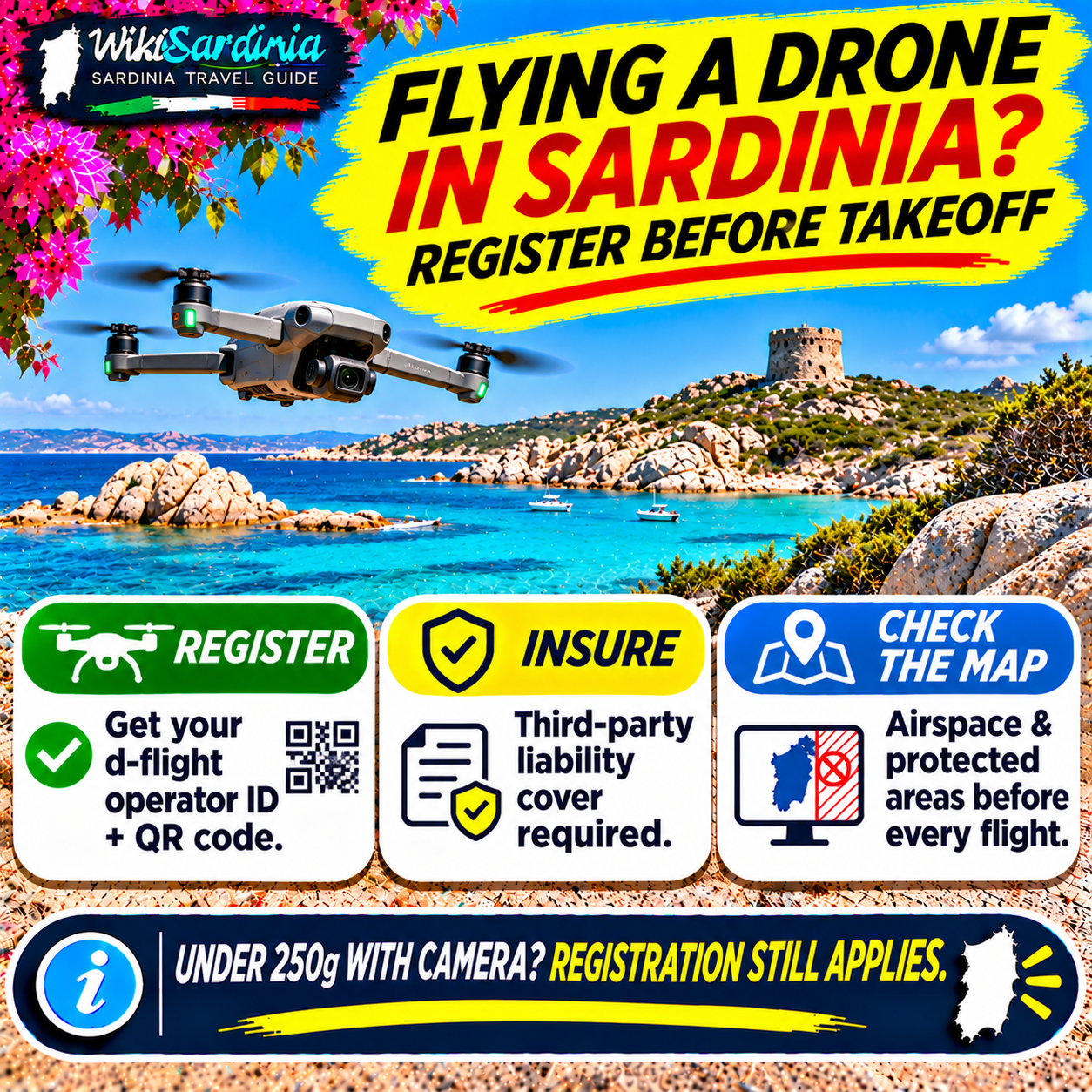
To fly a camera drone legally over Sardinia, most visitors must register as a drone operator, carry appropriate third-party liability insurance, and check the official d-flight airspace map before every flight. In Italy the operator-registration platform is d-flight, under the rules administered by ENAC, the Italian civil aviation authority. A lightweight drone such as a 249 g DJI Mini is not automatically exempt: if it has a camera and is not legally classified as a toy, operator registration is normally required. Registration alone never grants permission to fly over an airport, a restricted coastline or a protected natural area.
Is it ENAC, d-flight or “dronestore”?
ENAC is Italy's civil aviation authority. d-flight is the official online platform used for UAS operator registration, operator identification codes and geographical-zone maps. The d-flight website includes a store for purchasing the relevant services and subscription or registration products, but “dronestore” is not the name of a separate mandatory Italian government registration system. Use the official d-flight services guide rather than an unofficial intermediary selling a supposed permit.
Step by step: how do I register on d-flight?
- Open d-flight.it and create an account using an email address you can verify.
- Complete the platform's accreditation process and choose the subscription or service needed for UAS operator registration. Review the current price shown at checkout; fees and products can change.
- From your account, open the “Op. UAS” operator-registration section and enter the requested identity and operator details.
- Follow the platform's instructions to submit any required documents and complete registration.
- Obtain your unique European UAS operator registration number and its QR-code representation.
- Print or otherwise apply the operator identification to every drone you operate, as required by ENAC. If the drone has an applicable remote-identification function, configure it according to the applicable rules.
- Keep the registration current and retain evidence of insurance and any pilot qualification required for your drone.
The official d-flight guide explains that operator registration requires a valid subscription, the Op. UAS form and any requested supporting documents. It also distinguishes the mandatory operator QR code from an optional separate UAS QR code associated with certain additional services. Do not buy the wrong product assuming both are universally required.
Am I registering myself or each drone?
In the ordinary European open category, the operator registers once and uses the resulting operator number on the drones they operate. The registration identifies the responsible person or organization; it is not the same as individually registering each aircraft as a certified drone. The European Union Aviation Safety Agency (EASA) explicitly distinguishes operator registration from drone registration. Some d-flight fleet-management or additional-service functions may still require entering an individual aircraft's details.
Does a drone under 250 grams need registration?
Usually yes if it has a camera and is not a toy. ENAC exempts operators of drones weighing under 250 g only when they have no camera, microphone or other personal-data collection sensor, or where the applicable toy exemption applies. EASA gives the familiar example of a 249 g DJI Mini with a camera: its operator must register, but a remote-pilot training certificate is not required for ordinary compliant A1 operations. An under-250 g camera drone still requires Italian liability insurance and compliance with geographical-zone restrictions.
Do I need a drone pilot license?
It depends on the drone's class, weight and operation. For a compliant C0 or other qualifying under-250 g camera drone in A1, a formal A1/A3 pilot certificate is not normally mandatory, though the pilot must understand the instructions and rules. For many heavier drones in C1, C3 or C4, the A1/A3 online training and examination are required. C2 operations under A2 involve additional competence and distance requirements. Check the exact classification on your drone and the EASA open-category table before flying. A drone's marketing name alone is not enough to establish its regulatory category.
Do I need insurance for a recreational drone?
Yes, in Italy. ENAC requires drone operators to have adequate third-party liability coverage for the type of operation, including recreational use. This applies even to a non-toy camera drone below 250 g. Check the policy's territorial coverage, exclusions, flight category and effective dates. A normal travel-insurance or home-insurance policy should not be assumed to cover drone liability without written confirmation. Keep proof accessible while traveling.
What if I already registered in another EU/EASA country?
Operator registration is generally recognized across participating EASA states, so a visitor who is already validly registered as a UAS operator in another EASA member state should not create a duplicate Italian registration solely for a holiday. Display the existing operator number and comply with Italian airspace, insurance and local operational rules. If you live outside the EASA system, EASA directs operators to register in the first EASA state in which they intend to operate, subject to the applicable requirements. Check the EASA guidance and ENAC instructions for your specific circumstances.
What if I am visiting from the United States?
An FAA registration or American Part 107 qualification does not, by itself, replace the applicable European operator-registration, pilot-competence, insurance or airspace rules. A US resident who has not already registered in an EASA state generally needs to follow the first-state-of-operation registration process. If Sardinia is your first European drone destination, start with Italy's d-flight process and confirm any documentation or identity requirements before traveling. Do not assume your US drone insurance covers operations in Italy; ask the insurer for written territorial confirmation.
Where can I see Sardinia's no-fly zones?
Use the official d-flight map and inspect the exact launch location, route, maximum permitted altitude and any temporary airspace reservations immediately before each flight. ENAC's 2026 guidance on UAS geographical zones explains that d-flight displays restrictions around airports and heliports, security-sensitive areas and environmental zones. The colors and height limits have specific meanings; a zone may prohibit open-category flights from ground level or impose other restrictions. Do not rely exclusively on the drone manufacturer's geofencing app, which is not the authoritative Italian legal map.
Can I fly near Olbia, Alghero or Cagliari airports?
Airports and their surrounding airspace have specially regulated geographical zones. The fact that a scenic coastline is several kilometres from a runway does not establish that a flight is legal. Check the exact point on d-flight, including the altitude band and whether open-category flight is permitted. ENAC explains that in designated airport-safety geographical zones, open-category operations are prohibited; flights requiring a different authorization pathway cannot be legalized merely by flying lower or using a 249 g drone. If the map prohibits your planned flight, do not take off without the appropriate authorization.
Can I fly over Sardinian beaches in summer?
There is no automatic blanket ENAC drone ban over every Italian beach from June through September. ENAC clarified in February 2026 that a coastal flight restriction sometimes quoted for summer applies to certain manned VFR flights, not directly to UAS operations. Drone pilots must instead comply with the official d-flight restrictions, their open-category limits and the obligation not to fly over assemblies of people. A crowded beach can make a flight unlawful or unsafe even when the map does not show a red area. Always maintain appropriate separation from uninvolved beachgoers.
Can I fly over La Maddalena, Asinara or other protected landscapes?
Protected natural areas deserve special care, but avoid the oversimplified claim that every national park is automatically a drone no-fly zone. ENAC's official explanation states that aviation no-fly restrictions over protected parks apply where approved by ENAC and published on d-flight. ENAC also acknowledges that some published zone boundaries have been approximated and are being reviewed. If your proposed flight falls in a published restricted area, contact the relevant park authority about any required clearance and follow the applicable ENAC authorization process. Separately check lawful access, takeoff and landing rules and wildlife-disturbance restrictions. Never fly close to nesting birds or other sensitive wildlife.
How high and how far can I fly?
For ordinary open-category flights, the standard EASA maximum is 120 metres above the closest point of the Earth's surface, unless a lawful exception or a lower geographical-zone limit applies. Keep the drone within visual line of sight (VLOS) or comply with the observer arrangements permitted by the rules. Do not fly beyond visual range just because the camera feed remains clear. Coastal cliffs can make altitude measurements confusing; the 120 m limit is not simply an unlimited height above your takeoff point. Follow any stricter local ceiling shown on d-flight.
Can I film people on beaches or private homes?
Respect privacy and data-protection rules. ENAC identifies GDPR compliance as an operator responsibility. Avoid recording identifiable strangers in intrusive situations, hovering above private property or publishing footage that unlawfully exposes people. Consent, legitimate purpose, publication context and other applicable privacy rules matter; the legality of filming is not determined solely by whether the drone is physically over public land. Choose wide landscape compositions that minimize identifiable bystanders.
Can I fly a drone for commercial videos or social media?
European drone rules primarily classify operations by risk, not simply by whether a video is personal or monetized. A low-risk operation may qualify for the open category even when the footage is used commercially, provided every applicable condition is met. Higher-risk flights, such as certain operations near people or outside the open-category limits, may require the specific category and additional authorizations. Advertising or commercial filming may also trigger separate location, privacy, land-access or filming permissions. Do not assume that a paid job grants extra airspace rights.
What about takeoff from a beach, cliff or private property?
Permission to use the airspace and permission to use the ground are different issues. Check whether you may legally access the site and launch from it, especially in protected areas, concession-managed spaces and private land. Avoid takeoff near crowds, wildlife, narrow footpaths and areas where a forced landing could injure someone. Even if the map permits flight, an unsafe takeoff site is not acceptable.
Can I fly in strong coastal winds?
Only within the drone's operating limits and your ability to maintain control. Sardinia's Maestrale and local coastal gusts can be strong, particularly around headlands and cliffs. Check wind at flight altitude, not just at beach level, and preserve battery margin for the return against headwinds. Do not launch in rain or conditions beyond the manufacturer's limits. A legal flight can still be an unsafe flight.
How much does registration cost?
d-flight lists registration and subscription services with fees on its official platform, and the relevant cost depends on the current product and account status. Rather than quoting an unverified fixed 2026 price, consult the current d-flight service and store information during signup. Drone insurance is a separate expense. Be wary of third-party sites charging extra for a supposed compulsory “Sardinia drone permit” without identifying an actual official authorization.
What if d-flight shows a red or restricted area?
Do not launch first and ask later. Open the map details to identify the restriction, its vertical limits and the responsible authority. Some restrictions may have specific authorization procedures, while others are incompatible with open-category operations. ENAC says certain non-safety restrictions may permit authorized operations with the appropriate clearance, but this is not a universal exemption. For a casual holiday flight, the practical choice is often to find a different lawful location outside the restriction rather than attempting a complex authorization.
What should I carry while flying?
- Valid operator registration and identification number displayed on the drone where required.
- Proof of adequate third-party liability insurance.
- Any remote-pilot certificate required for the drone and operation.
- The current d-flight map details and any specific flight authorization.
- Drone documentation, charged batteries and emergency contact information.
Preflight checklist for a Sardinian coastal shoot
- Identify the drone's class and whether operator registration and pilot training are required.
- Complete operator registration in your state of residence or first EASA state of operation, as applicable.
- Display the operator identification and configure remote ID where applicable.
- Confirm valid third-party liability insurance covering Italy.
- Check d-flight for the exact takeoff point, route, altitude and temporary restrictions.
- Check protected-area rules, land-access permissions and wildlife-sensitive locations.
- Choose a site away from crowds, assess wind and maintain visual line of sight.
- Keep below the applicable altitude ceiling and never fly over assemblies of people.
- Land immediately if conditions change or the operation becomes unsafe.
Useful Italian phrases
“Devo registrarmi come operatore UAS?” — Do I need to register as a drone operator? “Questa zona è vietata al volo?” — Is flying prohibited here? “Qual è l'altezza massima consentita?” — What is the maximum permitted altitude? “Serve il nulla osta dell'Ente Parco?” — Do I need the Park authority's clearance? “Ho l'assicurazione di responsabilità civile.” — I have third-party liability insurance.
Official resources
ENAC — UAS operators; ENAC — open-category requirements; ENAC — geographical zones and 2026 beach/park clarification; d-flight — registration and operator QR-code instructions; EASA — drone FAQs and category rules.
The WikiSardinia takeaway
Register the operator, insure the drone, label it correctly and check d-flight before every flight. A camera drone under 250 g is not exempt from these steps merely because it is small. The right to fly over a Sardinian beach, cliff or national park depends on the exact airspace and operating conditions, not just on having an operator QR code. When the official map or safety conditions do not permit the flight, choose another location.