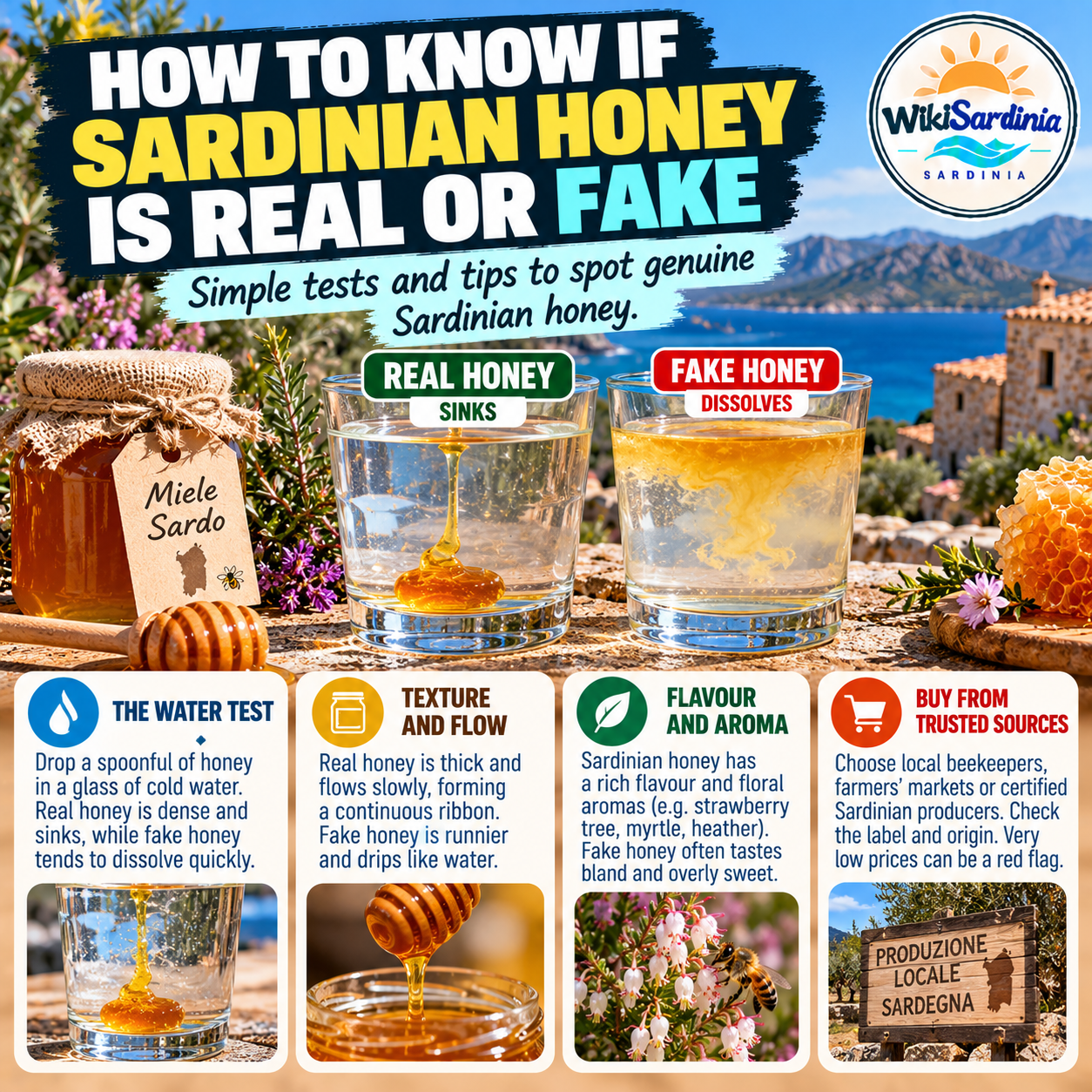
Want to know whether a jar labelled miele sardo is genuine? The most useful approach is to check where it comes from, who produced it and whether the label provides clear, traceable information. Popular home tricks—such as dropping honey into a glass of water—cannot reliably distinguish authentic honey from adulterated honey.
Does the water test work?
No. Honey’s behaviour in water depends on factors such as moisture content, temperature, viscosity and how it is added. Genuine honey may disperse in water, while a syrup or adulterated product can behave in ways that look similar. Whether a spoonful sinks or dissolves is not a reliable authenticity test.
The same caution applies to viral flame tests, paper tests and judging honey by thickness alone. These methods cannot confirm the floral origin or prove that a product has not been mixed with other sugars. Reliable detection of adulteration may require laboratory analysis.
Check the label and origin
Start by reading the jar carefully. Look for the country or countries of origin, the name and address of the responsible producer or packer, and the product’s required labelling information. If the seller advertises honey specifically from Sardinia, ask which beekeeper or area it comes from and whether the batch can be traced to that producer.
Terms such as “local”, “natural” or “artisanal” are not, on their own, proof of origin. A clear answer about the producer and source is more useful than a vague marketing claim.
Where to buy genuine Sardinian honey
- Direct from a beekeeper: ask where the hives are located and which flowers or vegetation the bees forage on.
- Farm shops and farmers’ markets: choose sellers who can identify the producer and explain the origin.
- Specialist food shops: check the label and keep the receipt so you can follow up if information is unclear.
- Traceable local brands: look for producer details and consistent information about origin and harvest.
Does real honey crystallise?
It can—and often does. Crystallisation is a natural process influenced by the honey’s sugar composition, temperature and storage. Some genuine honeys crystallise quickly, while others remain liquid for much longer. Crystallisation is not proof of authenticity, and a jar that stays liquid is not automatically fake.
Can colour, smell or taste reveal a fake?
Not with certainty. Sardinian honeys can vary in colour and aroma according to the plants visited by the bees and the season. Texture, colour and flavour can help you appreciate a honey’s characteristics, but they cannot independently prove purity. Be cautious about products with unclear origin or sellers who cannot answer basic questions, rather than relying on appearance alone.
What if you suspect honey is adulterated?
Keep the jar, label, receipt and any batch information. Contact the seller or producer and ask for clarification. If the concern remains, you can report it to the relevant consumer or food-safety authority. Do not accuse a producer of fraud based only on a home test.
The reliable rule for buying Sardinian honey
There is no dependable kitchen trick that proves honey is genuine. For a jar of Sardinian honey, prioritise a clearly identified producer, transparent origin information and traceability. Buying directly from a beekeeper you trust can make it easier to ask questions and learn about the harvest—without relying on myths about water, flame or crystallisation.