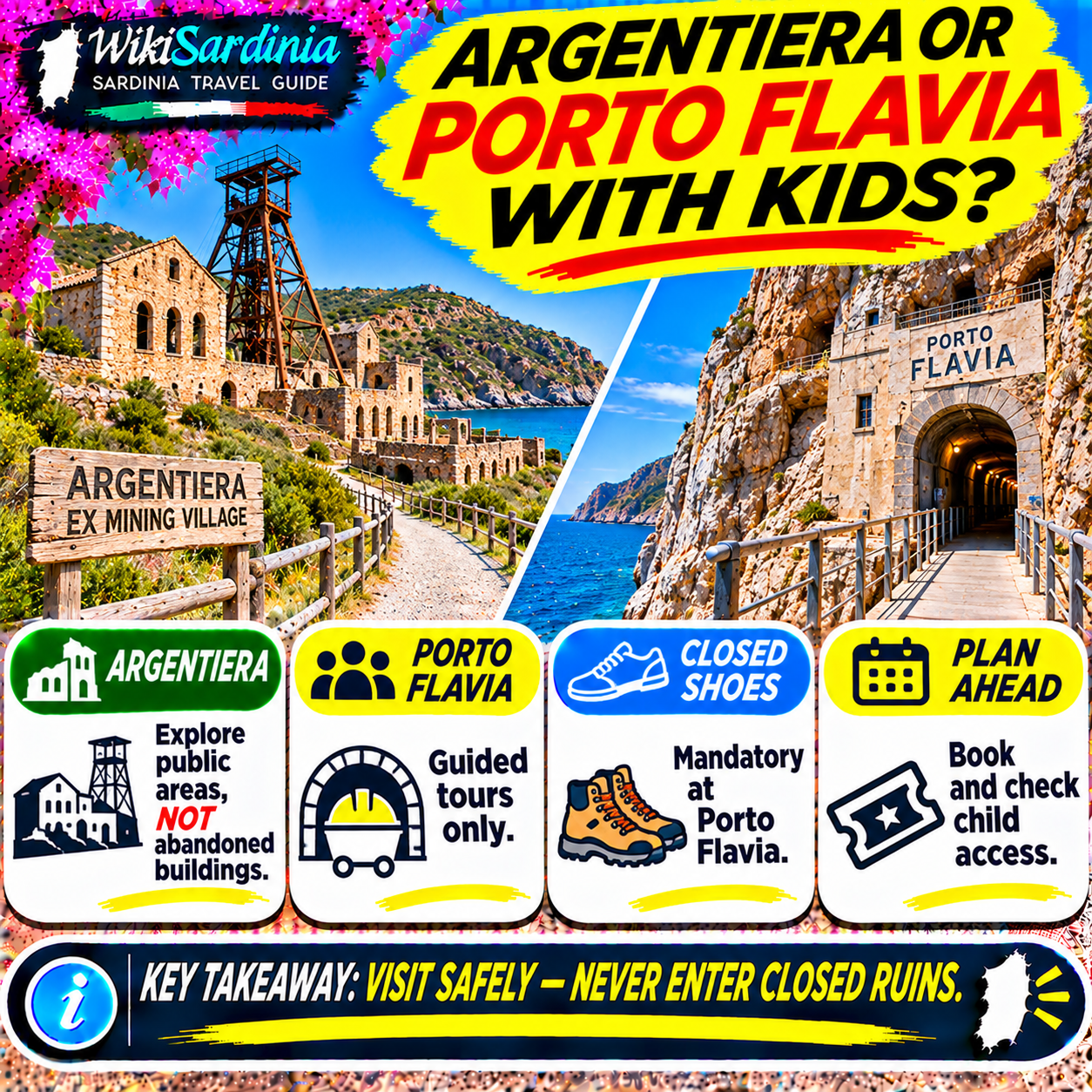
Yes, families can visit both Argentiera and Porto Flavia in Sardinia—but they are very different experiences, and neither should be treated as an abandoned mine to explore freely. Argentiera is a former mining village on the northwest coast with public streets, an open-air cultural project and organized visits to parts of the historic complex. Porto Flavia, on the southwest coast near Masua, is a restored former mineral-loading port that can be entered only on an authorized guided tour. The safest rule with children is simple: enjoy public areas and designated visitor routes, and never enter derelict buildings, tunnels or fenced-off industrial spaces.
Argentiera versus Porto Flavia: which is better with children?
Argentiera is a more flexible stop if your family wants to see dramatic mining buildings from public areas, learn about industrial history and perhaps visit the nearby coast. But some structures remain ruins, and you must keep children away from unstable masonry, openings, shafts, spoil heaps and prohibited areas. Porto Flavia is a structured visit with staff and an established tour route. It is better for families who want a clear historical explanation and a controlled experience, provided children can cope with an underground passage and the walking involved. Neither option is universally safe for every age or ability.
Is Argentiera really an abandoned ghost town?
Argentiera is often described as a ghost town because its mining industry closed and many historic buildings were left unused. But it is not an empty, unregulated playground. It is a coastal settlement in the municipality of Sassari with a history of regeneration, public cultural spaces and the MAR – Miniera Argentiera open-air museum project. The official SardegnaTurismo guide describes its industrial ruins, coastline and transformation. The municipality has supported rehabilitation of public spaces, but this does not mean every remaining derelict building has been made safe for visitors.
Can children walk around Argentiera?
Yes, in publicly accessible areas and on any authorized visitor route, with adult supervision. Choose established streets and clearly designated cultural spaces rather than improvising a route through industrial ruins. Children should not climb on walls, machinery, abandoned staircases, roofs or fencing. Keep them away from cliff edges, unprotected drops and debris. Do not enter any structure simply because a door appears open or another visitor has gone inside. Access permission and structural safety are separate matters.
Can we go inside the old Argentiera mine buildings?
Only when the specific building or route is officially open and access conditions are met. The MAR project offers guided visits centered on the historic Laveria, the mineral-processing building. The operator's 2026 guided-visit program advertised approximately 45-minute visits on selected summer weekends, with advance reservation required. Those dates were specific to the 2026 season and should not be assumed for 2027. SardegnaCultura's April 2026 visitor listing described free access with reception staff in groups of up to ten and expressly prohibited unaccompanied minors. Because published schedules and arrangements can differ, confirm directly with MAR which spaces are open, whether children are accepted and whether reservations are required for your intended date.
What makes abandoned mine sites dangerous?
Old industrial sites can contain unstable floors, corroded stairs, falling masonry, exposed metal, hidden openings and unprotected drops. Mine workings may also have poor air quality, flooding or other hazards not visible from outside. Historic mining areas can contain contaminated spoil or dust; do not allow children to play on waste heaps or collect unknown mineral fragments. These are general hazards associated with abandoned mining infrastructure, not a claim that every part of Argentiera is contaminated or structurally unsafe. The practical distinction is between managed public access and unauthorized exploration.
Is Porto Flavia an abandoned mine?
Not exactly. Porto Flavia was a mineral-loading port, not the mine where the ore was extracted. Built in the 1920s, it used tunnels and storage silos cut into a cliff to transfer ore from nearby mines to ships. The site has since been restored for tourism. The official Iglesias Turismo page explains the history and operates visitor ticketing. The coastal view toward the Pan di Zucchero sea stack is a highlight, but access to the historic infrastructure is controlled.
Is Porto Flavia safe for kids?
Porto Flavia is designed for guided visitors, including families, but the route has physical demands. Tours last approximately 50 minutes. The official visitor information describes an upper gallery about 600 metres long, with a fairly even dirt surface. Access to the lower gallery involves a staircase of approximately 108–110 steps; official pages differ slightly in the count. The route is not suitable for everyone. Before booking, consider your child's age, comfort in enclosed spaces, ability to walk and follow instructions, and any mobility or cardiac concerns in the group.
Are babies and toddlers allowed at Porto Flavia?
The official operator's access rules state that strollers are not allowed. Infants may be carried in an appropriate front baby carrier; the Porto Flavia page specifically says children under one year must use a front carrier and receive a small protective head covering from staff. The operator also states that children must not simply be carried in an adult's arms during the visit. This means families with babies should confirm eligibility and the exact carrier requirements before buying tickets. A toddler who cannot safely walk the required route may need a different outing.
What should children wear at Porto Flavia?
Closed-toe shoes are mandatory. Flip-flops, open sandals and similar footwear are not accepted under the operator's published rules. Choose comfortable shoes with good grip and everyday clothing suitable for a historic mining site, not swimwear. Bring water for before and after the visit, but remember that eating and drinking inside the mining site are prohibited. Follow the guide's instructions and any requirements for protective equipment. Even in summer, the underground setting can feel different from the beach outside.
Does Porto Flavia have an age limit?
The official rules explicitly address infants, which means the site is not categorically adults-only. However, they do not establish that every child can complete every section of the tour. Ask the operator about your child's age, whether the lower-gallery stairs are included, whether an upper-gallery-only visit is possible and what happens if a child becomes distressed. Do not infer eligibility from the existence of a reduced children's ticket alone.
What about children who are afraid of dark tunnels?
Porto Flavia's visit involves enclosed galleries, and some children may find the setting unsettling. Explain beforehand that it is a guided historical tour rather than an adventure through an abandoned mine. Ask whether the galleries are illuminated, whether there are loud noises, how the group exits and whether a shortened visit is possible. Avoid promising that a child can leave instantly from any point in the route. If your child is uncomfortable in enclosed spaces, consider a coastal viewpoint or an outdoor cultural visit instead.
Is Porto Flavia wheelchair or stroller accessible?
The official site indicates that the upper gallery may be accessible to some visitors with mobility limitations when accompanied, subject to individual assessment. The staircase to the lower gallery creates a separate barrier. Do not assume that the entire route is wheelchair accessible, and remember that strollers are not permitted. Contact the operator in advance with your specific mobility requirements and ask which sections are available, what assistance is permitted and whether there are accessible facilities.
How much do Porto Flavia tickets cost?
At the time of this guide's November 2026 research, the official Iglesias Turismo page listed €13 for a standard adult ticket and €8 for children aged 6–12, with other reduced categories. Prices and eligibility may change, and the published page does not establish a universal price for every younger child. Check the live ticketing page before paying. Entry is limited for safety reasons, so advance purchase is strongly recommended. Tickets are offered through the official Iglesias Turismo booking page, at the Iglesias tourist office and at the site ticket office when available.
How long is a Porto Flavia visit and when should we arrive?
The guided tour lasts about 50 minutes. The operator asks visitors to reach the ticket office 15 minutes before their booked time and warns that late arrival may mean missing the tour without a refund. There is also a short walk from the parking area to the entrance. Allow extra time for the drive and for helping children with shoes or other preparations. Tour languages and times are scheduled, so choose an English-language slot if needed rather than assuming every departure is bilingual.
Can you visit Argentiera and Porto Flavia on the same day?
They are in different parts of Sardinia: Argentiera is on the northwest coast near Sassari, while Porto Flavia is in the southwest near Masua and Iglesias. They are not two attractions in the same mining village. Combining both in one family day trip would involve substantial driving, and it is usually more enjoyable to visit the site closest to your accommodation. Families based around Alghero or Sassari may find Argentiera more convenient; those staying around Iglesias or the Sulcis coast may prefer Porto Flavia.
Is the beach at Argentiera suitable for families?
The coastal scenery is beautiful, and a beach stop can complement a visit to the village. However, sea conditions, access, currents and seasonal facilities vary. Do not assume a beach is supervised or suitable for small children merely because it is near a tourist attraction. Stay on established paths, check the weather and sea conditions, and avoid scrambling over cliffs or mining debris to reach secluded coves. If conditions are rough, enjoy the view from a safe public area rather than entering the water.
Which site should families choose?
Choose Argentiera if you want a flexible outdoor visit with historic scenery and are prepared to keep children within authorized public areas. A confirmed MAR guided visit can add valuable historical context. Choose Porto Flavia if your children are comfortable with a structured 50-minute tour and you want to experience a restored industrial monument from inside. For babies, stroller users, people with mobility limitations or children uncomfortable in tunnels, check restrictions before committing to Porto Flavia. Neither destination is suitable for unsupervised exploration of ruins.
Family safety checklist
- Use only authorized public routes or guided tours. Never cross barriers or enter closed structures.
- Supervise children closely. Historic buildings, mine openings and cliff edges are not playgrounds.
- Wear sturdy closed shoes. They are compulsory at Porto Flavia and sensible around historic sites.
- Check age and mobility requirements. Porto Flavia does not allow strollers and has significant stairs.
- Book ahead where required. Porto Flavia has controlled admission; MAR programs can be seasonal.
- Bring water and sun protection for outside. Follow site rules on food and drinks indoors.
- Check current conditions. Weather, maintenance and safety restrictions can change access.
Useful Italian phrases
“La visita è adatta ai bambini?” — Is the visit suitable for children? “Si può entrare solo con una guida?” — Can we enter only with a guide? “Il passeggino è consentito?” — Is a stroller allowed? “Ci sono scale o passaggi stretti?” — Are there stairs or narrow passages? “Quali edifici sono aperti al pubblico?” — Which buildings are open to visitors? “Serve prenotare?” — Do we need to book?
Official sources and booking information
Iglesias Turismo — Porto Flavia official visitor and ticket information; Iglesias Turismo — official access and safety regulations; SardegnaCultura — MAR Argentiera visitor rules, updated April 2026; MAR Argentiera — 2026 guided visit program; SardegnaTurismo — Argentiera; SardegnaTurismo — Open MAR. Information on 2026 schedules is historical; check the operator's latest announcements for later travel dates.
The WikiSardinia takeaway
Both Argentiera and Porto Flavia can make memorable family outings when visited responsibly. At Argentiera, stick to public areas and authorized MAR visits—never enter abandoned mining buildings on your own. At Porto Flavia, book the official guided tour, wear closed shoes and check the rules for infants, stairs and mobility. The dramatic ruins and tunnels are part of Sardinia's industrial heritage, not places for children to explore without supervision.