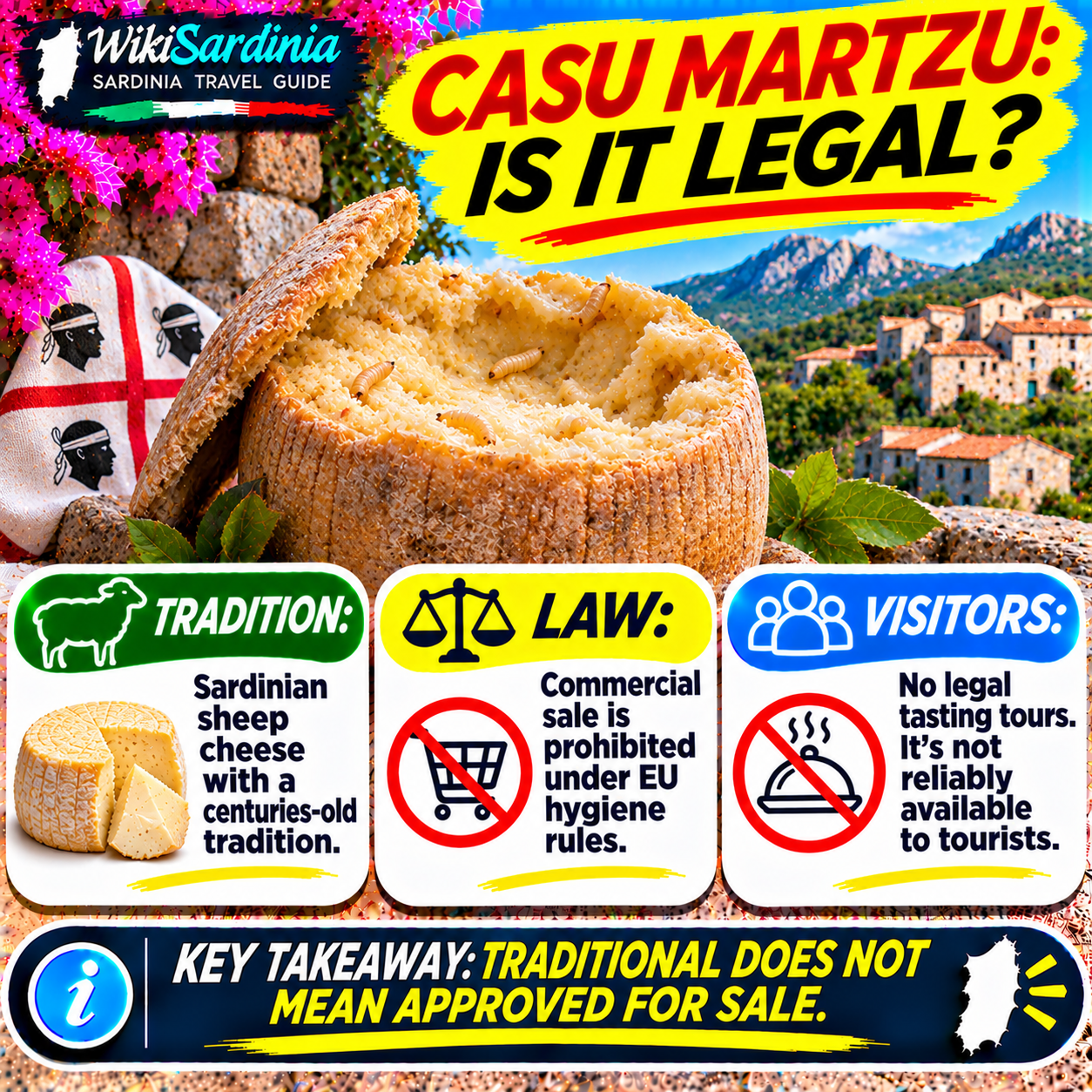
Yes, Casu Martzu (also spelled Casu Marzu) is a real Sardinian cheese, and its commercial sale is not permitted under the food-safety rules applicable in Italy and the European Union. Yet the traditional practice has not disappeared. Some families and shepherding communities still prepare and eat it privately. For visitors, the important distinction is between a surviving food tradition and a legally available restaurant experience: there is no dependable, authorized tourist tasting circuit for Casu Martzu.
What is Casu Martzu?
Casu Martzu is a traditional Sardinian sheep's-milk cheese in which the larvae of the cheese fly, Piophila casei, play a central role in breaking down the cheese. The process transforms a firmer pecorino-like cheese into an exceptionally soft, pungent and sometimes almost spreadable paste. Its name is often translated as “rotten cheese,” though the local names and spellings vary. The unusual process is why the cheese has become internationally famous—and why it raises significant food-safety questions.
Is Casu Martzu actually illegal in Italy?
Commercially marketing Casu Martzu is not legally permitted under the applicable food-hygiene framework. This is more precise than saying that every act of possessing, discussing or privately eating it is a crime. The European Commission explained the regulatory barriers in its response to European Parliament petition 0702/2023, which sought a route to legal recognition of the cheese. The broader hygiene framework includes Regulations (EC) No 852/2004 and No 853/2004, as well as general food-safety requirements. Those rules govern food businesses and products placed on the market.
The EU concept of placing on the market is wider than a cash sale: it can include offering, distributing or transferring food, even without payment, in commercial contexts. Consequently, a restaurant or agriturismo cannot assume that offering an unapproved product “for free” avoids food-safety obligations. The precise legal position of strictly private domestic preparation and consumption is different from commercial sale and should not be collapsed into the claim that simply eating the cheese is illegal.
Why do European rules restrict it?
The cheese's distinctive transformation relies on live insect larvae, which create hygiene and consumer-safety concerns. In its 2024 response to the European Parliament, the European Commission described the risks associated with ingesting larvae and the food's non-compliance with applicable requirements. Slow Food's Ark of Taste entry likewise acknowledges the tradition but explicitly states that European hygiene rules do not allow its commercial sale. This is not merely a bureaucratic dispute over the name: the production process raises substantive questions about contamination and the safety of the finished food.
But isn't it recognized as a traditional Sardinian product?
Yes, the tradition is documented in Italian and Sardinian food heritage, and Casu Marzu is associated with Italy's Prodotti Agroalimentari Tradizionali (PAT) framework. However, PAT recognition records traditional production and cultural heritage; it is not a food-safety approval or an exemption allowing a prohibited product to be sold. The Sardinian regional government publishes and updates the official traditional-food lists, while the European Parliament petition itself recognized the tension between traditional status and marketing restrictions. Do not confuse PAT with a DOP or IGP certification or with an authorization to serve the product commercially.
Can tourists still try Casu Martzu in mountain villages?
It is possible to encounter the tradition, but you should not count on being able to buy or book a tasting. Casu Martzu is associated with pastoral communities across Sardinia, especially inland areas such as Barbagia and the Nuoro region. A May 2026 National Geographic report documented people still making and sharing it, including experiences around Dorgali and private gatherings. This shows that the practice survives; it does not establish a lawful public tasting service, current availability at a named restaurant or a reliable way for tourists to obtain it.
A visitor may hear stories about a family wheel of cheese or see the tradition discussed during a cultural visit. But private hospitality is not a guaranteed tourist product, and a stranger should not pressure shepherds, families or restaurants to provide food that cannot lawfully be marketed. Be especially cautious of websites advertising paid “secret Casu Martzu tours,” anonymous sellers or offers to ship it internationally.
Is it served in restaurants or agriturismi?
Do not expect it on a legitimate public menu. The absence of a normal commercial market means that a restaurant's reputation for traditional Sardinian cooking does not imply Casu Martzu is available. Historical travel reports and anecdotes may describe individual experiences, but they are not evidence of present-day legal service or a reservation option. If you are visiting an agriturismo, there are many excellent legally marketed local sheep's-milk cheeses to enjoy without asking staff to breach food-safety requirements.
What does it taste like?
Descriptions commonly emphasize an intensely pungent, spicy, sharp and fermented sheep-cheese flavor. The texture is much softer and more spreadable than aged pecorino because of the breakdown of fats and proteins during the unusual maturation. Taste and condition can vary considerably because this is not a standardized, legally regulated retail product. A vivid tasting description is not a recommendation to consume it.
Is Casu Martzu dangerous to eat?
There are meaningful safety concerns. Live larvae and uncontrolled production conditions can pose biological hazards, and ingestion has been linked in medical discussions to possible intestinal myiasis or pseudomyiasis, although the frequency and precise magnitude of risk are not well established. The European Commission and Slow Food identify health concerns as reasons commercial sale is not permitted. A person cannot verify safety simply by smelling the cheese, checking its appearance or relying on a producer's experience. Traditional methods described online—such as chilling the cheese, removing visible larvae or putting a portion in a bag—are not validated safety procedures. Travelers who are pregnant, immunocompromised or otherwise medically vulnerable have additional reasons to avoid unregulated dairy products.
Can you bring Casu Martzu back to the United States?
Do not plan to take it home as a souvenir. It has no normal lawful commercial supply chain, and dairy and animal-origin foods are subject to U.S. customs and agricultural restrictions. The fact that another cheese may be admissible does not establish that Casu Martzu is. Travelers must declare relevant food products when entering the United States; admissibility depends on the actual product and current agency rules. For a portable Sardinian cheese gift, choose a properly labelled, commercially sold cheese and check the latest U.S. Customs and USDA requirements.
What happened to the proposal to legalize it?
A petition presented to the European Parliament in 2023 sought reconsideration of the restrictions and suggested developing specific production and safety rules. The European Commission replied in January 2024, discussing the hygiene concerns and existing framework. A petition or scientific proposal does not itself change the law. As of this article's November 2026 research check, no verified EU authorization allowing normal commercial marketing of traditional Casu Martzu was identified. Any future regulatory change should be checked against official EU and Italian publications rather than inferred from a news headline.
What can curious travelers experience instead?
If the appeal is the history of Sardinian shepherding and powerful sheep's-milk cheese, try Fiore Sardo DOP, Pecorino Sardo DOP or an aged local pecorino from a licensed producer. These are authentic and legally marketed cheeses with distinct textures and flavors. You can also explore the island's dairy heritage through recognized farm shops, cheesemakers and food festivals in the Nuoro area or elsewhere in Sardinia. Ask whether a producer offers a permitted cheese tasting or a demonstration of traditional dairy techniques, rather than expecting a Casu Martzu tasting.
Can you visit Barbagia or Dorgali to learn about the tradition?
Yes. The inland landscapes, pastoral heritage and cheese-making culture of Barbagia and the Dorgali area are worth exploring in their own right. A village visit or authorized dairy tour may help you understand the tradition's origins even if Casu Martzu is not available to taste. Check opening hours, visitor policies and language options directly with the producer or local tourism office. Do not enter private farms or cheese-making premises without permission.
Useful Italian and Sardinian phrases
“Che cos'è il casu martzu?” — What is Casu Martzu? “È una tradizione ancora praticata?” — Is this tradition still practiced? “Posso visitare un caseificio autorizzato?” — May I visit an authorized dairy? “Fate degustazioni di formaggi sardi?” — Do you offer tastings of Sardinian cheeses? “Avete Fiore Sardo o Pecorino Sardo DOP?” — Do you have Fiore Sardo or Pecorino Sardo PDO? These questions let visitors learn about the culture without assuming the prohibited cheese is commercially available.
Official sources and further reading
European Parliament — Petition 0702/2023 and European Commission response on Casu Marzu (January 2024); European Commission — EU food-hygiene legislation; EUR-Lex — Regulation (EC) No 852/2004; Regione Sardegna — Traditional agricultural and food products register; Slow Food Foundation — Casu Marzu, Ark of Taste; National Geographic — Sampling Sardinia's legendary maggot cheese (May 2026). These sources distinguish the official legal position from cultural documentation and anecdotal private encounters.
The WikiSardinia takeaway
Casu Martzu is a real Sardinian food tradition, but it is not a legally marketed tourist delicacy. Commercial sale and restaurant service are restricted by food-safety rules; private traditions continue in some communities, but a tourist cannot rely on booking a tasting. The PAT heritage designation does not override EU hygiene law, and the health risks should not be dismissed. For a safe, accessible introduction to Sardinia's pastoral cheese culture, choose a licensed producer offering traditional pecorino tastings.