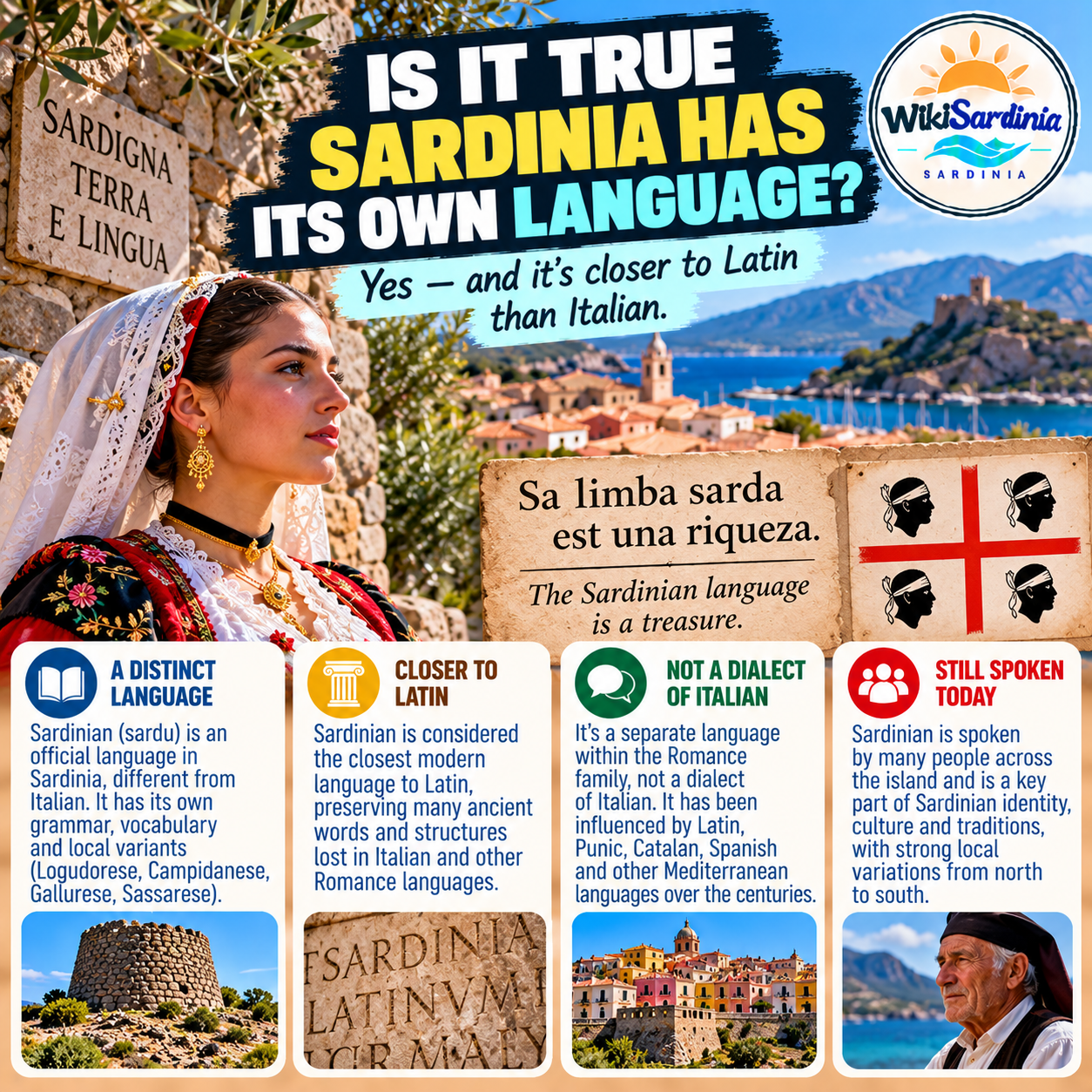
Yes. Sardinia has its own historic language: Sardinian, known as limba sarda or sardu. It is a distinct Romance language that developed from spoken Latin, rather than simply a local way of speaking Italian. Sardinian has its own grammar, vocabulary, literature and regional varieties, and it remains an important part of the island’s cultural identity.
Is Sardinian closer to Latin than Italian?
There is a good reason people say that. Linguists often describe Sardinian as one of the most conservative Romance languages because it has preserved certain features of Latin that changed in other languages, including Italian. However, “closer to Latin” is a useful shorthand, not a rule that applies to every word or grammatical feature. Sardinian has also changed over time and has been influenced by the many peoples and languages connected with the island.
Where is Sardinian spoken?
Sardinian is spoken in many communities across the island, but it is not identical everywhere. Two major groups are commonly described: Logudorese, associated mainly with central and northern areas, and Campidanese, associated mainly with the south. There are local differences in pronunciation, vocabulary and usage, and the boundaries between varieties are not always sharp.
Does everyone in Sardinia speak Sardinian?
No. Italian is widely used in everyday life, education and public services, and knowledge of Sardinian varies by age, family and locality. Some people speak it fluently at home and in their communities; others understand it, use only a few expressions or do not speak it. Language transmission to younger generations is an important concern for many Sardinian cultural organisations.
Is Sardinian the only traditional language on the island?
No. Sardinia has a rich and varied linguistic landscape. Alghero has a historic Catalan-speaking community, while Sassarese and Gallurese are also spoken in northern areas, and Tabarchino survives in communities in the south-west. These have distinct histories and should not all be treated as dialects of Sardinian. Their presence reflects centuries of contact, migration and cultural exchange across the Mediterranean.
Does Sardinian have official protection?
Yes. Italian national law 482/1999 recognises Sardinian as a historic linguistic minority language, and regional legislation supports the protection and promotion of Sardinia’s linguistic heritage. Regional Law 22/2018 sets out the island’s language-policy framework. These measures recognise that the language is part of Sardinia’s cultural heritage, even though Italian remains the dominant language in many public settings.
Useful Sardinian words to recognise
Written forms and pronunciation can vary between local varieties, but you may encounter expressions such as bonu die (“good day”) and gràtzias (“thank you”) in some contexts. If you are visiting a village, asking a speaker how a phrase is said locally is a friendly way to learn—and shows respect for the island’s linguistic diversity.
A language, not just an accent
Sardinian is a language with deep Latin roots, a long literary and oral tradition, and a range of living local varieties. Its relationship with Italian is only one part of the story. To understand Sardinia more fully, listen to the language in local music, place names, conversations and cultural events—and remember that not everyone on the island has the same linguistic background.
Further reading: Italian Senate dossier on the protection of Sardinia’s linguistic heritage; Cambridge University Press — Cagliari Sardinian; Italian Senate dossier on regional language policy.