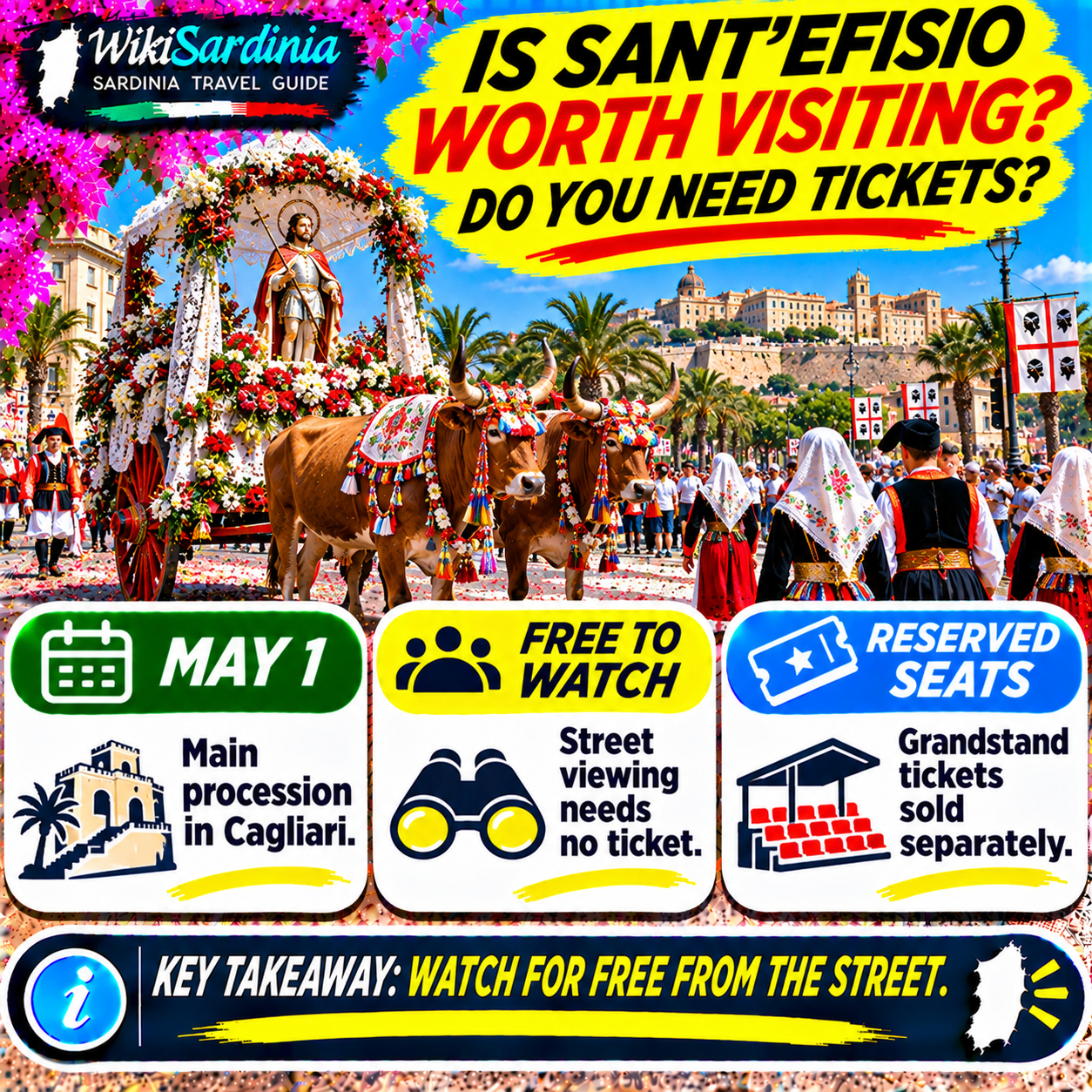
Yes—the Feast of Sant'Efisio in Cagliari is one of the most memorable cultural events you can experience in Sardinia. The main procession takes place on May 1, when thousands of participants in traditional dress, decorated carts, musicians and horsemen accompany a religious pilgrimage. You do not need a ticket to watch from public streets. Tickets are sold separately for designated seated grandstands, and arrangements change by year. If your trip includes Cagliari at the beginning of May, the festival is worth making time for—even if you are not religious.
What is the Feast of Sant'Efisio?
Sant'Efisio is a deeply rooted religious and civic tradition commemorating Saint Ephysius, a Christian martyr associated with Sardinia and the ancient city of Nora. The annual pilgrimage commemorates a vow made during the plague of 1652; the procession has been held every year since 1657. The celebration is not simply a tourist costume parade: it remains a living act of devotion, accompanied by regional music, ceremonial clothing and community participation. The festival typically extends from May 1 to May 4, following the saint's statue from Cagliari toward Nora and back. The official Cagliari tourism website explains the tradition and its stages.
Do you need tickets for the procession?
No. Watching the procession from public streets is free. You do not need a paid ticket simply to stand along the public route and watch participants pass. The distinction is between free street viewing and reserved seats in temporary grandstands, for which the City of Cagliari may sell tickets. Some sections can be cordoned off for safety, official delegations or ticketed seating, and public access is subject to crowd-control instructions. A ticket for a grandstand does not confer access to the religious procession itself as a participant.
How much are grandstand tickets?
Prices change by edition and by grandstand location. For the 2026 festival, the City of Cagliari announced five grandstands with different prices and locations. The official announcement specified €20 for an uncovered grandstand in Piazza Matteotti, €30 for a covered grandstand near Palazzo Vivanet and €35 for two covered Via Roma grandstands. The same announcement described a designated area for wheelchair users and accompanying people with free access. These are 2026 historical prices, not confirmed prices for 2027 or later. Check the latest official municipal notice for the next edition's prices, sales channels, accessibility arrangements and refund terms: City of Cagliari — 2026 grandstand announcement.
Should you buy a grandstand ticket?
A reserved seat may be worthwhile if you want a defined viewing location, expect difficulty standing for a long time or are traveling with family members who need a break. A ticket can also reduce uncertainty about where you will watch, but it does not guarantee shade, unobstructed photographs or an absence of crowds. For many visitors, standing along the free public route is enough to enjoy the atmosphere. If you choose a ticket, verify whether your specific stand is covered, its entry time, its access point and whether you can leave and re-enter.
What is the best day to visit?
May 1 is the best day for first-time visitors. It is the major ceremonial departure from Cagliari, with the greatest concentration of traditional costumes, decorated ox carts, horsemen, music and spectators. The pilgrimage continues through communities south of Cagliari toward Nora on May 2 and May 3, then returns to Cagliari on May 4. The evening return can be especially moving, but the scale and format are different from the main May 1 procession. If you can only spare a few hours, prioritize May 1 rather than assuming the same spectacle repeats every day.
What will you actually see on May 1?
Depending on the annual program, the procession can include tracas (traditional decorated ox-drawn carts), groups wearing distinctive regional Sardinian clothing, riders, ceremonial guards, musicians playing the launeddas, and devotional singing. The saint's statue is carried in a ceremonial vehicle or other approved arrangement. Do not assume every year's procession looks identical. The official 2026 program and later event records document adaptations to the normal carriage arrangements. Use the published schedule for your specific travel year rather than treating historic descriptions as a promise of particular animals, vehicles or numbers of participants.
Where is the best place to watch in Cagliari?
Via Roma and the Piazza Matteotti area are familiar viewing locations, and the City has historically placed reserved grandstands there. The procession begins in the Stampace district near the Church of Sant'Efisio and travels through central streets before heading out of the city. The exact route and any roadworks or restrictions can change from one edition to the next. For a free viewing spot, consult the official route map and choose a permitted section with sufficient pavement space; avoid standing in crossings, access lanes or emergency routes. A grandstand area may not offer the best experience for every visitor: atmosphere, proximity, shade and the ability to move around differ by location.
How early should you arrive?
Arrive well before the scheduled passage of the procession, especially if you hope to watch from a popular central street. The 2026 official program described a midday departure of the saint's statue from the Stampace church, but other groups and ceremonies begin earlier. The best arrival time depends on your chosen viewing location and the current year's route. Do not treat noon as the time when every group starts or when the procession reaches every street. Bring patience: crowds and road closures can slow movement considerably.
Is the festival worth visiting if you are not Catholic?
Yes. Sant'Efisio combines religious devotion with some of the richest public displays of Sardinia's traditional clothing, music, craftsmanship and regional diversity. Visitors can appreciate the costumes and communal atmosphere without participating in prayers or church services. The respectful approach is to remember that this is an active religious observance, not an entertainment performance staged solely for tourists. Keep a suitable distance during prayers, do not obstruct the procession and avoid intrusive photography of worshippers.
What about children and families?
The costumes, horses and decorated carts can be exciting for children, but crowds, waiting and May sunshine may be tiring. Bring water, sun protection, snacks and any essentials for young children. Identify a meeting point in case your group becomes separated, and avoid relying on a stroller in the most crowded sections. If a child is sensitive to noise or large crowds, choose a less congested permitted section of the route. Reserved seats may be helpful, but verify children's ticket rules for the specific year.
Is the procession wheelchair accessible?
Accessibility depends on the street section, crowd barriers, paving and designated viewing areas. In 2026 the City announced a specific grandstand for wheelchair users and companions with free access, but this arrangement should not be assumed unchanged for future editions. Ask the municipality about the current accessible viewing area, reservation procedure, step-free route, toilets and any documentation needed. The historic streets of Cagliari can have slopes and uneven paving, so plan your route from public transport or parking in advance.
How should you get to Cagliari?
If you are already in southern Sardinia, public transport may be more convenient than driving into the festival area. Cagliari has a railway station at Piazza Matteotti and urban bus services, but festival closures may change stops and routes. If you drive, park outside restricted streets and allow time to walk or use authorized transport. Check municipal traffic notices and the relevant rail or bus operator's current service alerts. Do not assume the usual city-center parking or taxi drop-off locations will be accessible during the procession.
What should you wear and bring?
Comfortable shoes, water, a hat and sunscreen are useful for long periods outdoors. Wear respectful everyday clothing if you intend to enter a church. A small bag is easier to manage in crowds than bulky luggage, and a phone with an offline map can help if streets are closed. Ask before photographing people closely, and never touch costumes, animals or ceremonial objects without permission. If the weather is poor, consult official announcements for route or program changes.
What is the route from Cagliari to Nora?
The traditional pilgrimage begins in the Church of Sant'Efisio in Cagliari's Stampace district and travels south through communities including Giorgino, Sarroch and Pula toward Nora, associated with the saint's martyrdom. It returns to Cagliari on May 4. The precise ceremonial stops and daily schedule vary, and not every stage has the same public access or tourist infrastructure. The Italian Ministry of Culture's intangible-heritage institute describes the ritual route and its cultural significance.
Is there anything else to do in Cagliari that day?
Yes, but keep your itinerary flexible. You can explore the historic neighborhoods, enjoy viewpoints and discover Sardinian food after the procession, subject to opening hours and road closures. Avoid scheduling a tight restaurant reservation, ferry departure or airport transfer immediately after the procession's expected passage. Travel times and crowds are unpredictable on a major public holiday.
Is May 1 a public holiday in Italy?
Yes. May 1 is Labour Day (Festa dei Lavoratori), a national public holiday in Italy. Some shops, museums and services may have holiday hours or closures independently of the Sant'Efisio celebrations. Restaurants may be busy, and transportation schedules may differ from ordinary weekdays. Check the specific business or operator rather than assuming normal hours.
When do tickets go on sale for next year's festival?
The municipality announces grandstand sales for each edition. In 2026, its April 8 announcement stated that tickets would go on sale on April 10. That historical timetable does not establish a permanent sales date. For the next festival, monitor the City of Cagliari's official website and Cagliari Turismo for the new program, authorized ticketing details and accessible seating arrangements. Be cautious about unofficial resale offers.
What about the 2027 festival?
The annual tradition is centered on May 1–4, but the detailed 2027 procession schedule, ticket prices, route changes and grandstand sales should not be presented as confirmed until the municipality publishes them. This guide uses verified 2026 municipal information as an example and separates it from what future visitors must check. Even if you plan to watch for free, review the latest route and traffic announcements shortly before arrival.
Useful Italian phrases
“La processione è gratuita?” — Is the procession free to watch? “Servono biglietti per stare lungo la strada?” — Do we need tickets to watch from the street? “Dove si acquistano i biglietti per le tribune?” — Where can we buy grandstand tickets? “A che ora passa Sant'Efisio qui?” — What time does Sant'Efisio pass here? “C'è un'area accessibile per persone in carrozzina?” — Is there an accessible area for wheelchair users? “Quali strade sono chiuse?” — Which streets are closed?
Official sources
Cagliari Turismo — 370th Feast of Sant'Efisio, 2026; City of Cagliari — 2026 grandstand ticket announcement; SardegnaTurismo — 2026 event and traditional procession; Italian Ministry of Culture — Sant'Efisio intangible cultural heritage; Sardinia Regional Government — 2025 historical context. Prices, schedules and restrictions cited for 2026 are not guarantees for future editions.
The WikiSardinia takeaway
Sant'Efisio is absolutely worth experiencing if you are in Cagliari on May 1, and you can watch the procession for free from public streets. Pay only if you choose a reserved grandstand seat. The celebration is a centuries-old pilgrimage and one of the best opportunities to see Sardinia's regional traditions together in one place. Plan to arrive early, respect its religious character and check the official municipal program for your travel year.