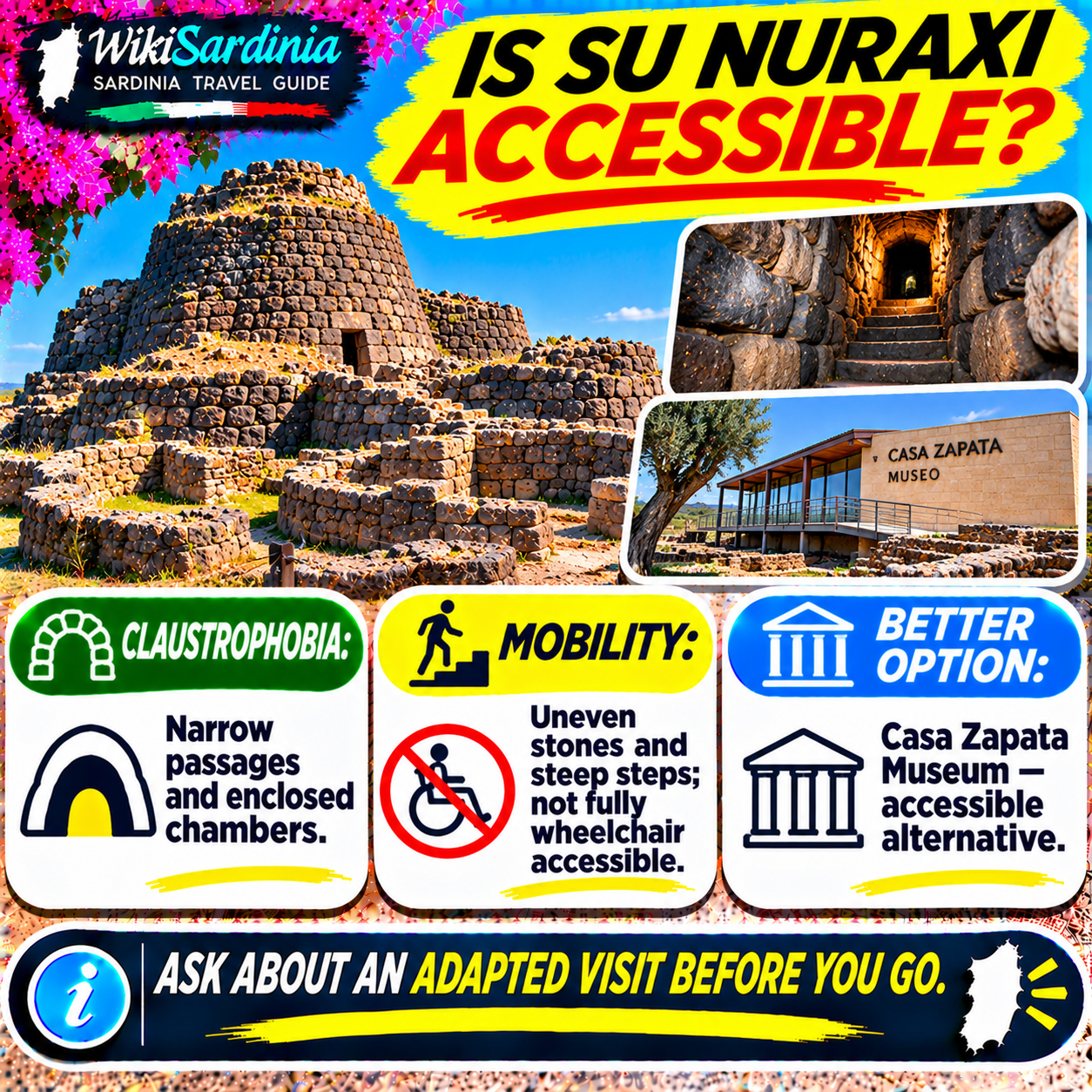
Su Nuraxi di Barumini is not fully accessible for visitors with mobility impairments, and its narrow stone passages can be challenging for people with claustrophobia. That does not mean every visitor with either condition must skip Barumini. It means the complete interior route should not be assumed safe or comfortable for everyone. Ask the site operator what parts can be visited without steep steps or confined chambers. For a more accessible way to discover Nuragic archaeology, the nearby Casa Zapata Museum is a particularly valuable alternative.
Why can Su Nuraxi feel claustrophobic?
The UNESCO-listed Bronze Age complex contains massive stone towers, enclosed chambers and narrow corridors. Inside the central structures, some passages are confined, with limited space and steep stone steps. Visitors sensitive to enclosed spaces may find the combination of close walls, restricted movement and a group-led route uncomfortable. There is no reliable universal threshold for claustrophobia: one person may enjoy a short stone passage while another may experience severe distress. Do not assume that an outdoor archaeological site is entirely open-air.
Can someone with claustrophobia avoid the tower interiors?
Ask the guide before the tour begins. The managing Fondazione Barumini requires visitors to join a guided tour; visitors cannot freely improvise a route through the archaeological area. Ask whether the current tour permits a visitor to remain outside particular chambers, skip narrow sections or follow an adapted exterior-only explanation. Such arrangements may depend on safety rules, staffing and any restoration works. No general right to an independent exterior-only visit or guaranteed partial route is published on the operator's visitor page, so obtain confirmation directly.
Is Su Nuraxi wheelchair accessible?
The full tower-and-passage route should not be considered wheelchair accessible. Uneven ancient stone surfaces, narrow entrances and steep steps are substantial physical barriers. Some listings describe accessible parking, an entrance or visitor facilities, but these features do not prove that a wheelchair can pass through the original Bronze Age tower interiors. The official regional cultural portal notes facilitated access for visitors with specific needs, without establishing that the entire route is step-free. Ask the operator to specify exactly which outdoor and interior areas are accessible with your wheelchair, scooter or mobility aid.
What if I can walk but struggle with stairs or balance?
Visitors who can walk short distances may still find parts of the route difficult. The main challenges are uneven stones, changes in level, confined steps and the possibility of needing to turn or descend in tight spaces. Walking sticks or other aids may not solve every problem, especially where space is limited. The operator recommends comfortable clothing and non-slip shoes. If you have limited balance, fatigue, joint pain or a recent injury, describe your specific needs to the foundation rather than relying on a generic “accessible” label.
Is there a less confined way to experience Nuragic history in Barumini?
Yes. Casa Zapata Museum in Barumini is the strongest alternative for many visitors with mobility limitations. The Municipality of Barumini describes the museum as fully accessible and specifically identifies the Nuraghe Su Nuraxi 'e Cresia, preserved beneath the museum, as accessible to people with reduced mobility. Visitors can explore archaeological remains from a purpose-built museum environment rather than navigating the original narrow corridors of Su Nuraxi's main fortress. The museum also has multilingual displays and a tactile station for blind visitors. See the Municipality's official Casa Zapata description.
Is Casa Zapata completely free of enclosed spaces?
It is an indoor museum, not an outdoor-only attraction. Visitors with claustrophobia should distinguish between a conventional museum room and a narrow ancient tunnel: the former may feel comfortable while the latter may not. The museum's modern layout avoids the need to enter the ancient tower's cramped interior, but comfort depends on individual triggers. Ask about the route, room sizes, crowding and available exits before your visit if enclosed environments are a concern.
What about the Giovanni Lilliu Centre?
The Giovanni Lilliu Centre is another cultural venue in Barumini included in the heritage network's combined ticket. It offers exhibitions and interpretation of the archaeological landscape, and the foundation describes it as visitable in all weather conditions. However, its published general visitor information does not, by itself, certify every exhibit space or restroom for every mobility need. Contact the foundation for the specific step-free route, lifts, accessible toilets and any temporary exhibition closures.
How do guided visits work?
The Fondazione Barumini's official visitor page says Su Nuraxi is open year-round, guided visits are mandatory, departures are approximately every 30 minutes and a tour lasts about an hour. Visits can be restricted in bad weather. The foundation lists Italian, English and French among its guided-tour languages, but that does not mean every departure is available in every language. For visitors with mobility limitations or anxiety in enclosed spaces, discuss route flexibility and language requirements before buying tickets or making a long journey.
Can I see Su Nuraxi without completing the interior route?
There are views of the monumental exterior and surrounding landscape, but access within the archaeological site is controlled. A ticket or a guided departure does not automatically entitle you to leave the group, enter restricted areas or follow a self-directed route. If your priority is seeing the structure rather than entering it, ask whether an outdoor explanation, a reduced route or a suitable viewpoint can be arranged. If no suitable arrangement is available, Casa Zapata and the foundation's virtual tour are better choices than attempting an unsafe passage.
Is there a virtual tour?
Yes. The foundation's official Su Nuraxi page includes a virtual-tour link. This can help visitors preview the site and may provide a meaningful alternative for someone unable to enter the original structures. A virtual tour does not establish that the physical site is accessible, and its interface or compatibility with assistive technology should be checked separately.
What about guide dogs?
The foundation states that animals are not admitted to Su Nuraxi except guide dogs, for which advance reservation is required. If you travel with a guide dog, contact the operator before arriving to clarify the applicable route, any safety considerations and arrangements. This is not a guarantee that every historic passage can accommodate the animal.
Are admission discounts available for disabled visitors?
The SardegnaCultura regional visitor listing, updated in January 2026, states that admission is free for disabled visitors and accompanying carers. The foundation's 2026 Casa Zapata service charter also confirms free admission for disabled visitors and one companion. These are published policies, but travelers should confirm the current documentation requirements, exact eligibility and ticket arrangements directly with the operator. Free admission does not imply that the full archaeological route is accessible.
What should I ask before booking?
Tell the foundation whether you use a manual wheelchair, power chair, walker or cane; whether you can manage steps; whether you can tolerate narrow, dimly lit corridors; and whether you need a guide in English. Ask for an explicit description of the route you would actually be permitted to follow, not merely whether the attraction is “accessible.” Ask if an adapted tour or exterior-only explanation is possible, how long you must stand or walk, whether there are resting places and where the nearest accessible restroom is located.
How do I contact the site?
Use the official Fondazione Barumini Sistema Cultura website or its tickets and visitor-information page. The foundation lists prenotazioni@fondazionebarumini.it for advance group bookings; travelers can use its published contact channels to request clarification about accessibility and adapted visits. Avoid relying on unverified third-party booking pages for assurances about wheelchair access or suitability for claustrophobia.
Sample message in Italian
Buongiorno, vorrei visitare Su Nuraxi ma ho difficoltà con le scale / utilizzo una sedia a rotelle / soffro di claustrofobia. È possibile effettuare una visita adattata, evitando i passaggi stretti e le scale? Quali parti del sito sono accessibili? In alternativa, Casa Zapata è adatta alle mie esigenze? Grazie.
Translation: Hello, I would like to visit Su Nuraxi but have difficulty with stairs / use a wheelchair / experience claustrophobia. Is an adapted visit possible, avoiding narrow passages and stairs? Which parts of the site are accessible? Alternatively, would Casa Zapata suit my needs? Thank you.
What should families or companions know?
Do not pressure someone with claustrophobia to enter a confined passage to keep up with the group. Agree on a plan with the guide before starting, including where a visitor can safely wait if a section is unsuitable. If someone uses mobility aids, make sure the operator confirms a safe route rather than assuming a companion can lift or carry them through a historic structure. In summer, heat and exposure can add fatigue, so bring water and sun protection and choose a comfortable visiting time.
Sources and official visitor information
Fondazione Barumini — tickets, guided visits, visitor rules; Fondazione Barumini — Su Nuraxi and virtual tour; Municipality of Barumini — Casa Zapata accessibility; SardegnaCultura — Su Nuraxi visitor information and disability admission; Italian National Museums — guided visits required for safety; Fondazione Barumini — Casa Zapata 2026 service charter. Accessibility conditions and any adapted routes must be confirmed for the individual visitor and date.
The WikiSardinia takeaway
Su Nuraxi is spectacular, but its full historic route is not suitable for everyone. Narrow passages and steep, uneven steps can make it difficult for visitors with claustrophobia, wheelchair users and people with reduced mobility. Do not mistake accessible parking or an entrance for full access to the monument. Contact Fondazione Barumini to discuss an adapted visit; if the original tower route is unsuitable, Casa Zapata Museum offers a documented accessible alternative for discovering Nuragic history without navigating the ancient fortress interiors.